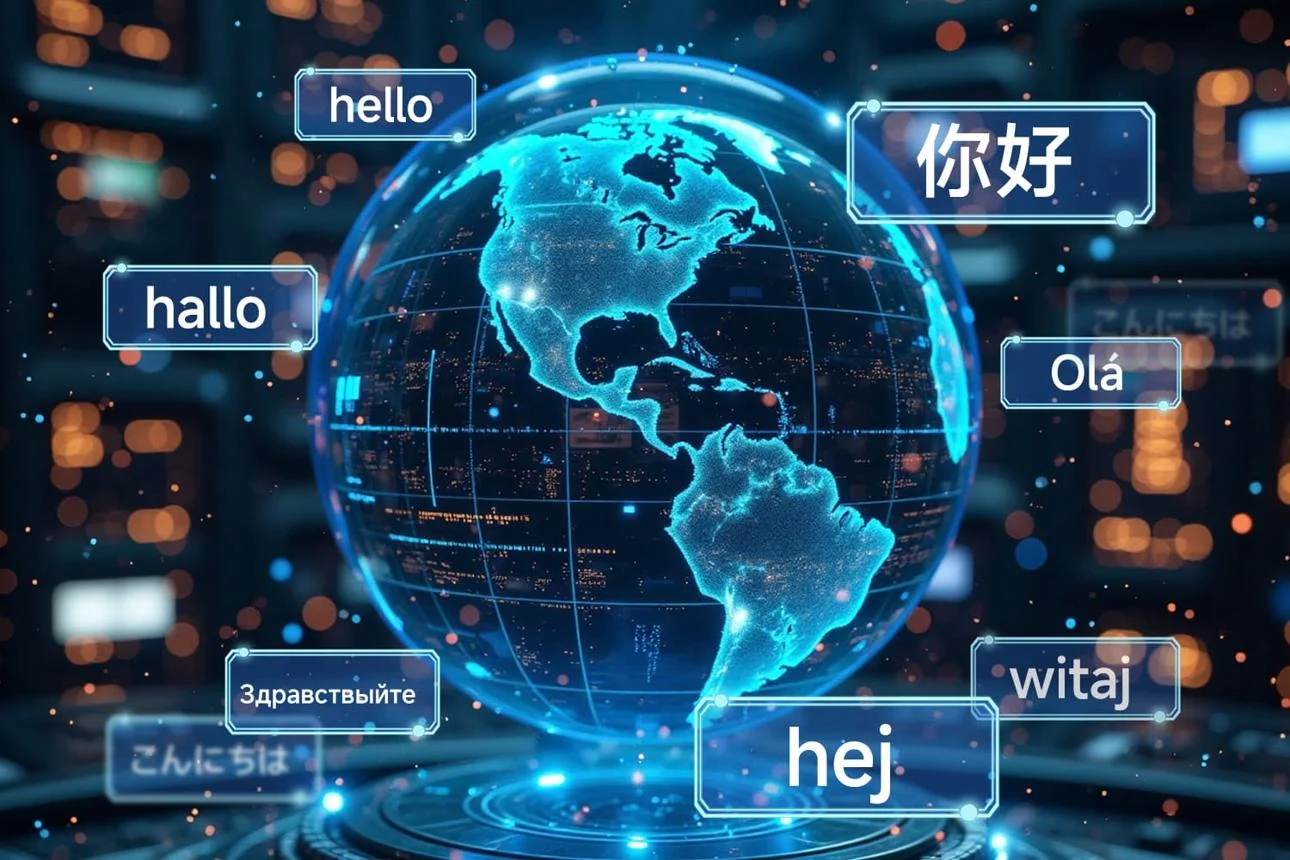
Translation AI uses artificial intelligence and machine learning to convert text, speech, and other content between languages while preserving meaning and context. It helps individuals and businesses communicate faster, but accuracy, cultural nuance, privacy, and human review remain important considerations.
At a Glance
- What it is: AI-powered technology that translates content between different languages.
- How it works: Uses neural networks, machine learning, and language models to generate translations.
- Popular tools: Google Translate, DeepL, Microsoft Translator, and ChatGPT.
- Main benefits: Faster translation, multilingual communication, lower routine translation costs, and workflow automation.
- Main limitations: Context errors, cultural differences, inconsistent terminology, and weaker performance in some language pairs.
- Best practice: Use AI for efficiency and qualified human reviewers for important content.
What Is Translation AI?
Translation AI refers to artificial intelligence technologies that automatically convert content from one language into another. These systems analyze words, sentence structures, linguistic patterns, and context to produce translations.
Unlike traditional word-for-word translation, modern AI translation systems can process entire sentences and paragraphs. They attempt to preserve meaning, grammar, and natural language flow.
For example, a user can translate an English business email into Spanish without manually looking up every word. An AI translation tool can generate a complete version within seconds.
The technology also supports more than written communication. Depending on the platform, users can translate:
- Text messages and documents.
- Websites and digital content.
- Images containing written text.
- Spoken conversations.
- Video subtitles and captions.
- Business communications and customer support messages.
Translation AI is now used across education, travel, healthcare administration, e-commerce, software development, and international business.
However, automated translation does not guarantee perfect communication. A grammatically correct sentence can still contain an incorrect meaning.
How Does Translation AI Work?
AI translation combines machine learning, language processing, and multilingual training data. The system analyzes the source content and generates an equivalent version in the requested language.
Most modern translation services use neural machine translation (NMT). Some also incorporate large language models (LLMs) and generative AI.
1. Language Detection
The system first identifies the language of the source content.
For example, when someone enters a sentence without selecting a language, the tool may automatically recognize English, French, Urdu, or another supported language.
Automatic detection helps simplify the translation process.
2. Text Processing and Context Analysis
The translation system examines the input, including word relationships and sentence structure.
It identifies linguistic patterns that help determine how words should be translated.
Context matters because the same word can have different meanings.
For example, the English word “bank” can refer to a financial institution or the side of a river. A translation system needs surrounding information to select the appropriate equivalent.
3. Neural Machine Translation
Neural machine translation uses artificial neural networks to generate translations.
These models learn from large collections of multilingual text and existing translations. They identify relationships between words and phrases across languages.
Instead of translating every word independently, an NMT system evaluates how different parts of a sentence relate to one another.
This approach generally produces more natural translations than older word-based systems.
4. Translation Generation
After processing the source content, the model generates the target-language text.
It considers grammar, sentence structure, vocabulary, and learned linguistic patterns.
The final output may differ from the original sentence structure while preserving its intended meaning.
5. Post-Translation Review
Some professional workflows include additional checks for grammar, terminology, formatting, and consistency.
Human reviewers can correct errors that automated systems overlook.
For important business, legal, medical, and technical documents, this review can be essential.
Translation AI vs. Traditional Machine Translation
Traditional machine translation and modern AI translation are closely related. In fact, neural machine translation is itself an established form of artificial intelligence.
The difference is mainly in the underlying methods and capabilities.
| Area | Older Translation Systems | Modern AI Translation |
|---|---|---|
| Technology | Rules and statistical patterns | Neural networks and language models |
| Context | Often limited | Better contextual processing |
| Sentence structure | More rigid | More flexible |
| Idioms | Frequently difficult | Better recognition, but not perfect |
| Tone | Limited customization | Some tools support tone and formality |
| Adaptability | Often requires manual rules | Can use learned patterns and customization |
| Human review | Often necessary | Still important for high-risk content |
Modern systems have improved translation quality and usability. However, their performance varies by language pair, subject matter, and input quality.
Key Features of Modern AI Translation Tools
Translation platforms offer different capabilities depending on their intended audiences. Some focus on everyday communication, while others support professional translation workflows.
Text Translation
Text translation is the most common feature.
Users enter words, sentences, or longer passages and receive translated content. It is useful for emails, articles, social media posts, research, and everyday communication.
Document Translation
Document translation helps users convert files without manually copying every paragraph.
Depending on the service, supported formats may include Word documents, PDFs, and PowerPoint presentations.
Professional users should check whether the platform preserves tables, images, headings, and formatting.
Image Translation
Image translation extracts written content from pictures using optical character recognition (OCR).
It can help users understand:
- Restaurant menus.
- Product labels.
- Street signs.
- Screenshots.
- Scanned documents.
- Printed instructions.
The quality depends partly on image resolution, text visibility, and language support.
Voice and Speech Translation
Speech translation converts spoken language into another language.
A typical workflow combines speech recognition, translation, and text-to-speech generation.
This feature can support conversations, travel, meetings, and multilingual customer interactions.
However, background noise, accents, speaking speed, and overlapping voices can affect results.
Real-Time Translation
Some platforms offer live translation features for conversations, meetings, and other communication workflows.
These capabilities can reduce language barriers during international interactions.
Users should distinguish between live translated captions, translated audio, and two-way conversation translation. They are different features and may have different availability.
Glossaries and Terminology Management
Professional translation requires consistent terminology.
For example, a software company may want a particular technical term translated consistently across product pages, documentation, and support articles.
Glossaries help enforce preferred translations. DeepL also documents customization features such as glossaries, style rules, and translation memories. How Can We Help You? +1
Popular Translation AI Tools in 2026
Several established platforms offer AI-powered translation. Their strengths differ, so selecting a tool depends on language coverage, workflow requirements, customization, and privacy.
「Google 翻訳」のUIデザイン一覧(2023年12月版) – UI Pocket
1. Google Translate
Google Translate is a widely used translation service for everyday multilingual communication. It supports text, voice, image, and conversation-related translation features, with availability varying by platform and language.
Best suited for: Travelers, students, and general users.
Website: Google Translate
DeepL Übersetzer – direkt online nutzen – CHIP
2. DeepL
DeepL offers text and document translation, alternative translations, formality controls, and terminology customization features. Its supported languages and features vary.
Best suited for: Professional writing, business documents, and terminology-sensitive workflows.
Website: DeepL
Microsoft Translator icon in Windows 11 Color Style
3. Microsoft Translator
Microsoft Translator provides machine translation for text and speech. Its ecosystem also supports developer integrations through translation services and APIs.
Best suited for: Organizations, developers, and Microsoft ecosystem users.
Website: Microsoft Translator
File: ChatGPT-Logo.svg – Wikimedia Commons
4. ChatGPT

ChatGPT can translate text while following instructions about tone, audience, and writing style. Users can also request explanations of ambiguous phrases or alternative wording.
It is a general-purpose generative AI assistant, not a dedicated machine translation service.
Best suited for: Context-sensitive drafts, localization assistance, and multilingual content editing.
Website: ChatGPT
Translation Tool Comparison
| Platform | Main Strength | Target User | Pricing Transparency | Important Limitation |
|---|---|---|---|---|
| Google Translate | Everyday translation and accessibility | General users | Free consumer access; other services vary | Quality varies by language and context |
| DeepL | Translation customization | Professionals | Free and paid offerings | Feature and language availability varies |
| Microsoft Translator | Business and developer integration | Organizations | Service-specific pricing | Requires configuration for some workflows |
| ChatGPT | Flexible prompts and contextual editing | Writers and teams | Plan-dependent | Not a dedicated translation quality system |
Important pricing note: These platforms have different consumer and business offerings. API usage, document limits, subscription features, and regional availability can change. Check official pricing pages before purchasing.
Main Use Cases of Translation AI
AI-powered translation is useful wherever people need to communicate across language boundaries.
1. International Business Communication
Companies often communicate with customers, suppliers, employees, and partners in different countries.
Translation AI can help translate routine emails, product descriptions, internal documents, and customer inquiries.
It can also support multilingual customer service operations.
For contracts, regulatory documents, and important negotiations, professional review remains advisable.
2. Website and E-Commerce Localization
Online businesses can use translation tools to prepare multilingual product descriptions, category pages, help articles, and marketing materials.
However, translation and localization are not identical.
Translation converts language. Localization adapts content to the cultural, linguistic, and commercial expectations of a particular market.
For example, a product description may require different measurements, currency formats, spelling, and promotional language in another country.
3. Education and Research
Students can use translation AI to understand foreign-language materials, research articles, and educational resources.
Researchers can also use it to explore documents written in languages they do not speak.
However, academic citations, technical terminology, and original quotations should be checked against their sources.
4. Travel and Tourism
Travelers can translate menus, signs, directions, and everyday conversations.
Image and voice translation features can be especially useful when visiting unfamiliar destinations.
These tools can help with routine interactions but should not replace qualified interpretation during emergencies.
5. Content Creation and Publishing
Content teams can use translation AI to prepare multilingual blog posts, newsletters, video captions, and social media content.
A useful workflow combines automated translation with human editing.
Editors should check terminology, cultural references, search intent, and the natural writing style of the target language.
6. Software and Technical Documentation
Developers and technical writers can translate:
- User manuals.
- Product interfaces.
- API documentation.
- Software tutorials.
- Troubleshooting guides.
- Help-center articles.
Technical accuracy matters more than fluent wording alone. Incorrect commands, warnings, or product instructions can cause serious problems.
Benefits of Translation AI
AI translation offers several practical advantages.
Speed and efficiency: It can translate large amounts of routine text much faster than manual translation.
Lower routine costs: Automated translation can reduce the amount of manual work required for suitable projects. Human review may still add costs.
Greater accessibility: People can access information that would otherwise remain difficult to understand because of language barriers.
Scalability: Businesses can process multilingual content across multiple markets and communication channels.
Consistent terminology: Glossaries and translation memories can help organizations maintain preferred language across repeated projects.
Flexible workflows: APIs allow developers to connect translation services with websites, applications, and business systems.
These benefits are most valuable when organizations combine automation with appropriate quality controls.
Limitations and Risks of AI Translation
Translation AI has improved considerably, but it still has important weaknesses.
Contextual Errors
A system may choose an incorrect meaning when a sentence contains ambiguous words or incomplete context.
This can create a translation that looks natural but communicates something different.
Cultural and Linguistic Nuance
Humor, sarcasm, idioms, regional expressions, and cultural references are difficult to translate consistently.
A phrase that sounds friendly in one language may sound inappropriate or overly formal in another.
Low-Resource Languages
Some languages have less high-quality digital training data than others.
This can affect translation quality, especially for regional dialects and less commonly supported language pairs.
Technical and Industry-Specific Terminology
Legal, medical, financial, and engineering content often contains specialized terminology.
An incorrect translation can change the meaning of an instruction, clause, diagnosis, or technical requirement.
Hallucinations in Generative AI
General-purpose language models can occasionally introduce information that does not exist in the original text.
For translation, this is especially problematic because the system should preserve the source meaning rather than invent missing details.
Formatting and Document Problems
Automated document translation may affect tables, page layouts, footnotes, and complex formatting.
Always inspect the translated file before publishing or distributing it.
Research also reinforces the importance of human evaluation. A 2026 study analyzing professionally annotated Chinese-to-English translation outputs found that fluent-looking translations could still contain significant accuracy errors. Its findings apply to the evaluated datasets, not every language pair or translation platform. Springer
Is Translation AI Accurate?
Translation AI can produce useful and often fluent translations, but accuracy depends on several factors:
- The source and target languages.
- The quality of the original text.
- The complexity of the subject.
- The amount of context provided.
- The translation model and its training data.
- The availability of terminology customization.
For routine messages and general information, automated translation may be sufficient.
For legal agreements, medical instructions, financial disclosures, and official documents, qualified human review is strongly recommended.
A fluent translation should never automatically be treated as a verified translation.
Translation AI vs. Human Translation
AI translation and professional human translation serve related but different purposes.
| Evaluation Factor | Translation AI | Human Translator |
|---|---|---|
| Speed | Very fast | Depends on project size |
| Routine costs | Often lower | Usually higher |
| Cultural understanding | Variable | Stronger contextual judgment |
| Creative adaptation | Can be inconsistent | More flexible |
| Terminology | Depends on model and customization | Can apply specialist knowledge |
| Confidentiality | Depends on provider and contract | Depends on professional practices |
| High-risk documents | Requires review | Can provide expert verification |
Neither approach is suitable for every project.
A practical solution is machine translation post-editing (MTPE). AI produces the initial translation, and a human translator corrects meaning, terminology, tone, and formatting.
This hybrid workflow can balance speed with professional quality.
The American Translators Association also distinguishes between using machine translation to understand general content and relying on professional translation for important communications. American Translators Association (ATA)
Translation AI and Data Privacy
Privacy deserves particular attention when translating confidential information.
Users may submit business contracts, customer records, internal communications, unpublished research, or personal documents.
Before using a translation service, examine its privacy policy and subscription terms.
Important questions include:
- Does the provider retain submitted text?
- Is customer content used for model training?
- How long are translations stored?
- Can administrators control data retention?
- Does the service offer enterprise privacy controls?
- Where is submitted information processed?
- Are API and consumer data policies different?
Consumer Tools vs. Enterprise Translation Services
Free consumer translation tools may have different data handling terms from paid business services.
An enterprise agreement may offer additional administrative and contractual protections. However, a paid plan does not automatically guarantee every privacy requirement.
Similarly, SOC 2 compliance does not automatically establish Zero Data Retention (ZDR).
ZDR refers to specific data-retention arrangements. Organizations should verify the actual contractual terms rather than assuming a particular certification guarantees them.
For sensitive information, use an approved business service and avoid submitting confidential material to an unverified tool.
How to Choose the Right AI Translation Tool
Selecting a translation platform requires more than comparing language counts or interface designs.
The right choice depends on the type of content, quality expectations, and operational requirements.
1. Check Language Pair Support
Confirm that the platform supports both the source and target languages.
Do not assume that every tool offers equal quality across all language combinations.
A service may support a language for basic text translation but not for document translation, voice features, or terminology customization.
2. Test Translation Quality
Use representative content rather than isolated sentences.
Test:
- Everyday conversations.
- Long paragraphs.
- Industry terminology.
- Idiomatic expressions.
- Regional language variations.
Ask a fluent speaker or qualified translator to review the results.
3. Examine Customization Options
Professional users may need glossaries, translation memories, formality controls, and style settings.
These features help maintain consistency across large projects.
4. Review Pricing and Usage Limits
Check whether the service charges through subscriptions, API usage, document volume, or other usage-based arrangements.
Also examine:
- Monthly usage allowances.
- Document size restrictions.
- API request limits.
- Additional user charges.
- Subscription renewal terms.
- Paid feature availability.
A free plan may be sufficient for occasional translation but unsuitable for continuous business operations.
5. Evaluate Integrations
Businesses may need translation within their existing software.
Look for APIs, content management system integrations, customer support integrations, and compatibility with computer-assisted translation (CAT) tools.
6. Review Privacy and Security
Check retention policies, data processing agreements, access controls, and the provider’s security documentation.
This step is especially important for organizations handling confidential information.
Best Practices for Getting Better AI Translations
Even a capable translation model can produce poor results when the input is unclear.
These practices can improve output quality.
Write clear source content. Avoid unnecessary jargon, ambiguous expressions, and excessively long sentences.
Provide context. Explain the intended audience, purpose, and subject matter.
Specify the desired tone. Tell the tool whether the translation should sound formal, conversational, technical, or professional.
Use consistent terminology. Provide preferred translations for important names, phrases, and industry terms.
Specify regional variations. For example, distinguish between British and American English or regional Spanish.
Review important numbers and names. Dates, measurements, currency, product names, and legal references require particular attention.
Check the translated meaning. Do not judge quality only by grammatical fluency.
Example: A Better Translation Prompt
Instead of simply asking an AI tool to translate a paragraph, provide clear instructions.
Recommended prompt
Translate the following English text into natural Urdu.
Requirements:
- Preserve the original meaning.
- Use clear, professional Urdu.
- Maintain the original names, numbers, and technical terms.
- Avoid adding information that is not present in the source.
- Preserve the intended tone and formatting.
- Flag any ambiguous expression instead of guessing.
Text: [Insert your original text here]
Copy prompt
The Future of Translation AI
Translation technology is moving beyond basic text conversion.
Several developments are shaping its direction.
More Natural Multilingual Communication
Translation systems are increasingly being integrated into communication applications, business platforms, and digital services.
The goal is to make multilingual communication more accessible without requiring users to switch between separate applications.
Multimodal Translation
Multimodal AI can work with different types of information, including text, images, and audio.
This creates opportunities for more integrated translation workflows involving documents, visual content, and spoken communication.
Context-Aware Translation
Newer language models can follow instructions about audience, tone, and writing style.
Dedicated translation systems also use terminology controls and translation memories to maintain consistency.
However, additional context does not automatically guarantee accuracy.
Greater Business Integration
Translation APIs allow businesses to incorporate language services directly into websites, applications, and internal workflows.
Companies can use automated translation to support multilingual customer experiences and international operations.
Human-AI Collaboration
Professional translators increasingly have opportunities to use AI for initial drafts, repetitive content, terminology assistance, and quality checks.
Human expertise remains important for reviewing meaning, cultural sensitivity, and high-risk content.
The long-term direction is not simply automated translation. It is a more integrated workflow where AI handles suitable repetitive tasks, and people oversee quality.
Who Should Use Translation AI?
Translation AI can support different users, although the appropriate level of human review depends on the application.
| User Type | Potential Application | Recommended Approach |
|---|---|---|
| Students | Understanding foreign-language materials | AI with source verification |
| Travelers | Menus, signs, and conversations | Automated translation |
| Businesses | Emails and customer communication | AI with quality checks |
| Content creators | Multilingual articles and captions | AI with editorial review |
| Developers | Translation APIs and applications | API testing and localization |
| Professional translators | Initial drafts and terminology assistance | Human-led post-editing |
For everyday communication, automated translation may be enough. Organizations working with sensitive or regulated information need stronger quality and privacy controls.
FAQs
1. What is Translation AI used for?
Translation AI converts text, speech, images, and documents between languages. People use it for communication, education, business, travel, website localization, and multilingual content creation.
2. Which AI tool is best for translation?
Google Translate, DeepL, and Microsoft Translator are established translation platforms. ChatGPT can also help with context-sensitive translation and editing. The right choice depends on language support, translation quality, privacy, and required features.
3. Is AI translation better than human translation?
AI translation is generally faster and can reduce the cost of routine translation tasks. Human translators provide valuable contextual understanding, cultural judgment, and specialist knowledge. Combining both approaches can deliver an effective workflow.
4. Can AI translate documents and images?
Yes. Several translation platforms support document and image translation. Image translation often uses optical character recognition to extract text before translating it. File formats and feature availability depend on the service.
5. Is it safe to use free AI translation tools?
Safety depends on the provider’s data policies and the information being translated. Users should review data retention and training policies before submitting confidential content. Sensitive business or personal information should only be processed through an approved service.
Conclusion
Translation AI is changing how individuals and organizations communicate across language barriers. It makes routine translation faster, improves accessibility, and supports multilingual business operations.
Platforms such as Google Translate, DeepL, and Microsoft Translator offer different translation capabilities. General-purpose AI assistants also provide useful translation and editing support.
However, translation quality still depends on language combinations, context, terminology, and the complexity of the original content. Privacy and data retention also deserve careful consideration.
The most practical approach is to use AI for suitable translation tasks and human expertise for important content. Before choosing a platform, evaluate its language support, accuracy, pricing, integrations, and privacy policies.