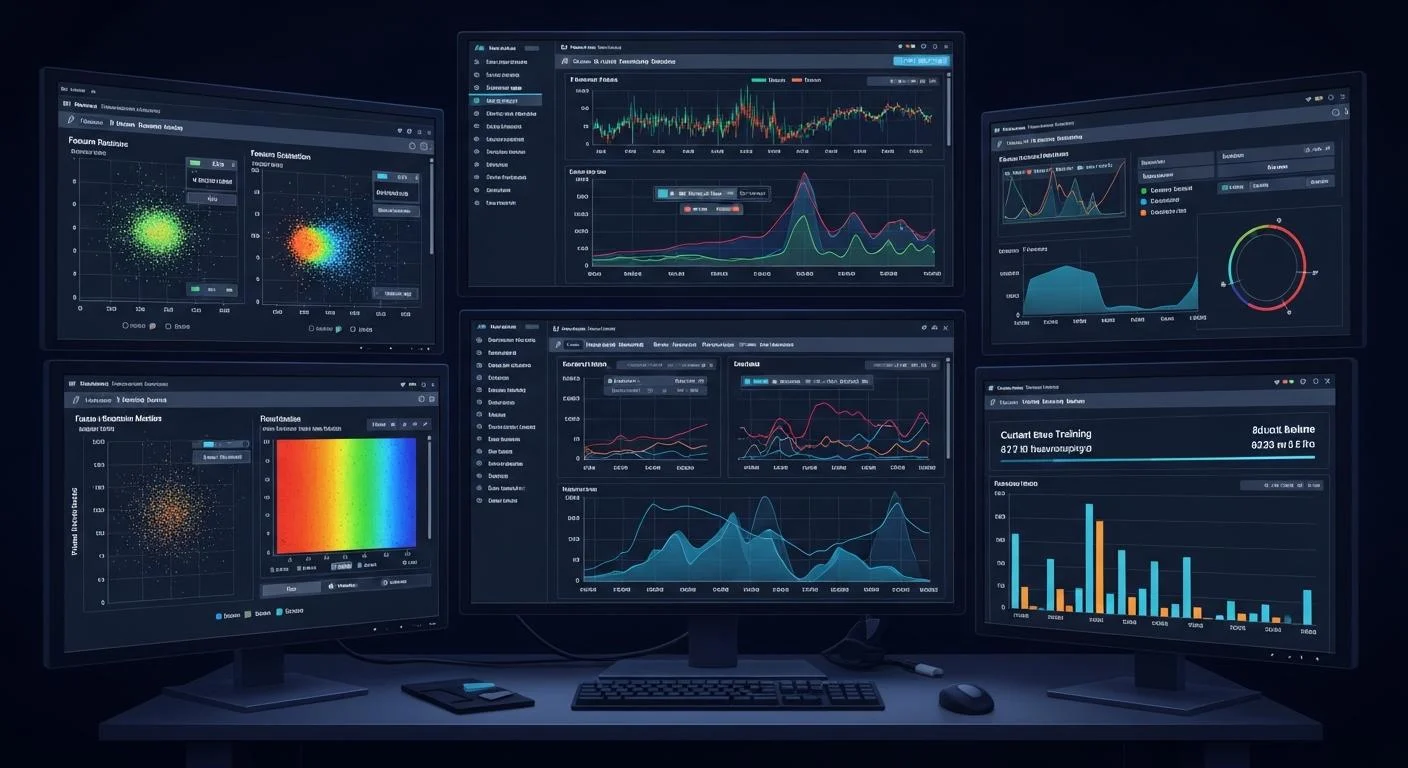
Evidently AI is an open-source Python framework for evaluating, testing, and monitoring machine learning models, LLMs, RAG applications, and AI agents. It helps developers measure AI quality, detect data drift, identify performance issues, and improve the reliability of AI systems.
Evidently AI at a Glance
Evidently AI vs YOLO (2026) | Comparación lado a lado
Evidently AI
AI evaluation, testing, and observability framework
Open-source software
| Category | Details |
|---|---|
| Product type | AI evaluation and observability |
| Main technology | Python and machine learning |
| License | Apache 2.0 |
| Built-in evaluations | 100+ |
| Supported systems | ML, LLMs, RAG, AI agents |
| Primary users | Developers and AI teams |
| Official website | evidentlyai.com |
| GitHub | Evidently repository |
Based on the official product website, documentation, and GitHub repository.
What Is Evidently AI?
Evidently AI is an open-source framework for evaluating, testing, and monitoring AI and machine learning systems.
It helps developers understand whether their AI applications produce reliable results. It also identifies changes in data, model performance, and generated responses.
Building an AI application is only the first step. Developers must continuously check whether it performs correctly after deployment.
For example, a business might develop an AI chatbot to answer customer questions. The chatbot may generate fluent responses, but some answers could contain incorrect information.
A basic application test might confirm that the chatbot responds successfully. However, it cannot necessarily determine whether the response is accurate, relevant, or supported by reliable information.
Evidently helps technical teams investigate these problems through structured evaluation and monitoring.
Its main capabilities include:
- LLM evaluation: Assess the quality of AI-generated responses.
- RAG evaluation: Examine retrieval relevance and generated answers.
- AI agent testing: Evaluate multi-step AI workflows and actions.
- Data drift detection: Identify changes in incoming data.
- Model monitoring: Track machine learning performance.
- Data quality testing: Identify missing values and unexpected records.
- Custom evaluations: Create metrics for specific application requirements.
The Evidently Python library is available under the Apache 2.0 license. Its official repository describes more than 100 built-in evaluations and supports both offline evaluation and production monitoring. Open-source AI Evaluation and Observability+1
How Does Evidently AI Work?
Evidently analyzes datasets, model predictions, AI-generated responses, and evaluation results.
Developers provide the relevant information and select the metrics they want to measure. The framework calculates evaluation results and presents them through reports, test suites, and monitoring interfaces.
The process generally involves five stages.
1. Collecting AI and Machine Learning Data
The first step involves collecting the information required for evaluation.
Depending on the application, this information may include:
- User prompts and questions.
- AI-generated responses.
- Expected or reference answers.
- Model predictions.
- Retrieved documents.
- Historical datasets.
- User feedback.
- Production monitoring records.
For a predictive machine learning model, developers might compare actual outcomes with predicted results.
For an LLM application, they might evaluate user questions, generated responses, and supporting context.
The quality of an evaluation depends heavily on the quality of its input data.
2. Selecting Evaluation Metrics
Evidently offers built-in evaluations for different AI and data-related tasks.
Developers select metrics according to their application’s requirements.
| Evaluation area | What it measures |
|---|---|
| Data quality | Missing values, duplicates, and unexpected records |
| Data drift | Changes in data distributions |
| Text evaluation | Text length, sentiment, and other characteristics |
| LLM evaluation | Generated response quality |
| RAG evaluation | Retrieval relevance and answer quality |
| Classification | Accuracy, precision, and recall |
| Regression | Prediction errors and statistical performance |
Teams can also create custom metrics when built-in evaluations do not cover their requirements.
3. Running Reports and Tests
After selecting metrics, developers can generate evaluation reports.
Reports summarize results and help technical teams investigate individual evaluation runs.
Test Suites introduce another useful capability. They allow developers to define conditions that results must satisfy.
For example, a team might establish a minimum acceptable classification accuracy or a maximum permitted data drift threshold.
If a condition fails, developers can investigate the problem before approving a new model or application update.
4. Visualizing Evaluation Results
Evidently presents evaluation results through reports and monitoring interfaces.
Developers can examine metrics, compare evaluation runs, and investigate unusual changes.
This reduces the need to inspect every data record manually.
It also helps technical teams communicate evaluation findings with other stakeholders.
5. Monitoring AI Systems After Deployment
Evaluation should not stop when development ends.
An AI system may perform well during testing but behave differently when exposed to real-world users and changing data.
Continuous monitoring helps developers identify these changes.
For example, a customer support chatbot might initially provide accurate answers. Later, changes in company documentation could reduce response quality.
Monitoring relevant evaluation metrics helps teams investigate these problems before they affect more users.
Evidently supports this broader evaluation and monitoring workflow. GitHub+1
Key Features of Evidently AI
Evidently provides several capabilities for evaluating and monitoring modern AI applications.
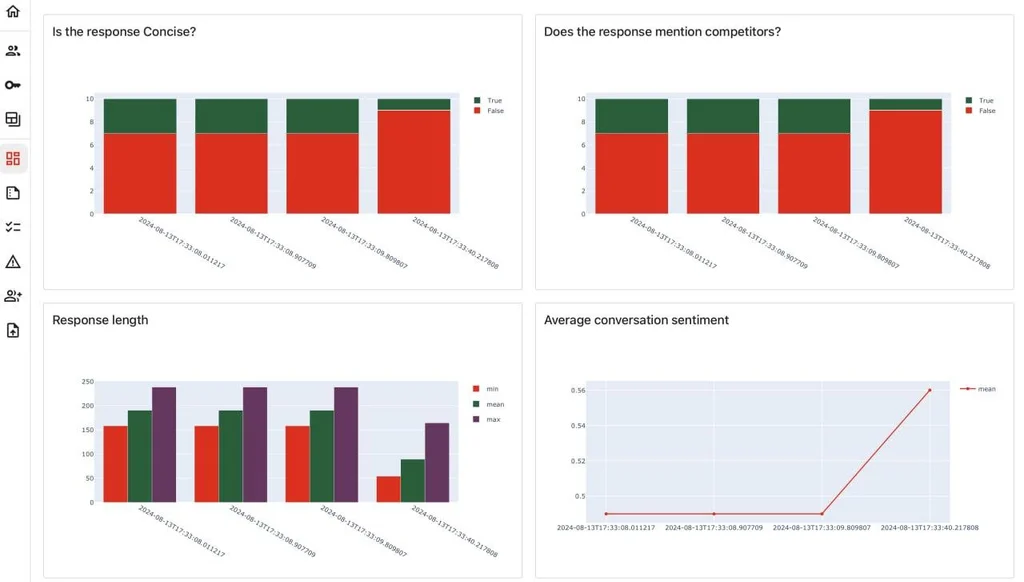
1. LLM Evaluation and Testing
LLM hallucinations and failures: lessons from 5 examples
evidentlyai.com
Large Language Models can generate incorrect, irrelevant, or misleading responses.
Evidently helps developers evaluate these outputs using configurable metrics and evaluation methods.
Important evaluation areas include:
- Response relevance.
- Factuality and correctness.
- Text similarity.
- Sentiment and toxicity.
- Instruction adherence.
- Output format compliance.
- Personal information detection.
- Custom evaluation rules.
Teams can use these evaluations to compare model versions and identify quality regressions.
2. RAG Evaluation
Retrieval-Augmented Generation (RAG) allows an AI application to retrieve external information before generating an answer.
However, a RAG application can fail even when its language model works correctly.
It might retrieve irrelevant documents, miss important information, or generate an answer unsupported by the retrieved context.
Evidently provides evaluation capabilities for investigating these issues.
| RAG evaluation area | Purpose |
|---|---|
| Context relevance | Checks whether retrieved information matches the query |
| Answer relevance | Evaluates whether the response addresses the question |
| Factuality | Investigates whether answers are supported |
| Retrieval quality | Measures the relevance of retrieved information |
| Custom evaluation | Applies application-specific quality rules |
This is particularly useful for enterprise knowledge assistants, document chatbots, and AI-powered search applications.
3. Data Drift Detection
Evidently AI – Open-source AI Evaluation and Observability
evidentlyai.com
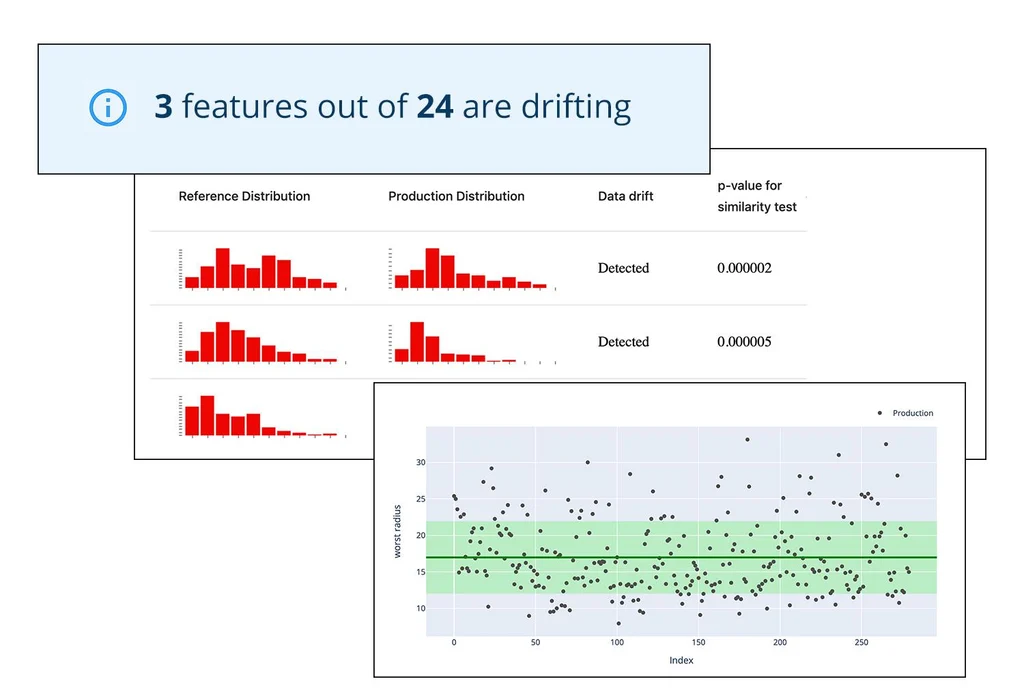
Data drift occurs when the characteristics of incoming data change over time.
Consider a machine learning model trained using customer purchasing behavior from 2024.
By 2026, customer preferences and purchasing patterns might change. The model may become less reliable because its production data no longer resembles its training data.
Evidently supports statistical comparisons that help identify these changes.
Its monitoring capabilities can examine:
- Numerical data distributions.
- Categorical feature changes.
- Missing values.
- Unexpected categories.
- Prediction distributions.
- Text and embedding changes.
Data drift does not automatically prove that a model has become inaccurate. It indicates that developers should investigate whether model performance has changed.
4. Data Quality Monitoring
Machine learning models depend on reliable input data.
Even a well-designed model can produce poor predictions when its data contains errors.
This helps identify problems such as:
- Missing values.
- Duplicate records.
- Invalid values.
- Unexpected categories.
- Changes in feature distributions.
- Statistical anomalies.
This makes it useful for validating data before and after model deployment.
5. AI Agent Evaluation
AI agents can interact with tools, retrieve information, and perform multi-step tasks.
Their evaluation is more complicated than checking a single generated response.
A useful evaluation process may examine whether an agent:
- Understood the original request.
- Selected the appropriate tool.
- Retrieved relevant information.
- Followed the required workflow.
- Completed the intended task.
- Avoided unsafe or unauthorized actions.
Evidently’s current product positioning includes AI agent evaluation alongside LLM and RAG testing.
However, agent reliability still depends on evaluation design, representative test data, and the quality of the underlying application. Evidently AI+1
6. Custom Metrics and Evaluation Rules
Different AI applications require different quality measurements.
A customer support chatbot has different requirements from an e-commerce recommendation system.
Evidently allows developers to create custom evaluations using Python.
This flexibility is valuable when standard metrics do not fully represent an application’s requirements.
7. Reports, Test Suites, and Monitoring
Evidently supports different ways to inspect evaluation results.
Reports summarize metrics and help developers investigate individual evaluation runs.
Test Suites apply pass-or-fail conditions to evaluation results.
Monitoring interfaces help teams observe changes over time.
Reports can be exported in formats such as HTML and JSON. The open-source project also supports a monitoring interface that teams can self-host.
These capabilities make Evidently useful for both experimentation and production workflows. GitHub+1
How to Install and Use Evidently AI
One advantage of Evidently is its Python-based development workflow.
Developers familiar with Python and machine learning can install the framework through the Python package manager.
Step 1: Install Evidently
Run this command in your terminal:
pip install evidentlyStep 2: Import the Required Libraries
import pandas as pdfrom evidently import Datasetfrom evidently import DataDefinitionfrom evidently import Reportfrom evidently.presets import TextEvalsStep 3: Prepare an Evaluation Dataset
data = [ ["What is artificial intelligence?", "AI enables machines to perform intelligent tasks."], ["What is machine learning?", "Machine learning allows systems to learn from data."], ["What is Python?", "Python is a general-purpose programming language."]]columns = ["question", "answer"]eval_df = pd.DataFrame(data, columns=columns)Step 4: Create an Evidently Dataset
eval_dataset = Dataset.from_pandas( eval_df, data_definition=DataDefinition())Step 5: Generate an Evaluation Report
report = Report([ TextEvals()])result = report.run(eval_dataset, None)result.save_html("ai_evaluation.html")This example demonstrates a basic text evaluation workflow. It does not independently verify factual accuracy against a trusted reference dataset.
For more advanced evaluations, developers can configure LLM judges, semantic similarity, custom descriptors, and test conditions.
The official documentation provides additional examples and implementation guidance.
- Evidently Documentation
- GitHub Source Code
- Official Website
Main Use Cases of Evidently AI
Evidently supports several stages of the AI development lifecycle.
Machine Learning Model Monitoring
Data science teams can compare production data with reference datasets and investigate unexpected changes.
This is useful for classification, regression, ranking, and recommendation applications.
Generative AI Application Testing
Developers can evaluate chatbots, writing assistants, and AI-powered business applications.
They can investigate response quality, text characteristics, factuality, and application-specific requirements.
Enterprise RAG Systems
Companies building internal knowledge assistants can evaluate retrieval quality and generated responses.
This helps identify whether a problem comes from document retrieval, the language model, or the evaluation dataset.
MLOps and CI/CD Pipelines
Machine learning teams can integrate evaluation tests into development workflows.
For example, a team can run evaluation tests before deploying a new model version.
If an important quality condition fails, developers can investigate the release before production deployment.
AI Research and Experimentation
Researchers can compare model behavior under different configurations and test datasets.
Reports make it easier to organize experiments and examine changes between evaluation runs.
Benefits of Using Evidently AI
Evidently addresses a significant challenge in modern AI development: determining whether an AI system actually works as intended.
Its main benefits include:
Open-source flexibility: Developers can inspect the framework, customize evaluations, and integrate it into Python workflows.
Broad evaluation coverage: The framework supports traditional ML, generative AI, RAG, and AI agent use cases.
Custom metrics: Teams can create evaluation rules based on their specific requirements.
Early problem detection: Data and model monitoring can reveal potential issues before they become larger operational problems.
Developer-friendly workflow: Python APIs, reports, and test suites support experimentation and automated testing.
Flexible deployment: Teams can use the Python library and self-host the open-source platform or investigate commercial deployment options.
These benefits make Evidently particularly relevant to teams that need more than basic AI application development.
Evidently AI Pricing: Is It Free?
Evidently’s Python library is available under the Apache 2.0 open-source license.
Developers can use the core framework without paying a conventional software subscription fee.
However, it is important to distinguish the Python library from the broader Evidently Platform.
The official documentation describes an open-source platform edition and a commercial edition with additional capabilities for collaboration, no-code evaluations, access control, and scalability.
It also states that Evidently Cloud is no longer available as a SaaS product, while describing commercial Cloud and Enterprise deployment options. Prospective customers should confirm the currently available commercial arrangement directly with Evidently. Documentation+1
Open Source vs. Commercial Platform
| Feature | Open-source edition | Commercial edition |
|---|---|---|
| Python evaluations | Yes | Yes |
| Built-in evaluations | Yes | Yes |
| Custom metrics | Yes | Yes |
| Reports and Test Suites | Yes | Yes |
| Monitoring dashboard | Basic functionality | Advanced functionality |
| No-code evaluations | No | Yes |
| Advanced collaboration | Limited | Yes |
| Role-based access control | Not included in the documented OSS feature set | Yes |
| Dedicated support | Community resources | Commercial support |
Pricing verdict: The open-source library is free. Commercial platform pricing and availability should be confirmed through the official Evidently website.
Evidently AI vs. Competitors
Evidently operates in a growing market that includes ML observability, LLM evaluation, AI testing, and production monitoring.
Several platforms address similar problems, although their technical approaches and target users differ.
1. Langfuse
Brand Assets & Guide – Langfuse
Langfuse
Langfuse focuses on LLM tracing, observability, prompt management, and evaluation.
Best for: Developers building LLM applications who need detailed traces and prompt-level monitoring.
Pricing: Open-source self-hosting and commercial Cloud options.
Limitation: Its central focus differs from Evidently’s broader predictive ML and data-quality monitoring coverage.
Official website
2. Arize Phoenix
GitHub – Arize-ai/phoenix: AI Observability & Evaluation · GitHub
Arize Phoenix
Phoenix provides LLM tracing, evaluation, and observability capabilities.
Best for: AI engineering teams investigating LLM execution and RAG behavior.
Pricing: Open-source option, with separate commercial Arize offerings.
Limitation: Teams should compare its feature set and deployment model against their specific ML monitoring needs.
Official website
3. MLflow
Aprende a programar desde tu casa
MLflow
MLflow supports experiment tracking, model lifecycle management, and evaluation workflows.
Best for: Data science teams managing machine learning experiments and model development.
Pricing: Open-source core with additional managed commercial options.
Limitation: Teams may need additional configuration and integrations to build their preferred monitoring environment.
Official website
4. Deepchecks
Deepchecks Monitoring Review (2026) — Pros, Cons & Rating
Deepchecks
Deepchecks focuses on validating machine learning data and models, with capabilities for AI and LLM evaluation.
Best for: Teams that need structured validation across ML development workflows.
Pricing: Verify current commercial offerings.
Limitation: Its product capabilities and deployment options differ from Evidently’s open-source Python framework.
Official website
Competitor Comparison Table
| Platform | Target user | Key strength | Pricing transparency |
|---|---|---|---|
| Evidently AI | ML and LLM engineers | Evaluation and monitoring | Free OSS; commercial inquiry |
| Langfuse | LLM developers | Tracing and observability | Open-source and Cloud |
| Arize Phoenix | AI engineering teams | LLM tracing and evaluation | Open-source |
| MLflow | Data science teams | Experiment and model lifecycle | Open-source and commercial |
| Deepchecks | ML teams | Data and model validation | Verify current plans |
Which Platform Should You Choose?
Choose Evidently if you want a flexible Python framework for evaluating traditional machine learning and generative AI systems.
Choose Langfuse if detailed LLM traces and prompt management are your priority.
Choose Phoenix if you need to investigate LLM execution and RAG behavior.
Choose MLflow if experiment tracking and model lifecycle management are central to your workflow.
Choose Deepchecks if structured ML validation is a major requirement.
The right choice depends on your existing infrastructure, evaluation needs, and deployment preferences.
Limitations of Evidently AI
Although Evidently provides useful evaluation and monitoring tools, it is not a complete solution for every AI development requirement.
Understanding its limitations helps businesses select the right technology.
1. Python Knowledge Is Important
The open-source framework is primarily designed for Python developers.
Users without programming experience may find installation, metric configuration, and custom evaluations difficult.
The commercial platform offers additional no-code capabilities, but availability depends on the selected edition.
2. Evaluation Quality Depends on Data
An evaluation framework cannot automatically guarantee that its results are correct.
If the reference dataset contains inaccurate answers or incomplete examples, evaluation results may be misleading.
Teams should prepare representative datasets and regularly review their quality.
3. LLM-as-a-Judge Has Limitations
Some LLM evaluation methods use another language model to judge generated responses.
This approach can help assess subjective qualities, but it introduces potential bias and inconsistency.
For important applications, combine automated evaluation with human review and objective measurements.
4. Monitoring Requires Configuration
Installing Evidently does not automatically create a complete production monitoring system.
Developers must configure data collection, evaluation schedules, thresholds, and alerts.
They also need to decide how evaluation failures should affect deployment decisions.
5. Cloud and Self-Hosted Deployments Differ
The open-source framework and commercial platform do not necessarily provide identical management experiences.
Organizations should compare deployment requirements, available features, data handling, and operational responsibilities.
6. It Does Not Replace Model Training
Evidently focuses on evaluation, testing, and monitoring.
It is not a replacement for model training frameworks, GPU infrastructure, or dedicated model-serving platforms.
Developers may need additional tools for training, fine-tuning, deployment, and orchestration.
Privacy and Security Considerations
AI monitoring systems may process sensitive information.
For example, an evaluation dataset might contain customer conversations, internal business documents, or personal information.
Before adopting Evidently, organizations should understand where this information is stored and how it is processed.
Important questions include:
- Does evaluation data remain within the organization’s infrastructure?
- What information is transmitted to external model providers?
- Are third-party LLM APIs required for particular evaluations?
- Can sensitive information be removed before evaluation?
- What are the data retention policies for the selected deployment?
- Who can access evaluation reports and datasets?
- Are access controls and audit logs available?
- What encryption and security controls apply?
Does Open Source Automatically Mean Private?
No.
The open-source license allows organizations to inspect and use the framework under its licensing terms. It does not automatically establish the privacy characteristics of every deployment.
A self-hosted setup may give teams greater control over infrastructure, but they remain responsible for securing it.
Cloud or commercial deployments require a separate review of privacy policies, security documentation, and contractual commitments.
Do not assume that every LLM evaluation runs locally. Some evaluation methods can use external model providers depending on configuration.
Evidently AI vs. Traditional AI Monitoring
Traditional machine learning monitoring often concentrates on numerical performance indicators.
For example, a classification system might be monitored through accuracy, precision, recall, and changes in data distribution.
Generative AI systems introduce additional challenges.
A chatbot might return a technically valid response that contains incorrect information. An AI agent might select the wrong tool despite generating a convincing explanation.
Evidently addresses this broader evaluation problem through metrics for predictive ML and generative AI applications.
| Area | Traditional ML monitoring | Generative AI evaluation |
|---|---|---|
| Accuracy | Important | Application-dependent |
| Data drift | Important | Important |
| Hallucinations | Not usually applicable | Important |
| Text relevance | Not usually applicable | Important |
| Retrieval quality | Not usually applicable | Important for RAG |
| Toxicity | Application-dependent | Often important |
| Agent actions | Not usually applicable | Important for agentic systems |
Modern AI engineering needs both conventional statistical monitoring and evaluation methods designed for generative systems.
Evidently AI in 2026: Latest Developments
Evidently’s current positioning reflects the growing importance of AI evaluation beyond traditional machine learning.
Its official product materials emphasize three major areas:
- LLM evaluation and testing.
- AI agent and RAG evaluation.
- Predictive machine learning monitoring.
The project also highlights more than 100 built-in evaluations, synthetic test data, automated evaluation, and continuous monitoring. Open-source AI Evaluation and Observability+2
These capabilities reflect a broader shift in the AI industry.
Businesses are moving beyond simply deploying AI applications. They increasingly need ways to measure whether those applications remain accurate, reliable, and useful.
Why AI Evaluation Is Becoming More Important
Consider an organization that releases a new version of its customer support chatbot.
The updated model may generate more natural responses but could also introduce new factual errors.
Without systematic evaluation, the development team might overlook the problem.
A structured evaluation process can compare previous and updated versions using the same test dataset.
This helps identify:
- Changes in answer relevance.
- Increased hallucinations.
- Reduced retrieval quality.
- Unexpected response formats.
- Changes in safety-related metrics.
- Performance regressions.
Evidently provides tools that can support this process.
1. Answer the Search Query Immediately
Explain what Evidently AI is within the opening paragraph.
Readers should understand its purpose without scrolling through a long introduction.
2. Include Original Technical Explanations
Explain the difference between:
- Data drift.
- Model performance monitoring.
- LLM evaluation.
- RAG testing.
- AI agent evaluation.
These explanations provide meaningful information beyond a basic product description.
3. Add Practical Examples
Include Python installation instructions and an evaluation example.
Practical information makes the article more useful to developers.
4. Keep Pricing Information Accurate
Do not invent subscription prices or claim that every commercial feature is free.
Explain the distinction between the open-source library and commercial platform.
5. Use Authoritative Sources
Link to the official documentation, GitHub repository, and relevant technical resources.
6. Improve Author Transparency
Include an accurate author biography and, where possible, technical editorial review.
Do not claim hands-on testing unless it actually happened.
7. Add Original Visuals
Use screenshots of genuine evaluation reports or original diagrams explaining the monitoring workflow.
Do not present fabricated screenshots as actual product interfaces.
8. Build Relevant Topical Coverage
Support this article with genuinely useful content about:
- MLOps.
- LLM evaluation.
- RAG testing.
- AI observability.
- Machine learning monitoring.
- Data drift detection.
Important SEO distinction: There is no guaranteed article length, keyword density, FAQ schema, or special AEO format that automatically secures Google rankings. Strong performance depends on satisfying search intent, demonstrating expertise, providing useful information, and maintaining a technically sound website.
Who Should Use Evidently AI?
Evidently is particularly relevant to people who develop, evaluate, or maintain AI-powered systems.
| User type | Potential benefit |
|---|---|
| Data scientists | Model evaluation and data analysis |
| ML engineers | Model testing and monitoring |
| LLM developers | Generative AI evaluation |
| RAG developers | Retrieval and response quality testing |
| MLOps teams | Evaluation pipelines and monitoring |
| AI researchers | Model comparison and experimentation |
| Businesses | AI quality assurance |
Who May Not Need Evidently?
Evidently might not be necessary for someone who simply wants to use ChatGPT, generate images, write content, or automate basic office tasks.
It is primarily a development and monitoring framework, not a general-purpose AI assistant.
Small projects with limited evaluation requirements might also find simpler Python scripts sufficient.
FAQs
1. What is Evidently AI used for?
Evidently AI is used to evaluate, test, and monitor machine learning models, LLMs, RAG applications, and AI agents. It helps developers measure output quality, detect data drift, identify performance problems, and monitor AI systems.
2. Is Evidently AI free to use?
Yes. Evidently provides an open-source Python framework under the Apache 2.0 license. Commercial platform features are available separately, and their current pricing and availability should be verified with the provider.
3. Can Evidently AI evaluate ChatGPT and other LLMs?
Yes. Evidently supports LLM evaluation workflows, including configurable metrics for text quality, factuality, relevance, and application-specific requirements. The exact evaluation setup depends on the model, dataset, and metrics selected.
4. What is the difference between Evidently AI and Langfuse?
Evidently focuses on ML and LLM evaluation, data quality, drift detection, and monitoring. Langfuse focuses more heavily on LLM tracing, observability, prompt management, and evaluation. The better choice depends on the application’s monitoring requirements.
5. Is Evidently AI suitable for RAG applications?
Yes. Evidently supports RAG evaluation, including checks related to retrieval relevance, context quality, and generated responses. Developers can use these evaluations to investigate weaknesses in retrieval and answer generation.
6. Does Evidently AI support Python?
Yes. Evidently provides a Python library that can be installed using pip pip install evidently. Developers can use its APIs to create reports, evaluation tests, and monitoring workflows.
Conclusion:
Evidently AI is a useful framework for developers who need to evaluate and monitor machine learning and generative AI applications.
Its biggest strength is its coverage of traditional ML, LLMs, RAG systems, and AI agents within an extensible Python-based framework.
The open-source edition makes it accessible to developers, while the commercial platform provides additional capabilities for organizations with more advanced requirements.
However, it is important to understand its limitations. Evaluation quality depends on good datasets, appropriate metrics, and thoughtful testing. It also does not replace model training, deployment infrastructure, or human oversight.
For data scientists, MLOps engineers, and AI developers, Evidently is worth considering when building reliable AI applications.