Baidu AI is the artificial intelligence ecosystem developed by Chinese technology company Baidu, combining ERNIE foundation models, AI Cloud, developer tools, intelligent applications, and autonomous-driving technologies. Its platforms help individuals and businesses generate content, develop AI applications, automate workflows, analyze information, and deploy machine-learning solutions.
At a Glance: Baidu AI
- Company: Baidu.
- Headquarters: Beijing, China.
- Flagship AI models: ERNIE model family.
- Developer platform: Baidu AI Cloud Qianfan.
- Deep-learning framework: PaddlePaddle.
- Major applications: ERNIE, Baidu App, Baidu Wenku, Baidu Drive, and AI-powered productivity tools.
- Major research areas: Generative AI, multimodal intelligence, reasoning, AI agents, cloud computing, and autonomous driving.
What Is Baidu AI?
Baidu AI refers to the collection of artificial intelligence technologies, models, platforms, and applications developed by Baidu. Rather than representing one chatbot or standalone application, it describes a broader ecosystem that supports consumer AI services and enterprise development.
Baidu has invested in artificial intelligence for years. Its work includes natural language processing, computer vision, speech recognition, machine learning, and autonomous driving.
Today, its AI strategy centers on several connected technologies:
- ERNIE: A family of foundation models for language, reasoning, coding, and multimodal tasks.
- Qianfan: A platform for accessing, developing, and deploying large AI models and intelligent agents.
- PaddlePaddle: Baidu’s open-source deep-learning framework.
- AI Cloud: Infrastructure and services for training, hosting, and operating AI applications.
- AI applications: Consumer and business products that integrate generative AI into everyday workflows.
- Apollo: Baidu’s intelligent-driving and autonomous-mobility technology ecosystem.
This combination makes Baidu a key player in China’s artificial intelligence industry.
How Does Baidu AI Work?
Baidu AI operates through several connected layers. Each layer handles a different part of the artificial intelligence process.
百度千帆·大模型服务及Agent开发平台 -百度智能云

Apollo
Baidu Inc. (@Baidu_Inc) on X
1. AI Infrastructure
The infrastructure layer provides computing resources to train and run AI models.
It includes:
- AI accelerators and computing systems.
- Cloud-based computing resources.
- Model training infrastructure.
- Inference services for AI applications.
Inference is the process through which a trained model generates an answer or performs a task.
Baidu develops its own AI computing architecture and combines it with other computing resources. This infrastructure supports both internal products and enterprise customers. Baidu Inc+1
2. Foundation Models
The model layer includes ERNIE, Baidu’s family of large foundation models.
These models process information, understand language, generate content, and support reasoning and other AI tasks.
Depending on the model, capabilities can include:
- Natural language understanding.
- Text generation and summarization.
- Programming assistance.
- Multimodal processing.
- Complex reasoning.
- Tool usage and agent workflows.
3. AI Development Framework
Baidu uses PaddlePaddle as its deep-learning framework.
Developers can use it to build, train, and deploy machine-learning models. It supports the development of AI systems across different industries.
Baidu released PaddlePaddle 3.0 in April 2025, strengthening its full-stack AI development ecosystem. Baidu Inc+1
4. AI Applications and Agents
The application layer brings AI capabilities into products people and businesses can use.
Examples include AI-assisted document creation, intelligent search, productivity applications, digital employees, and multi-agent workflows.
An AI agent differs from a conventional chatbot. It can use tools and perform multiple connected steps toward a defined objective.
For example, a productivity agent might gather information, organize it, prepare a document, and produce a final presentation.
Baidu AI’s Main Products and Technologies
The Baidu AI ecosystem includes several products with different purposes. Understanding these differences helps users select the right service.
ERNIE: Baidu’s Flagship AI Model Family
文心一言
yiyan.baidu.com
ERNIE is the central component of Baidu’s generative AI strategy.
ERNIE stands for Enhanced Representation through Knowledge Integration. The model family has evolved from language understanding systems into broader generative and multimodal AI technologies.
ERNIE models support different tasks, including:
- Answering questions and generating text.
- Summarizing lengthy documents.
- Writing and debugging code.
- Understanding complex instructions.
- Supporting reasoning and research.
- Working with external tools.
- Creating content through connected AI workflows.
Important 2026 development: ERNIE 5.5 Flash Preview
On November 11, 2026, Baidu introduced ERNIE 5.5 Flash Preview.
According to Baidu’s official release information, the model has:
| Specification | Announced details |
|---|---|
| Total parameters | 280 billion |
| Active parameters | 14 billion |
| Context window | 1 million tokens |
| Default maximum output | 64K tokens |
| Primary focus | Coding, agents, knowledge work, and content creation |
| API availability | Baidu Qianfan |
| Weight availability | Apache 2.0 open-source release announced as forthcoming |
The model uses a mixture-of-experts architecture. This allows it to activate a smaller portion of its total parameters for each token.
Baidu also demonstrates its capabilities through game development, 3D modeling, research reports, spreadsheets, and video creation.
These demonstrations are company-published examples, not independent proof that every task will achieve the same results in production. The model remains a preview, and Baidu says post-training is ongoing. ERNIE+2
ERNIE Bot: The Consumer AI Assistant
百度文心一言:智能问答系统的革新与升级
cloud.baidu.com
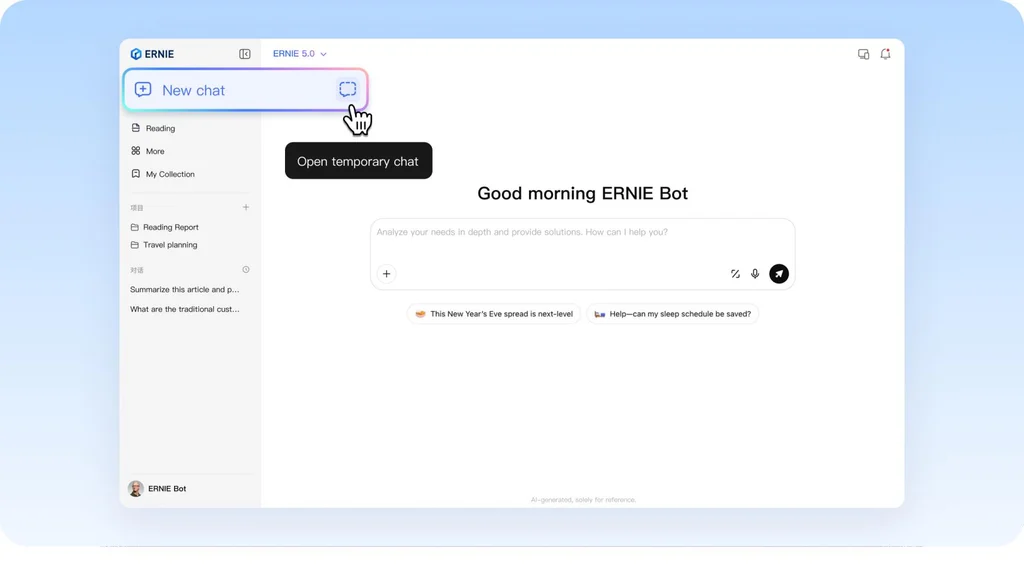
ERNIE Bot is Baidu’s conversational AI assistant.
It provides a familiar chatbot experience for users who want to interact with artificial intelligence through natural-language instructions.
Common applications include:
- Asking questions.
- Writing articles and reports.
- Summarizing information.
- Brainstorming ideas.
- Learning unfamiliar subjects.
- Improving written content.
- Getting programming assistance.
An important pricing development occurred on April 1, 2025. Baidu made ERNIE Bot free for users on PC and mobile, following improvements to its models and lower inference costs. Baidu Inc
However, consumer access should not be confused with unlimited API usage or free enterprise deployment.
Baidu Qianfan: AI Development and Model Platform
OpenClaw 使用文档 – 百度千帆·大模型服务及Agent开发平台
cloud.baidu.com
Baidu Qianfan is particularly relevant to developers and businesses.
It functions as a model-as-a-service platform, often abbreviated as MaaS.
Instead of developing every AI component independently, organizations can use Qianfan to access models and build applications.
Its capabilities include:
- Foundation-model API access.
- Model selection and deployment.
- Fine-tuning and model customization.
- Data management.
- Application development.
- Agent workflow development.
- Integration with external tools.
Qianfan also supports third-party and open-source models, rather than restricting developers to Baidu’s own ERNIE family.
This flexibility matters because businesses can evaluate different models for different workloads. cloud.baidu.com+1
PaddlePaddle: Open-Source Deep Learning
开发 C++ 算子-API文档-PaddlePaddle深度学习平台
paddlepaddle.org.cn
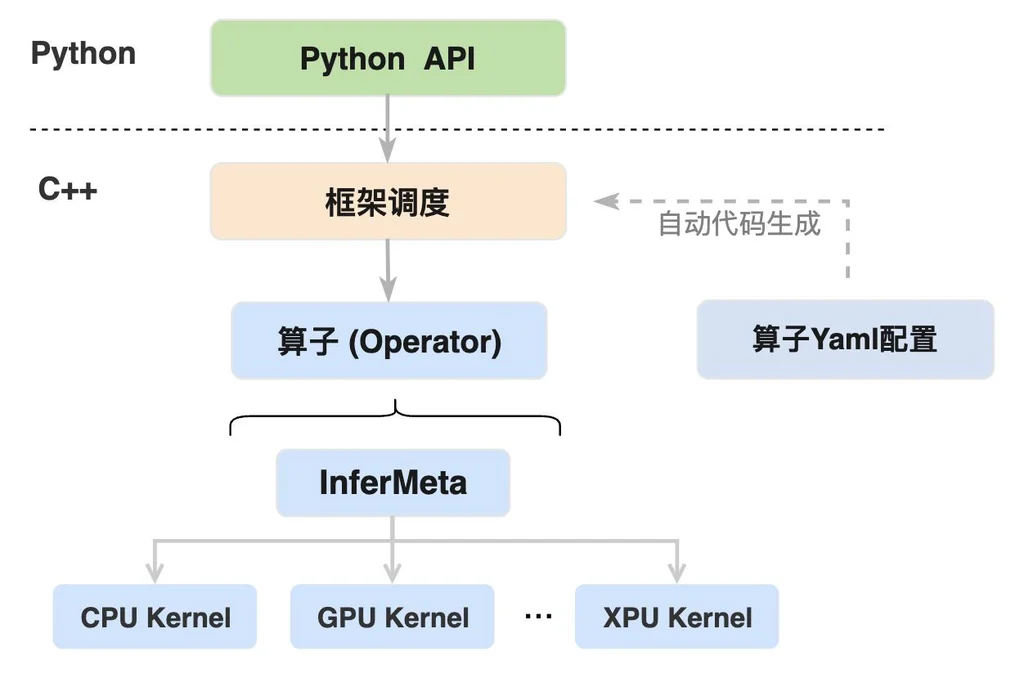
PaddlePaddle provides the development foundation for building machine-learning applications.
It serves a different purpose from ERNIE.
- ERNIE provides pretrained AI models.
- PaddlePaddle provides tools for developing and training models.
- Qianfan provides cloud-based model services and application development capabilities.
Developers can use deep-learning frameworks to train models, process datasets, and create specialized AI systems.
PaddlePaddle is particularly relevant to researchers, machine-learning engineers, and organizations developing customized AI applications.
Baidu AI Cloud
Baidu AI Cloud provides the computing and platform services needed to operate AI systems.
Its services support:
- AI model training.
- Cloud infrastructure.
- Model deployment.
- Enterprise applications.
- Data processing.
- AI-powered business automation.
One important distinction is that Baidu AI Cloud is not simply an AI chatbot. It is an infrastructure and development environment for organizations building AI-powered products.
Apollo: AI for Autonomous Driving
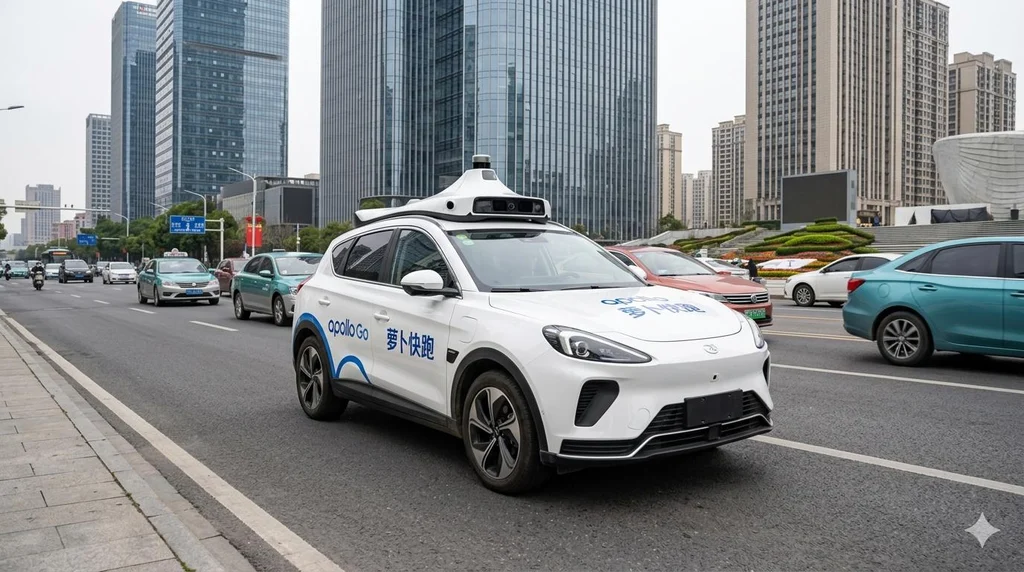
Роботакси Apollo Go парализовало дорожное движение в китайском Ухане / Авто и транспорт / iXBT Live
ixbt.com
Baidu Apollo extends Baidu’s artificial intelligence work beyond software applications.
Apollo includes technologies associated with intelligent driving and autonomous mobility.
Its ecosystem includes Apollo Go, Baidu’s autonomous ride-hailing service.
AI technologies help autonomous vehicles interpret their surroundings, recognize road objects, understand traffic conditions, and make driving-related decisions.
Apollo illustrates how Baidu applies AI to physical systems, rather than limiting its research to language models and digital assistants. Baidu Inc+1
Main Features of Baidu AI
Baidu’s features vary by product and model. However, several capabilities appear throughout its ecosystem.
| Feature | What it does | Potential application |
|---|---|---|
| Natural language processing | Understands and generates human language | Chatbots and writing |
| Generative AI | Produces new content | Documents and creative work |
| Reasoning | Processes multi-step problems | Research and analysis |
| Coding assistance | Helps generate and modify code | Software development |
| Multimodal AI | Works across supported information types | Content understanding |
| AI agents | Coordinates tools and tasks | Workflow automation |
| Model customization | Adapts models for specialized tasks | Enterprise AI |
| Cloud deployment | Hosts AI applications | Business operations |
Multimodal Intelligence
Multimodal AI processes different types of information instead of relying exclusively on text.
Depending on the particular model or service, this can include images, audio, video, and text.
Such capabilities can support document understanding, content creation, and more interactive applications.
However, multimodal functionality is not identical across all ERNIE models. Users should check individual model specifications.
Long-Context Processing
A context window determines how much information a model can consider during an interaction.
ERNIE 5.5 Flash Preview’s announced one-million-token context window is particularly relevant to long documents and multi-stage tasks.
Potential applications include:
- Analyzing extensive research materials.
- Reviewing large document collections.
- Processing lengthy technical specifications.
- Maintaining context across complex workflows.
A large context window does not guarantee perfect recall or accuracy. Users should still test retrieval quality and verify important details.
AI Agent Development
Baidu is increasingly positioning its platforms around AI agents.
Rather than producing only a text response, an agent can connect different tools and execute a sequence of actions.
This approach is useful for organizations seeking to automate repetitive operations and connect AI with existing business systems.
Practical Use Cases of Baidu AI
Baidu AI serves several audiences. Its practical value depends on the product, available integrations, and the complexity of the task.
1. Content Creation and Writing
ERNIE can assist with everyday writing and content development.
Users can explore applications such as:
- Drafting articles and reports.
- Creating marketing descriptions.
- Summarizing documents.
- Generating outlines.
- Improving written communication.
- Developing content ideas.
For publishers and marketers, these capabilities can reduce repetitive writing work. Human editing and factual verification remain essential.
2. Software Development
Developers can use ERNIE models through Qianfan to support programming workflows.
Potential tasks include:
- Generating code from instructions.
- Explaining unfamiliar code.
- Identifying programming errors.
- Creating test cases.
- Improving existing functions.
- Developing prototypes.
ERNIE 5.5 Flash Preview specifically emphasizes coding and longer, tool-assisted development tasks.
Developers should still test generated code for security vulnerabilities, performance problems, and compatibility issues.
3. Business Automation
Businesses can use Qianfan and related AI technologies to build intelligent workflows.
Examples include:
- Customer-support assistants.
- Automated document processing.
- Internal knowledge assistants.
- Sales-support agents.
- Business reporting.
- Workflow coordination.
The greatest potential value comes from connecting AI models with real business processes.
However, successful automation requires appropriate permissions, reliable data, and human oversight.
4. Education and Research
Baidu AI can support learning and research activities.
Students and researchers may use conversational models to:
- Explain technical concepts.
- Summarize research materials.
- Organize notes.
- Generate study questions.
- Explore programming concepts.
- Develop preliminary research outlines.
AI-generated academic information must be checked against original publications. A fluent response is not necessarily a reliable source.
5. E-Commerce and Digital Marketing
AI can support several parts of online commerce.
Businesses can explore applications such as:
- Product-description generation.
- Customer-service automation.
- Search and recommendation systems.
- Advertising content development.
- Customer-intent analysis.
- Marketing workflow automation.
Baidu’s existing search and advertising ecosystem provides an additional business context for these technologies.
6. Autonomous Mobility
Apollo demonstrates how Baidu applies machine learning and computer vision to autonomous driving.
Its technologies support the interpretation of road environments and driving-related decisions.
This use case is substantially different from chatbot applications. It requires specialized hardware, safety engineering, testing, and regulatory compliance.
Benefits of Using Baidu AI
Baidu AI offers several potential advantages for individuals and organizations.
A Broad AI Technology Ecosystem
One significant advantage is the combination of models, frameworks, cloud infrastructure, and applications.
Organizations can access multiple layers of AI development through Baidu’s ecosystem.
This can simplify certain development and deployment workflows.
Strong Chinese-Language AI Focus
Baidu has extensive experience in Chinese search, language technologies, and digital services.
Its ERNIE models are relevant to organizations developing Chinese-language applications.
This does not mean every model performs equally well in every language. International users should test their actual language requirements.
Multiple Development Options
Qianfan offers access to ERNIE models and supported third-party models.
This allows developers to evaluate different technologies without necessarily building separate infrastructure for every model.
Enterprise-Oriented Capabilities
Businesses can use cloud infrastructure, model customization, application development, and agent workflows.
These capabilities make the platform relevant to organizations developing specialized AI products.
Progress Toward Open Models
Baidu’s approach to model availability has evolved.
ERNIE 4.5 became open-source in 2025, and the company has continued expanding its model offerings.
ERNIE 5.5 Flash Preview is another important development, although its announced Apache 2.0 weight release should not be confused with already downloadable weights. ccianet.org+1
Limitations and Challenges of Baidu AI
Despite its capabilities, Baidu AI has limitations that users should evaluate before adopting it.
1. Regional Accessibility
Baidu’s products primarily serve the Chinese technology market.
Some services, interfaces, payment options, and integrations may be more accessible within mainland China.
International users should verify account registration requirements, supported regions, language options, and API availability.
2. Language and Localization Differences
ERNIE has a strong Chinese-language focus.
However, international developers may encounter differences in English-language performance, documentation quality, and localized product support.
Testing representative prompts is more useful than relying on general model descriptions.
3. Model Reliability
Like other generative AI systems, ERNIE models can produce incorrect information.
Potential problems include:
- Hallucinated facts.
- Incorrect calculations.
- Incomplete explanations.
- Outdated information.
- Generated code containing errors.
Important business, legal, financial, and technical outputs require verification.
4. Platform Complexity
Baidu offers several connected products with different purposes.
A new user may find it difficult to distinguish ERNIE Bot, ERNIE models, Qianfan, PaddlePaddle, and AI Cloud.
Each serves a different audience and requires a different level of technical knowledge.
5. Preview-Model Limitations
ERNIE 5.5 Flash Preview is not the same as a finalized production release.
Baidu identifies it as an intermediate post-training checkpoint.
Its capabilities and performance may change as development continues. Production teams should test model stability before relying on it for critical applications. ERNIE+1
6. Data Governance Considerations
Businesses should examine how their data is processed, stored, and accessed.
Before sending confidential information to any AI service, investigate:
- Data storage locations.
- Data retention periods.
- Model-training policies.
- Access controls.
- Encryption arrangements.
- Contractual data-processing terms.
- Available deletion procedures.
- Enterprise deployment options.
Do not assume that using an enterprise AI platform automatically provides Zero Data Retention (ZDR).
Likewise, a security certification, where applicable, does not independently establish that customer prompts are never retained.
Baidu’s platform documentation describes security and deployment capabilities, but organizations must evaluate the terms of the specific service they intend to use. cloud.baidu.com+1
Baidu AI Pricing: Is It Free?
Baidu AI uses different pricing arrangements depending on the product.
The consumer assistant, API services, cloud infrastructure, and developer subscriptions should not be treated as one pricing plan.
Consumer Access
Baidu made ERNIE Bot free on PC and mobile beginning April 1, 2025.
This makes conversational AI accessible without requiring users to purchase a conventional chatbot subscription. Baidu Inc
Developer API Pricing
Developers generally pay according to the selected model, token consumption, and applicable service arrangements.
For example, Baidu’s Qianfan listings in November 2026 advertise ERNIE 5.5 Flash Preview input pricing from approximately ¥0.50 per million tokens and output pricing from ¥2 per million tokens.
These are promotional starting rates, not universal prices for every model or request. cloud.baidu.com+1
Qianfan Token Plans
Baidu also offers subscription-based Token Plans.
The following prices appeared on its official Chinese-language platform when checked in November 2026:
| Plan | Advertised monthly price | Monthly allowance |
|---|---|---|
| Mini | ¥4.90 | 1,400 points |
| Lite | ¥19.90 | 11,500 points |
| Standard | ¥49.90 | 22,000+ points |
| Pro | ¥99.90 | 45,000+ points |
| Max | ¥299.90 | 165,000+ points |
These are advertised personal-plan prices and allowances, not guaranteed permanent rates. Promotional discounts, regional availability, and plan terms can change.
The subscription uses a points-based system. Points should not automatically be interpreted as an equivalent number of tokens.
Check the current model-specific consumption rules before purchasing. cloud.baidu.com+1
Official pricing and platform information: Baidu Qianfan platform.
Baidu AI vs. Its Main Competitors
China’s AI industry has several major competitors. Baidu competes across foundation models, consumer applications, enterprise AI, and cloud infrastructure.
DeepSeek: qué es, cómo funciona y qué opciones tiene esta inteligencia artificial
QWEN AI: Alibaba’s Competitor to ChatGPT and Gemini
[TechTalkThai] Tencent เปิดตัว Hunyuan Large เคลมเหนือ Llama 3.1 70B และ 405B Tencent บริษัทยักษ์ใหญ่สัญชาติจีน ล่าสุดได้เปิดตัวโมเดล Open Source ใหม่ภายใต้ชื่อ Hunyuan Large ขนาด 389B พารามิเตอร์ ที่รองรับ Context
4
Major AI Competitors
| Platform | Target user | Key strength | Pricing transparency | Main limitation |
|---|---|---|---|---|
| Baidu ERNIE | Consumers and developers | Chinese AI ecosystem and enterprise integration | Published model and subscription pricing | Regional and product complexity |
| Alibaba Qwen | Developers and businesses | Model variety and open-model ecosystem | Varies by model and service | Requires model-specific evaluation |
| DeepSeek | Developers and general users | Reasoning-focused models and API access | Published API pricing varies | Performance and service availability vary by model |
| Tencent Hunyuan | Enterprises and developers | Integration with Tencent’s ecosystem | Varies by service | Product and model availability differ |
| ByteDance Doubao | General consumers and creators | Consumer AI applications and content workflows | Depends on product | Less focused on independent developer infrastructure |
These platforms compete in overlapping areas, but their products are not interchangeable. ccianet.org+2
Baidu AI vs. Alibaba Qwen
Alibaba’s Qwen ecosystem is a major competitor in foundation models and developer services.
Qwen is particularly relevant to developers exploring downloadable model weights and customization options.
Baidu offers a broader combination of ERNIE models, Qianfan, PaddlePaddle, and existing consumer applications.
The choice depends on model requirements, deployment options, and the surrounding technology stack.
Baidu AI vs. DeepSeek
DeepSeek is known for its reasoning-focused models and developer-oriented offerings.
Baidu competes through its ERNIE family and integrated AI Cloud infrastructure.
For developers, comparing actual API costs, output quality, context limits, latency, and licensing is more useful than choosing based on company reputation.
Baidu AI vs. Tencent Hunyuan
Tencent Hunyuan is another important Chinese foundation-model ecosystem.
Tencent’s integration opportunities are relevant to organizations already using its cloud and business services.
Baidu offers a different combination of search-related technologies, ERNIE, Qianfan, and PaddlePaddle.
Baidu AI vs. ByteDance Doubao
Doubao focuses strongly on consumer-facing AI experiences.
Baidu competes through both consumer products and enterprise development infrastructure.
Businesses looking for model APIs may find Qianfan more relevant than a consumer chatbot comparison.
Who Should Use Baidu AI?
Baidu AI is most relevant to people and organizations whose requirements align with its ecosystem.
| Audience | Potentially useful products | Why they may use them |
|---|---|---|
| General users | ERNIE Bot | Writing, learning, and question answering |
| Developers | ERNIE and Qianfan | API access and application development |
| Businesses | Qianfan and AI Cloud | Enterprise AI deployment |
| Researchers | ERNIE and PaddlePaddle | Model experimentation and development |
| Content creators | ERNIE-powered applications | Content and productivity workflows |
| Automotive developers | Apollo | Intelligent-driving technologies |
Who may want to consider alternatives?
- Users who require a specific international AI service that Baidu does not support.
- Companies needing verified contractual ZDR guarantees that are unavailable under their selected service.
- Developers whose infrastructure depends on a different cloud provider.
- Organizations requiring a particular model license or deployment architecture.
Latest Baidu AI Developments in 2026
Baidu’s AI strategy has increasingly emphasized agentic systems, model efficiency, and practical business applications.
Three developments are particularly relevant.
ERNIE 5.5 Flash Preview
Announced on November 11, 2026, this model introduces a 280-billion-parameter architecture with 14 billion active parameters and a one-million-token context window.
Its stated focus includes coding, 3D modeling, knowledge work, and content creation.
The API is available through Qianfan, while the Apache 2.0 weight release was announced as forthcoming. ERNIE+1
Baidu World 2026 and Token Exchange
At Baidu World on November 12, 2026, Baidu introduced Token Exchange.
The company describes it as a marketplace connecting AI model service providers with customers.
The announcement also covered updates to AI agents, including DuMate, KOOKO, Baidu Yijing, and Famou 3.0. prnewswire.com
An Increasingly Agent-Centric Strategy
Baidu has been developing its cloud platform toward agent-based applications.
This reflects a broader industry movement from conversational AI toward systems capable of coordinating tools and completing multi-step tasks.
The important distinction is that an agent’s practical value depends on execution reliability, tool permissions, and the quality of its underlying data.
FAQs
1. What is Baidu AI used for?
Baidu AI is used for conversational assistance, content generation, programming, research, business automation, cloud-based AI development, and autonomous-driving technologies. Its applications include ERNIE, Qianfan, PaddlePaddle, and Apollo.
2. Is Baidu AI free to use?
Some Baidu AI products offer free access. ERNIE Bot became free on PC and mobile in April 2025. However, API usage, cloud infrastructure, and enterprise services may involve additional charges.
3. What is the difference between Baidu AI and ERNIE?
Baidu AI refers to Baidu’s broader artificial intelligence ecosystem. ERNIE is its family of foundation models within that ecosystem. Other components include Qianfan, PaddlePaddle, AI Cloud, and Apollo.
4. Is Baidu AI available internationally?
Some Baidu AI models and developer services have international access options. However, availability depends on the individual product, account requirements, supported regions, and service terms. International users should verify access before adopting a particular service.
5. Is Baidu AI better than DeepSeek or Qwen?
There is no universal winner. Baidu offers an integrated AI ecosystem, Alibaba Qwen provides a broad model ecosystem, and DeepSeek offers competitive reasoning-focused models. Users should compare individual models, pricing, licensing, language performance, and deployment requirements.
Conclusion:
Baidu AI represents a broad artificial intelligence ecosystem rather than a single chatbot. Its technologies connect foundation models, cloud infrastructure, developer frameworks, productivity applications, and autonomous-driving systems.
ERNIE provides the foundation for generative AI, while Qianfan supports model access and enterprise development. PaddlePaddle and AI Cloud strengthen the underlying development infrastructure.
The November 2026 introduction of ERNIE 5.5 Flash Preview also highlights Baidu’s growing focus on coding, reasoning, and agent-based workflows.
For developers and businesses, Baidu deserves consideration when Chinese-language capabilities, cloud deployment, and integrated AI development tools matter.
However, users should evaluate regional availability, model reliability, pricing, licensing, and data governance before making a decision.
Ultimately, the best approach is to test the relevant Baidu AI products against real-world requirements rather than relying exclusively on marketing claims or benchmark rankings.