
Accrete AI is an enterprise artificial intelligence company that develops Knowledge Engine technology to connect organizational data, preserve institutional expertise, and power specialized AI agents. Its products, including the Knowledge Engine Platform, Argus, and Nebula, target complex enterprise, government, intelligence, and operational decision-making workflows.
At a Glance: Accrete AI
- Company: Accrete, Inc.
- Founded: 2017, according to the company’s published history.
- Founder: Prashant Bhuyan.
- Core technology: Enterprise Knowledge Engine and specialized AI agents.
- Main products: Knowledge Engine Platform, Argus, and Nebula.
- Primary markets: Enterprise organizations, government agencies, defense, and intelligence.
- Pricing: Publicly accessible standardized pricing was not verified.
- Official website: accrete.ai
What Is Accrete AI?
Accrete AI is an enterprise AI company focused on helping organizations turn fragmented information and institutional expertise into actionable intelligence. Its Knowledge Engine connects organizational data, identifies relationships, and provides specialized AI agents with contextual information for complex business and government workflows.
Founded in 2017 by Prashant Bhuyan, Accrete focuses on a problem that conventional AI assistants often struggle with: understanding how an organization actually operates.
Businesses accumulate knowledge across databases, documents, communication systems, employees, and operational processes. Much of that knowledge remains disconnected or undocumented. This creates information gaps when employees leave, teams change, or organizations make complicated decisions.
Accrete aims to address this problem through knowledge graphs, contextual reasoning, specialized agents, and organizational memory.
Its technology serves two broad markets:
- Enterprise organizations: Companies seeking to improve operational intelligence, automate workflows, and preserve institutional knowledge.
- Government and national security: Agencies requiring intelligence analysis, supply chain monitoring, foreign influence detection, and decision support.
The company’s current product portfolio includes the Knowledge Engine Platform, Argus, and Nebula. These products share a common technological foundation but address different operational requirements. Accrete+2
How Does Accrete AI Work?
Accrete’s approach centers on connecting information rather than simply generating responses from individual documents.
Traditional AI assistants often retrieve information from a limited collection of documents and use a large language model (LLM) to generate an answer. This approach can work well for summarization and basic question answering.
However, complicated organizational tasks require more context. A supply chain analyst, for example, may need to understand relationships between suppliers, subsidiaries, ownership structures, geographic locations, and historical events.
Accrete’s Knowledge Engine is designed to connect these different information sources.
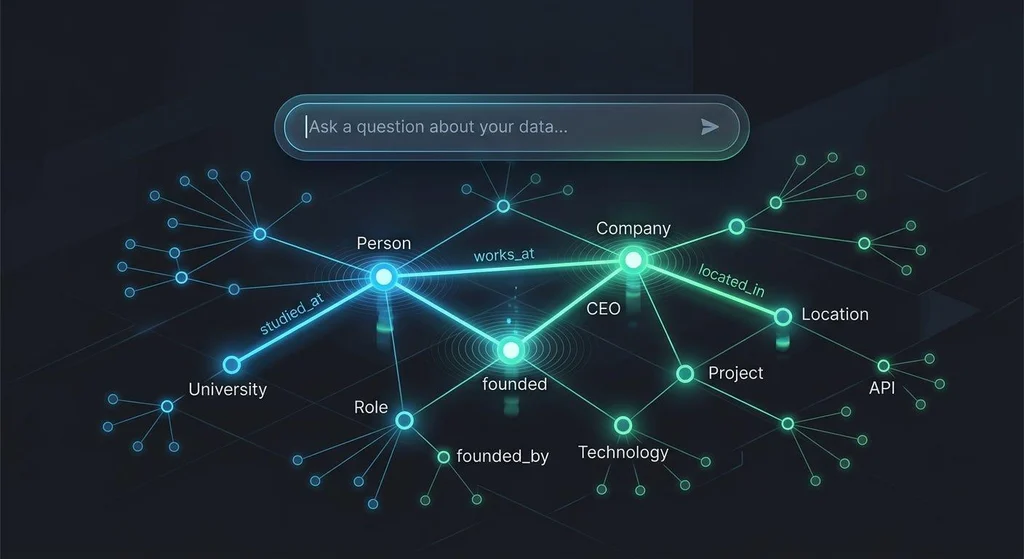
Knowledge Graphs Need an AI Layer. So I Built One
mlnotes.substack.com
1. Data Integration and Context Collection
The process begins by connecting relevant organizational information.
Depending on the deployment, this can include:
- Structured databases.
- Business documents and reports.
- Enterprise applications.
- Operational records.
- Publicly available information.
- Industry-specific datasets.
- Human expertise and organizational knowledge.
The objective is to make fragmented information available within a connected context.
2. Knowledge Graph Development
A knowledge graph represents information through entities and relationships.
For example, a company may have several suppliers, subsidiaries, investors, and business partners. A conventional database can store these records, but identifying relationships across multiple systems can require additional analysis.
A knowledge graph helps connect those relationships.
Accrete uses this approach to organize information and provide AI agents with a broader understanding of relevant entities, events, and connections.
3. Capturing Institutional Knowledge
One of Accrete’s central ideas is the preservation of tacit knowledge.
Tacit knowledge refers to experience, judgment, and practical understanding that people develop through their work. It is not always documented in formal procedures or databases.
Consider an experienced procurement manager who understands why certain suppliers repeatedly create delivery problems. Their understanding may include historical incidents, informal relationships, and operational patterns.
Accrete aims to capture and structure this type of expertise so specialized AI agents can use it in future workflows.
4. Specialized AI Agent Execution
Once relevant context is available, specialized agents can work on defined tasks.
These tasks may involve:
- Research and information analysis.
- Identifying relationships between entities.
- Monitoring operational developments.
- Preparing reports and recommendations.
- Investigating potential risks.
- Coordinating work across connected systems.
The Knowledge Engine Platform also supports building agents and saving successful workflows as reusable skills. Accrete+1
5. Human Review and Operational Governance
Accrete positions human judgment and operational control as important parts of its architecture.
This matters because an AI-generated recommendation is not automatically a reliable business decision.
Organizations must establish appropriate permissions, approval processes, review procedures, and accountability requirements.
The goal is to make AI-assisted work more useful without removing human responsibility from consequential decisions.
Key Features of Accrete AI
Accrete’s capabilities are best understood through its underlying technology and product architecture.
Enterprise Knowledge Engine
The Knowledge Engine is the foundation of Accrete’s current product portfolio.
It connects information across organizational systems and provides contextual information for specialized AI agents.
Its intended applications include:
- Organizational knowledge management.
- Enterprise research and analysis.
- Cross-system workflow execution.
- Decision support.
- Reusable expert workflows.
- Institutional knowledge preservation.
Unlike a basic chatbot, the platform is designed around organizational context and defined work outcomes.
Knowledge Graph Technology
Knowledge graphs help systems understand how information relates.
Instead of treating every document or database record as an isolated item, the technology connects entities and relationships.
This can improve investigations involving complicated networks, such as supplier ownership, financial relationships, and information influence.
However, graph quality depends on the accuracy, completeness, and freshness of the underlying information.
Specialized AI Agents
Accrete supports agents designed for particular business or government tasks.
These agents can use organizational context and specialized functions to complete workflows.
The approach differs from relying entirely on a general-purpose conversational model.
A specialized agent can follow a defined process, access relevant information, and prepare a structured deliverable.
Contextual Reasoning
Contextual reasoning helps an AI system interpret information within a broader operational situation.
For example, a change in a supplier’s ownership might appear insignificant when viewed independently. However, it may become important when connected to geographic exposure, previous ownership relationships, and procurement dependencies.
Accrete’s architecture aims to identify these connections.
Reusable Skills and Workflows
The Knowledge Engine Platform allows organizations to create specialized agents and save successful methods as reusable skills.
This can help teams standardize recurring work.
For example, an organization could establish a repeatable process for preparing research reports or reviewing operational risks.
The platform describes these capabilities as part of its build, work, and reuse workflow. Accrete+1
Accrete AI Products Explained
Accrete has several products built around its Knowledge Engine technology. Understanding their differences is important when evaluating the company.
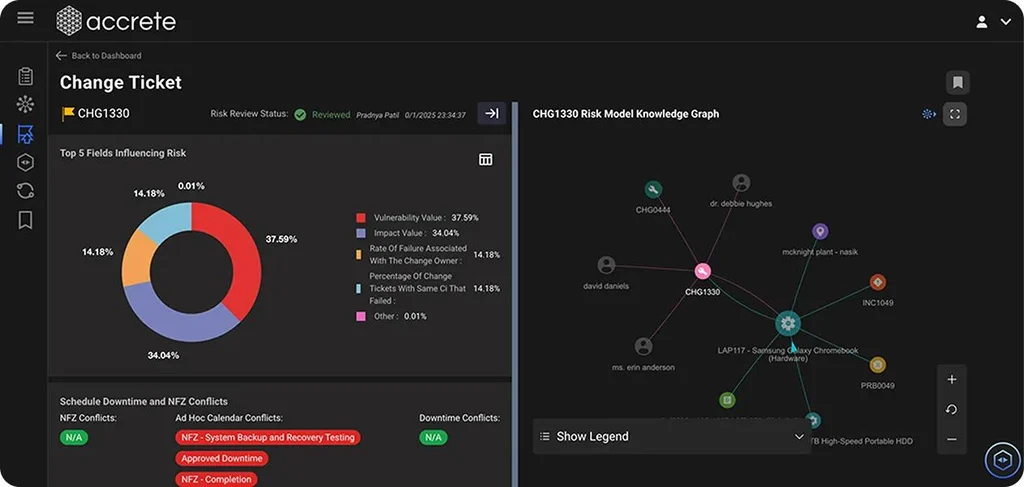
AI Knowledge Engine Platform | Accrete
The Hidden Web of Chinese Control Inside America’s Most Trusted Brands
Nebula for ITSI | Accrete
1. Knowledge Engine Platform
The Knowledge Engine Platform is Accrete’s central cognitive infrastructure.
It connects organizational information, coordinates specialized agents, and supports the production of business deliverables.
According to the company’s product documentation, users can create agents, execute research and analysis, and reuse successful methods.
Its potential applications include:
- Enterprise research.
- Business intelligence.
- Document analysis.
- Operational reporting.
- Cross-system workflows.
- Organizational knowledge management.
The platform is particularly relevant to organizations that need AI to understand internal processes rather than simply answer general questions.
2. Argus
Argus is Accrete’s government and national security-focused product family.
It applies Knowledge Engine technology to intelligence analysis, supply chain monitoring, and information operations.
The current product portfolio highlights two important areas.
Argus for Supply Chain Influence
This product focuses on identifying foreign ownership, control, and influence across suppliers, investments, entities, and connected networks.
Its purpose is to help organizations understand supply chain exposure and investigate relationships that may create national security risks.
Argus for Cognitive Advantage
This product focuses on narrative intelligence and information environments.
It helps analysts examine how narratives develop, spread, and influence perceptions across different information sources.
The product’s intended applications include monitoring public information, investigating influence activity, and preparing intelligence assessments.
Accrete’s August 2026 announcement also reported a U.S. Marine Corps sole-source contract for Argus for Cognitive Advantage. Accrete+2
3. Nebula
Nebula is Accrete’s purpose-built enterprise intelligence product family.
Its current product portfolio emphasizes two areas:
Nebula IT Service Intelligence
This solution focuses on understanding IT environments, identifying potential change risks, connecting incidents to possible causes, and examining system dependencies.
It is relevant to IT operations teams that need better visibility across complicated technology environments.
Nebula Social
This product focuses on social and market intelligence.
Its stated capabilities include identifying relevant narratives, creators, cultural signals, and audience relationships.
Businesses can use these insights to understand brand conversations and market developments.
These products demonstrate how Accrete applies its underlying knowledge technology to different operational problems. Accrete
Main Use Cases of Accrete AI
Accrete is not designed exclusively for one industry. Its products target organizations where fragmented information and complex relationships influence important decisions.
1. Supply Chain Risk Intelligence
Global supply chains involve manufacturers, suppliers, distributors, investors, and multiple ownership structures.
Monitoring these relationships manually can be difficult.
Accrete’s Argus platform is designed to help organizations identify potential foreign ownership, control, and influence across supply chain networks.
Potential applications include:
- Supplier relationship analysis.
- Foreign ownership investigations.
- Supply chain exposure monitoring.
- Entity relationship discovery.
- Risk intelligence reporting.
This is particularly relevant to government agencies and defense-related organizations.
2. National Security and Intelligence Analysis
Intelligence organizations process information from numerous sources.
These sources can include public information, documents, communications, and other mission-specific datasets.
Accrete’s Argus platform aims to connect these sources and support analysts with contextual intelligence.
Possible applications include identifying emerging narratives, examining relationships, and producing decision-support reports.
The company reports operational deployments within U.S. government environments. Its published announcements include work involving the U.S. Army, Air Force, and Marine Corps. Accrete+2
3. Enterprise Knowledge Management
Organizations frequently lose valuable knowledge when experienced employees leave.
Important decisions may also become difficult to understand when their original context disappears.
Accrete’s Knowledge Engine aims to preserve organizational knowledge and make it reusable through specialized agents.
This could help with:
- Internal research.
- Employee knowledge transfer.
- Business process documentation.
- Institutional memory.
- Decision history.
- Cross-department collaboration.
4. IT Operations and Incident Analysis
Modern IT environments contain interconnected applications, infrastructure, services, and dependencies.
An incident affecting one system can create problems elsewhere.
Nebula IT Service Intelligence is designed to connect operational information and help teams investigate incidents and potential change risks.
This makes it relevant to IT operations and infrastructure management teams.
5. Social and Narrative Intelligence
Brands, businesses, and government organizations need to understand how conversations develop across digital platforms.
Nebula Social and Argus for Cognitive Advantage address related but distinct requirements.
Nebula Social focuses on brands, audiences, creators, and cultural signals. Argus focuses on information environments and national security-related narrative analysis.
The distinction matters because commercial social intelligence and government information operations are not identical applications.
6. Enterprise Research and Reporting
Research teams often work across documents, databases, presentations, and internal systems.
The Knowledge Engine Platform aims to bring these resources into a shared environment.
Its agents can support research, analysis, and the creation of structured deliverables, including reports, dashboards, and presentations. Accrete+1
Benefits of Using Accrete AI
Accrete’s value proposition centers on contextual intelligence rather than simply generating text.
Its potential benefits include the following.
| Benefit | Practical value |
|---|---|
| Connected organizational data | Reduces information fragmentation |
| Knowledge preservation | Makes institutional expertise reusable |
| Specialized AI agents | Supports defined operational workflows |
| Relationship analysis | Helps identify connections across datasets |
| Workflow reuse | Standardizes recurring processes |
| Decision support | Provides additional context for human decisions |
| Enterprise integration | Connects information across organizational systems |
Better Organizational Context
A general-purpose AI assistant may not understand an organization’s internal history or operating procedures.
Accrete aims to address this limitation by connecting organizational knowledge with AI workflows.
More Consistent Processes
Reusable skills can help teams follow established procedures.
This may reduce variation in repetitive research, analysis, and reporting tasks.
Improved Information Discovery
Knowledge graphs can make relationships easier to investigate.
This is particularly valuable when relevant information exists across multiple disconnected sources.
Support for Complex Decisions
Accrete targets environments where decisions depend on several interconnected factors.
Its technology aims to provide a more complete picture before people make consequential decisions.
These are intended product benefits, not guarantees of improved business outcomes.
Accrete AI Pricing: Is It Free or Paid?
One of the important questions for prospective users is how much Accrete costs.
Accrete does not publish a generally applicable pricing schedule on the product pages reviewed for this article. Its enterprise and government offerings appear to follow a consultation and deployment-oriented purchasing model.
The company directs interested organizations toward product discussions, demonstrations, and government briefings rather than a public self-service pricing table. Accrete+2
What Determines Accrete AI Pricing?
For an enterprise AI platform, the final cost may depend on several factors:
- Deployment requirements: The infrastructure and hosting environment required by the organization.
- Data volume: The quantity and complexity of information the platform must process.
- Number of users: The size of the organization and the number of people accessing the platform.
- Agent configuration: The number and complexity of specialized agents.
- Integration requirements: Connections with existing databases and enterprise applications.
- Security requirements: Governance, access controls, and deployment restrictions.
- Support and maintenance: Training, implementation, and ongoing technical assistance.
These are general enterprise software cost considerations, not a confirmed Accrete pricing formula.
Does Accrete Offer a Free Plan?
Accrete’s website advertises Accrete Path Beta, which invites users to begin recording institutional knowledge.
However, this does not establish that the full Knowledge Engine Platform, Argus, or Nebula products have free plans.
Users should confirm beta eligibility, access restrictions, and any usage limits directly with the company.
Is Accrete AI Worth the Investment?
The answer depends on the problem an organization wants to solve.
A company with complex information systems and recurring knowledge-intensive workflows may benefit from contextual AI infrastructure.
However, a small business seeking an inexpensive writing assistant or basic chatbot may not need this level of enterprise technology.
Before purchasing, organizations should request a detailed proposal covering licensing, implementation, integrations, infrastructure, support, and renewal costs.
Accrete AI Privacy, Security, and Governance
Privacy and security deserve particular attention because Accrete targets enterprise and government environments.
Its products may process sensitive organizational information, proprietary business records, and mission-specific intelligence.
Accrete emphasizes access control, operational governance, human review, and deployments supporting classified government environments. The company also announced an Argus deployment into the Joint Worldwide Intelligence Communications System (JWICS) in February 2026. Accrete+1
However, deployment in a classified environment should not be interpreted as proof that every Accrete product has identical security authorization.
Important Security Questions
Organizations evaluating the platform should investigate:
| Security area | What to verify |
|---|---|
| Data retention | How long are prompts, documents, and outputs retained? |
| Model providers | Which underlying models process organizational information? |
| Data usage | Can customer information be used for model training? |
| Access control | Can permissions be configured by user, team, and data source? |
| Encryption | What encryption standards apply to stored and transmitted information? |
| Deployment | Are private-cloud, on-premises, or other controlled deployments available for the proposed product? |
| Compliance | Which specific certifications and authorizations apply to the contracted environment? |
| Auditability | Can users review agent actions, sources, and decision histories? |
Does Accrete AI Have Zero Data Retention?
A publicly verified, product-wide Zero Data Retention (ZDR) commitment was not established from the sources reviewed.
Organizations handling sensitive information should request written confirmation of retention policies, model-provider arrangements, and deletion procedures.
Similarly, claims about SOC 2 should be checked against the company’s current compliance documentation. SOC 2 reporting and Zero Data Retention are different matters.
Editorial recommendation: Review the official Accrete Trust Center and contractual security documentation before uploading confidential information.
Accrete AI: Technical Considerations and Limitations
Accrete’s approach addresses real enterprise AI challenges. However, its architecture also introduces considerations that prospective customers should understand.
1. Knowledge Graph Quality Depends on Data Quality
A knowledge graph is only useful when its underlying information is sufficiently accurate and current.
Incorrect entity matching, outdated records, and missing relationships can create misleading connections.
Organizations should evaluate how the platform handles conflicting information, source verification, and corrections.
2. Tacit Knowledge Is Difficult to Capture
Preserving institutional expertise is an ambitious objective.
Employees often communicate important knowledge through experience, informal conversations, and situational judgment.
Capturing this information requires appropriate processes and human participation.
An AI platform cannot automatically guarantee that every important piece of organizational knowledge has been identified.
3. AI Agents Still Require Oversight
Specialized agents can help automate research and operational workflows.
However, they can also misunderstand instructions, misinterpret information, or produce unsupported conclusions.
Organizations should establish approval requirements for sensitive operations.
4. Integration Can Be Complex
Large organizations often operate dozens or hundreds of applications.
Connecting these systems requires compatible interfaces, data permissions, identity management, and ongoing maintenance.
The implementation effort may be significant, particularly in legacy environments.
5. Pricing and Performance Require Direct Evaluation
Public pricing and independently verified comparative performance data are limited.
Accrete publishes performance figures on its website, but these should be treated as company-reported results rather than independent benchmarks.
For example, its August 2026 research references:
- 58% lower token cost when using Knowledge Engine.
- Twice as many tasks completed compared with frontier models.
- 32% greater accuracy with open-source models compared with a frontier model.
- 19 of 34 tacit-knowledge facts captured, compared with one using RAG.
These are specific results attributed to Accrete’s own research. They should not be generalized to every workload or deployment. Prospective customers should request the underlying methodology, test datasets, baseline configurations, and reproducibility details. The judgment layer for expert AI
Accrete AI vs. Competitors: Which Platforms Are Comparable?
Accrete operates in a market that includes enterprise intelligence, AI-powered data analysis, knowledge management, and specialized agent platforms.
There is no single competitor that perfectly matches its complete product portfolio.
However, several companies offer overlapping capabilities.
Object Explorer • Analyze and compare • Explore with charts • Palantir
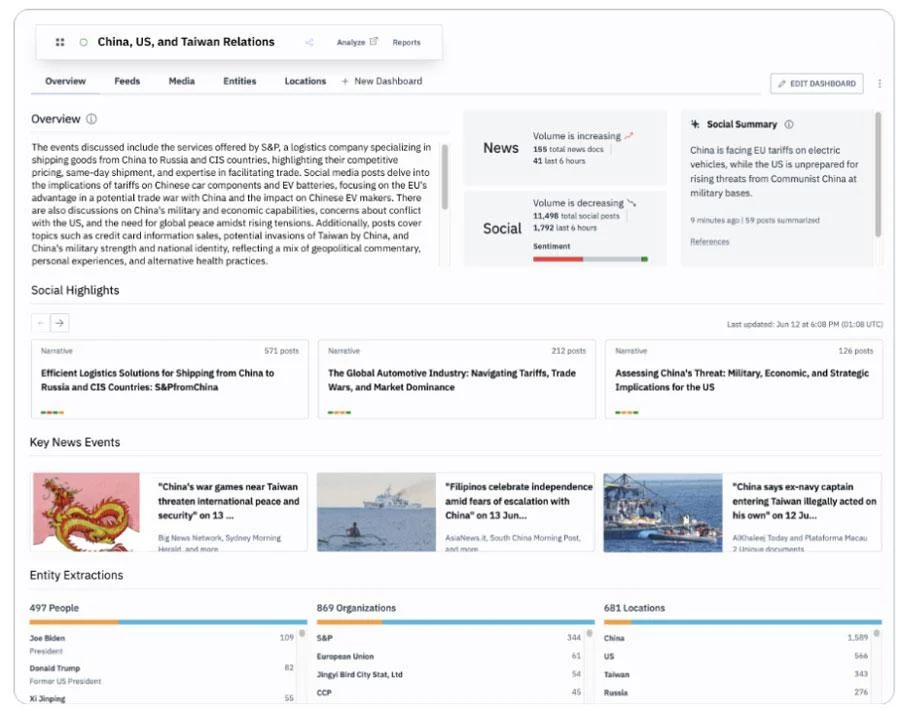
Primer.ai Government Solutions | Carahsoft
Primer Enterprise
Competitor Comparison
| Platform / Tool | Target user | Key strength | Pricing transparency | Main limitation |
|---|---|---|---|---|
| Accrete AI | Enterprises and government agencies | Knowledge graphs, institutional context, specialized agents | Contact sales | Public pricing and independent benchmarking are limited |
| Palantir | Large enterprises and government | Data integration, operational analytics, decision workflows | Primarily enterprise sales | Implementation can require substantial organizational resources |
| Primer AI | Intelligence and government teams | Intelligence analysis and information processing | Contact sales | More specialized intelligence focus |
| Vannevar Labs | Defense and national security | Mission-focused intelligence software | Contact sales | Primarily defense-oriented |
| Pryon | Enterprise knowledge teams | Enterprise knowledge access and AI search | Contact sales | Different emphasis from Accrete’s broader agent and intelligence portfolio |
This comparison describes broad market positioning, not a verified feature-by-feature product benchmark. cbinsights.com+1
Accrete AI vs. Palantir
Palantir is a major enterprise software provider with products for integrating data, analyzing information, and supporting operational decisions.
Both companies address complex organizational data problems.
However, Accrete emphasizes institutional knowledge, knowledge graphs, and specialized expert agents as central parts of its offering.
Palantir has a broader and more established enterprise data platform portfolio.
Organizations should compare actual workflows, implementation requirements, data governance, and total cost rather than relying on general marketing descriptions.
Accrete AI vs. Primer AI
Primer focuses on AI-powered analysis for intelligence and national security applications.
There is considerable overlap with Accrete’s Argus product family, particularly in intelligence workflows.
The distinction depends on the specific use case, available data sources, analytical requirements, and deployment environment.
Accrete AI vs. Vannevar Labs
Vannevar Labs develops technology for defense and national security organizations.
Its market overlaps with Accrete’s government-facing operations.
However, the products should not be treated as interchangeable. Buyers should compare their mission requirements, integration options, and operational capabilities.
Which Alternative Should You Choose?
- Choose Accrete for evaluation when organizational context, institutional knowledge, and specialized agents are central requirements.
- Evaluate Palantir when broad enterprise data integration and operational analytics are priorities.
- Consider Primer for intelligence analysis workflows.
- Evaluate Vannevar Labs for specialized defense technology requirements.
- Consider Pryon when enterprise knowledge access and AI search are the primary requirements.
The best choice depends on the actual workflow, not simply the number of advertised AI features.
Latest Accrete AI Developments in 2026
Accrete’s recent announcements show continued activity in government deployments, enterprise products, and data partnerships.
The following developments are particularly relevant.
U.S. Marine Corps Contract: August 21, 2026
Accrete announced that the U.S. Marine Corps awarded it a sole-source contract for Argus for Cognitive Advantage.
The platform is intended to track and analyze narrative development across open-source intelligence, social media, broadcast, messaging platforms, and foreign-language outlets. Accrete
TenderAlpha Data Agreement: November 6, 2026
Accrete announced an agreement with TenderAlpha to incorporate government contracting and supply chain data into Argus for Supply Chain Influence.
The announcement describes plans to provide deeper visibility into sub-tier suppliers and component-part sources beginning in early 2027. This is a planned capability, not evidence that the expanded integration was already operational on November 21, 2026. Accrete
Ocient Strategic Partnership: March 12, 2026
Accrete and Ocient announced a partnership targeting national security organizations.
The joint solution is designed to let Accrete’s agents operate against datasets stored within Ocient’s data platform.
The stated objective is to reduce unnecessary data movement while supporting analysis across large datasets. Ocient
U.S. Air Force Selection: April 14, 2026
Accrete announced that the U.S. Air Force selected Argus to help address foreign ownership, control, and influence risks in foreign investment and real estate acquisitions connected to national security. Accrete
Taken together, these developments indicate that Accrete is expanding its focus beyond general enterprise AI into specialized operational intelligence and government applications.
Who Should Use Accrete AI?
Accrete is best suited to organizations with complex information environments and knowledge-intensive operations.
| Audience | Potential application | Suitability |
|---|---|---|
| Government agencies | Intelligence and decision support | High |
| Defense organizations | Supply chain and influence analysis | High |
| Large enterprises | Organizational knowledge management | High |
| IT operations teams | Incident and dependency analysis | High |
| Research teams | Connected information analysis | Potentially high |
| Marketing organizations | Social and narrative intelligence | Depends on requirements |
| Individual users | Everyday AI assistance | Limited relevance |
| Small businesses | Basic content generation | May be excessive |
When Accrete AI Makes Sense
Consider evaluating Accrete when your organization:
- Manages large quantities of disconnected information.
- Needs to preserve institutional expertise.
- Performs complex investigations or research.
- Requires specialized AI agents.
- Needs relationships across multiple data sources.
- Operates under strict governance requirements.
When It May Not Be the Right Choice
Accrete may not be suitable when you simply need:
- An inexpensive AI writing assistant.
- Basic conversational AI.
- Simple image generation.
- A general-purpose chatbot.
- A lightweight personal productivity tool.
Its enterprise-oriented architecture may introduce unnecessary complexity for these requirements.
Common Mistakes to Avoid When Evaluating Accrete AI
Organizations should avoid several assumptions when researching the platform.
1. Confusing Accrete with a general-purpose chatbot
Accrete focuses on organizational intelligence and specialized agents, not simply conversational responses.
2. Assuming every product has identical capabilities
The Knowledge Engine Platform, Argus, and Nebula serve different requirements.
3. Treating company performance figures as independent benchmarks
Vendor-reported research needs methodological review before it can support purchasing decisions.
4. Assuming government deployment means universal security certification
Security authorizations must be checked against the specific product, environment, and deployment.
5. Ignoring implementation costs
Integration, data preparation, training, and ongoing maintenance can influence the total cost of ownership.
6. Automating high-impact decisions without human review
AI-generated findings should be validated before they influence sensitive business or government decisions.
FAQs
1. What is Accrete AI used for?
Accrete AI is used to connect organizational information, preserve institutional knowledge, and support specialized AI agents. Its applications include enterprise research, supply chain intelligence, government analysis, IT operations, and decision support.
2. Is Accrete AI free to use?
Accrete does not publish a general pricing schedule for its main enterprise and government products. The company offers product demonstrations and discussions, while Accrete Path Beta provides a separate entry point for exploring institutional knowledge capture.
3. What are the main products of Accrete AI?
Accrete’s main product portfolio includes the Knowledge Engine Platform, Argus, and Nebula. The Knowledge Engine provides the shared foundation, Argus focuses on government and national security intelligence, and Nebula addresses specialized enterprise intelligence applications.
4. How is Accrete AI different from ChatGPT?
ChatGPT is a general-purpose conversational AI product, while Accrete focuses on connecting organizational knowledge and supporting specialized enterprise workflows. Accrete’s approach emphasizes knowledge graphs, institutional context, and task-specific agents rather than only conversational question answering.
5. Is Accrete AI suitable for businesses?
Yes, Accrete targets enterprise organizations that need contextual information, knowledge management, and specialized workflow automation. However, businesses should evaluate integration requirements, pricing, data governance, and the complexity of their actual use cases before purchasing.
Conclusion:
Accrete AI represents an interesting approach to enterprise artificial intelligence.
Instead of focusing exclusively on generating content or answering questions, its Knowledge Engine aims to connect organizational information, preserve institutional expertise, and support specialized AI agents.
Its three main product areas serve different requirements. The Knowledge Engine Platform provides enterprise infrastructure, Argus targets government intelligence, and Nebula addresses specialized business applications.
The company’s government deployments and 2026 announcements demonstrate real commercial activity. However, its pricing, product-specific security commitments, and independent performance comparisons deserve closer examination.
For large enterprises, government agencies, defense organizations, and teams managing complicated information environments, Accrete is worth evaluating.
For individual users and small businesses seeking basic AI assistance, a simpler platform may be more practical.
Ultimately, organizations should judge Accrete by its ability to solve specific operational problems, integrate with existing systems, preserve data quality, and deliver measurable results under appropriate human oversight.