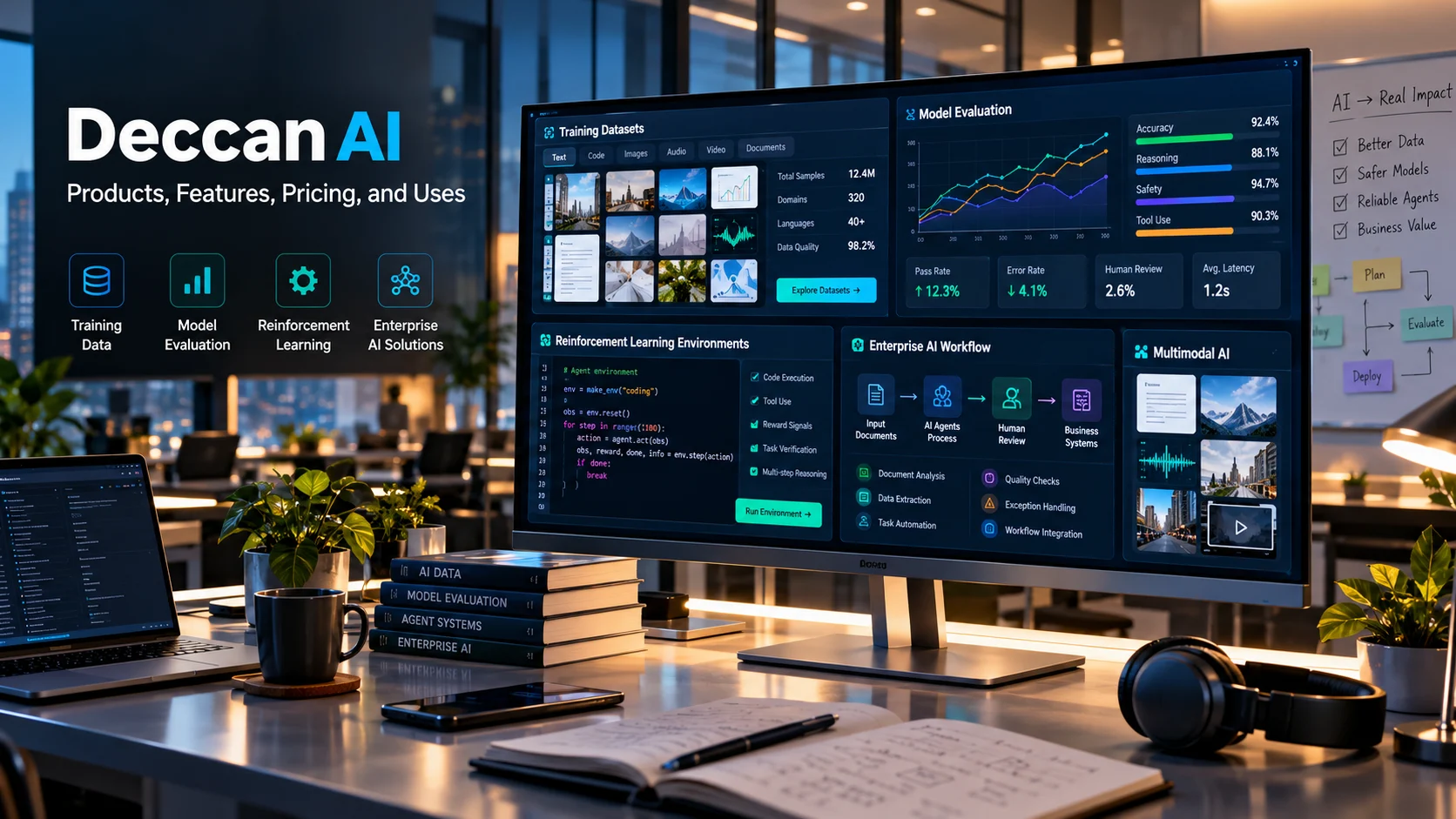
Deccan AI is an artificial intelligence company that helps organizations develop, train, evaluate, and deploy AI systems using specialized datasets, expert human feedback, reinforcement learning environments, and AI-powered enterprise solutions. Its offerings include training data, model evaluation through Helix, reinforcement learning environments through STARK RL, and enterprise automation through EnterpriseOS.
According to its official website, Deccan AI focuses on improving AI performance through high-quality data, expert evaluation, and practical deployment. Its services target AI research laboratories, developers, and businesses building advanced AI applications.
Official website: https://www.deccan.ai/
Unlike a general-purpose chatbot, Deccan AI primarily supports the development and operation of AI systems. Its products address problems such as unreliable model responses, weak reasoning, inconsistent evaluation, and the difficulty of deploying AI agents in real business workflows.
At a Glance: Deccan AI
- Company: Deccan AI, Inc.
- Main focus: AI training data, model evaluation, reinforcement learning, and enterprise AI operations.
- Target users: AI laboratories, enterprise technology teams, developers, and researchers.
- Key offerings: Specialized datasets, STARK RL, Helix Evals, and EnterpriseOS.
- Pricing: Public pricing is not clearly listed for the main enterprise offerings; contact the company for a quote.
- Official website: https://www.deccan.ai/
How Does Deccan AI Work?
Deccan AI supports several stages of the AI development lifecycle. The exact workflow depends on whether a customer needs training data, model testing, reinforcement learning environments, or deployed business automation.
1. AI training data and human feedback
AI models learn patterns from training examples. If those examples contain errors, inconsistent labels, or insufficient context, the resulting model may struggle with real-world tasks.
Deccan AI provides datasets and human-curated data services for tasks such as supervised fine-tuning, model alignment, reasoning, coding, and multimodal AI.
These resources can help teams teach models how to follow instructions, solve specialized problems, and respond more consistently.
2. Reinforcement learning environments
Reinforcement learning trains a model or agent through interactions, feedback, and reward signals. In practical applications, an agent may need to execute multiple actions before reaching a correct result.
Deccan AI’s STARK RL offering focuses on interactive environments for training and evaluating agents, including coding and tool-based workflows.
Such environments can help developers test whether an AI system completes a task correctly rather than merely generating a convincing answer.
3. Model evaluation and monitoring
A model that performs well on a static test may still fail when users provide ambiguous instructions or when an application changes.
Deccan AI offers Helix Evals, an evaluation platform designed to assess AI systems using defined criteria, test scenarios, and human review where appropriate.
Evaluation can help teams identify failure patterns, compare model behavior, and monitor performance as systems change.
4. Enterprise AI deployment
Training and evaluation are only part of the process. Businesses also need to connect AI systems to existing workflows, data sources, and operational controls.
Deccan AI’s EnterpriseOS focuses on AI-native business operations, with agents handling defined tasks and human reviewers supporting exceptions and quality control.
This approach is intended for organizations seeking to integrate AI into recurring operational processes rather than simply experiment with standalone chatbots.
Main Deccan AI Products and Services
Deccan AI’s offerings cover several connected areas of AI development. Each product serves a different purpose.
Deccan AI datasets
The company’s dataset catalog includes resources for language models, coding, multimodal understanding, model alignment, safety, and physical AI.
Examples of relevant applications include:
- Supervised fine-tuning for instruction-following models.
- Coding and debugging model development.
- Multilingual text and speech applications.
- Question answering over documents, images, and other media.
- Model alignment and safety evaluation.
- Training and testing AI systems that interact with tools.
Deccan AI also offers custom datasets for organizations with domain-specific requirements.
Before purchasing a dataset, teams should examine its documentation, sample quality, intended use, licensing, and compatibility with their model architecture.
Official resource: https://www.deccan.ai/datasets
STARK RL is Deccan AI’s reinforcement learning environment offering.
The platform is designed around interactive tasks where AI agents must perform actions, use tools, and reach verifiable outcomes. Its official materials describe containerized coding environments and verification methods that examine more than the final response.
This distinction matters because an AI agent can produce a correct-looking explanation without actually completing the required operation.
For example, a software engineering agent might need to modify code, run tests, and satisfy specific repository requirements. An environment that checks the resulting state can provide more meaningful feedback than one that scores the written response alone.
Who may benefit? AI laboratories, reinforcement learning researchers, and teams developing software engineering agents.
Helix Evals
Helix is Deccan AI’s evaluation offering for AI models and agents.
Its published capabilities include dynamic evaluations, human-led review options, expert-designed rubrics, and production monitoring. The objective is to detect failures that conventional automated tests may overlook.
Potential applications include:
- Comparing competing models on task-specific benchmarks.
- Testing multi-step agent workflows.
- Evaluating instruction-following and reasoning.
- Monitoring performance changes after model updates.
- Identifying recurring errors in deployed systems.
Businesses should ask how evaluation criteria are constructed, whether test data is independent of training data, and how human reviewers resolve disagreements.
A vendor’s evaluation results are useful evidence, but they should not replace independent testing on representative business tasks.
EnterpriseOS
EnterpriseOS is Deccan AI’s offering for AI-native business operations.
It is intended to combine AI agents, workflow redesign, domain expertise, and human oversight to support recurring operational processes.
Potential applications include document-heavy operations, back-office workflows, research tasks, and processes involving structured information.
For instance, an organization might use an AI-assisted workflow to extract information from documents, check it against business rules, prepare a recommendation, and send exceptions to a human reviewer.
The business value depends on actual performance, integration effort, error rates, and the cost of handling exceptions. Organizations should measure these factors during a pilot instead of assuming that automation will automatically reduce costs.
Official product information: https://www.deccan.ai/enterprise-os
Key Features of Deccan AI
Deccan AI’s capabilities are distributed across its data, evaluation, reinforcement learning, and enterprise offerings.
| Feature | What it does | Why it matters |
|---|---|---|
| Human-curated training data | Provides examples and feedback for model development | Can improve training quality and task relevance |
| Multimodal datasets | Supports work involving text, images, audio, video, and documents | Helps teams develop systems beyond text-only interactions |
| Reinforcement learning environments | Lets agents interact with structured tasks | Supports testing of action sequences and task completion |
| AI model evaluation | Uses test scenarios and defined criteria to assess behavior | Helps identify weaknesses before and after deployment |
| Custom data solutions | Addresses specialized training requirements | Supports domain-specific use cases |
| Enterprise AI agents | Applies AI to operational workflows | Can help automate recurring business processes |
The availability of each feature depends on the product and engagement. Buyers should confirm exact deliverables with Deccan AI before making purchasing decisions.
Benefits of Using Deccan AI
Better alignment between training data and business needs
Generic datasets may not adequately represent a company’s terminology, edge cases, or operational requirements.
Specialized training examples can help teams develop models for specific tasks, although results still depend on model architecture, training methods, and evaluation quality.
More meaningful AI evaluation
Testing AI systems requires more than checking whether an answer sounds plausible.
Task-specific rubrics, independent test cases, and outcome verification can reveal failures that general-purpose benchmarks miss.
This is especially important for agents that modify files, query databases, or execute multistep workflows.
Support for multimodal AI development
Organizations increasingly build systems that interpret documents, images, audio, and video alongside text.
Access to appropriately labeled examples can support these applications, provided the data matches the intended task and usage rights are clear.
A path from experimentation to deployment
Some organizations can build models but struggle to integrate them into real operations.
Deccan AI’s combination of evaluation, agent environments, and enterprise deployment services may help teams address multiple stages of that process through a coordinated engagement.
However, integration quality and operational outcomes must be established through testing rather than inferred from product descriptions.
Limitations and Considerations
Deccan AI may be relevant to advanced AI development, but it is not necessarily suitable for every buyer.
Pricing may require a sales conversation
The company’s primary enterprise offerings do not display a comprehensive public price list. Prospective customers should request a written quotation covering implementation, data volume, licensing, support, and ongoing usage.
Independent validation remains necessary
Training data and evaluation services can improve development workflows, but no provider can guarantee that a model will perform reliably across every task.
Customers should establish acceptance criteria and test the delivered solution against their own requirements.
Integration can involve additional work
Enterprise AI deployments may require API connections, access controls, workflow redesign, monitoring, and integration with existing applications.
These requirements can add implementation time and cost.
Data governance needs careful review
Organizations should verify data provenance, permitted uses, retention periods, access controls, deletion procedures, and contractual responsibilities.
Security certifications can provide useful assurance, but they do not by themselves establish that every configuration meets a customer’s requirements.
Specialized services may be excessive for simple projects
A small team building a basic chatbot may not need custom training datasets, dedicated reinforcement learning environments, or enterprise workflow services.
In such cases, existing model APIs and established development frameworks may be more practical.
Deccan AI Pricing: Is It Free?
Deccan AI’s commercial model varies by product and engagement. Its main enterprise and custom data offerings should not be assumed to have a single fixed price.
The company provides a contact process for prospective customers to discuss services, requirements, and project budgets.
| Offering | Pricing information | What to confirm |
|---|---|---|
| Custom AI training data | Request a quotation | Dataset size, annotation complexity, review requirements, and licensing |
| Ready-made datasets | Request access and commercial details | Sample availability, usage rights, and delivery format |
| STARK RL | Contact the company | Environment access, task volume, and support |
| Helix Evals | Contact the company | Evaluation volume, monitoring, and human review |
| EnterpriseOS | Contact the company | Implementation, integrations, ongoing operations, and service levels |
Official contact page: https://www.deccan.ai/contact-us
Practical advice: Request a written breakdown of one-time implementation fees, recurring costs, usage limits, and any additional charges for custom work. Compare the quotation with the cost of building and maintaining the same capabilities internally.
Deccan AI vs. Other AI Data and Evaluation Providers
Deccan AI operates in a market that includes AI data services, model evaluation platforms, and tools for discovering or building AI applications.
The following organizations provide useful comparison points, although they do not all compete with Deccan AI in exactly the same way.
| Platform | Primary focus | Potential fit | Important distinction |
|---|---|---|---|
| Deccan AI | Training data, RL environments, evaluation, and enterprise AI operations | Teams needing several parts of the AI development lifecycle | Product scope and commercial terms should be confirmed directly |
| Scale AI | AI data infrastructure and related AI development services | Organizations seeking data and AI infrastructure services | Compare delivery model, expertise, and contract scope |
| Surge AI | Human feedback and data services for advanced AI systems | Teams seeking specialized human-generated data and evaluations | Confirm available capabilities and project-specific terms |
| Hugging Face | Model and dataset discovery, open-source tooling, and AI development infrastructure | Developers exploring models, datasets, and community tools | A broader ecosystem rather than a direct substitute for every managed service |
| Futurepedia | AI tool discovery and directories | Individuals and businesses researching AI applications | Useful for discovery, not a like-for-like provider of custom training and evaluation services |
These are category-level comparisons, not a ranking of quality or performance. Current capabilities and pricing should be checked with each provider before a purchasing decision.
How to choose between these platforms
Start by identifying the bottleneck in your AI project.
- Need training examples or expert feedback? Compare data quality, domain expertise, labeling methods, and licensing.
- Need to evaluate an AI agent? Examine task coverage, outcome verification, rubric design, and monitoring capabilities.
- Need open-source models or datasets? Explore Hugging Face and inspect individual model or dataset licenses.
- Need business workflow automation? Compare integration requirements, exception handling, auditability, and total operating costs.
- Need to discover AI tools? A directory such as Futurepedia may be sufficient for initial research.
The right comparison depends on the deliverable, not simply the provider’s brand or the number of services it advertises.
Is Deccan AI Legitimate?
Deccan AI has an official corporate website, published product information, a contact page, and publicly available terms of service. These are useful starting points for evaluating a company, but they are not sufficient on their own to establish the suitability of a particular service.
Enterprise buyers should request references relevant to their use case, sample deliverables, contractual service levels, and a clear description of how quality is measured.
For security-sensitive projects, review the applicable security documentation and agreements directly with the company. Verify the scope and validity of any claimed certifications rather than relying only on marketing statements.
For independent assessment, conduct a pilot using representative data and measurable acceptance criteria.
Is Deccan AI a good fit for your project?
Deccan AI may be worth evaluating if your team needs specialized AI training data, agent evaluation, reinforcement learning environments, or managed AI-enabled operations.
It may be less appropriate if you only need a free chatbot, a basic automation tool, or a public model that can be integrated with minimal customization.
Before committing, assess technical fit, pricing, privacy, licensing, delivery timelines, and the ability to demonstrate results on your own tasks.
Deccan AI for Jobs and AI Training Work
People searching for Deccan AI may also be interested in contributing to AI training and evaluation projects.
The company has published information about its talent network and expert-led work. However, participation, qualifications, project availability, compensation, and location requirements can vary.
Use the official website to look for current opportunities: https://www.deccan.ai/
Before accepting a project, read the terms carefully and verify:
- Eligibility and required qualifications.
- Whether the engagement is employment or independent contracting.
- How work is assigned and evaluated.
- Payment rates, payment schedules, and dispute procedures.
- Confidentiality, data handling, and monitoring requirements.
- Whether work is guaranteed or depends on project availability.
Do not assume that registering guarantees access to paid tasks. Never pay an unverified recruiter an upfront fee to secure a job, and use official channels to confirm suspicious offers.
Privacy, Security, and Data Governance
AI training and enterprise automation may involve sensitive business information. Organizations should evaluate data governance before sharing source code, customer records, internal documents, or proprietary datasets.
Questions to ask Deccan AI include:
- Where will project data be stored and processed?
- Who can access raw data, annotations, model outputs, and evaluation logs?
- Will customer data be used for training or improving other models?
- What retention and deletion rules apply?
- Are customer-managed storage and access controls available for the specific service?
- Which security certifications and contractual commitments apply to the proposed deployment?
- How are subcontractors and external annotators governed?
Deccan AI’s official materials describe security and data-handling practices, but customers should verify the precise terms applicable to their engagement.
A SOC 2 report, an ISO certification, and a contractual promise about data use address different aspects of assurance. None should automatically be interpreted as a guarantee of zero data retention.
FAQs
1. What is Deccan AI used for?
Deccan AI supports AI model development and deployment through training datasets, human feedback, reinforcement learning environments, model evaluation, and enterprise AI solutions. Its products target organizations building or operating specialized AI systems.
2. Is Deccan AI free to use?
Deccan AI does not publish one universal price for its primary enterprise offerings. Pricing depends on the service and project requirements, so prospective customers should contact the company for current commercial terms.
3. What products does Deccan AI offer?
Its main offerings include AI training datasets, STARK RL for reinforcement learning environments, Helix Evals for AI evaluation, and EnterpriseOS for AI-enabled business operations. Availability and scope should be confirmed with the company.
4. Is Deccan AI suitable for small businesses?
It may suit a small business with specialized AI data, evaluation, or automation requirements and an appropriate budget. Businesses with simple chatbot needs may find existing model APIs or no-code tools more practical.
5. How can I apply for Deccan AI jobs?
Start with the company’s official website and published talent or careers opportunities. Review eligibility, project requirements, payment terms, and contractor conditions before accepting an engagement. Registration does not guarantee paid work.
Conclusion
Deccan AI focuses on the infrastructure and expertise needed to develop, evaluate, and deploy advanced AI systems. Its offerings span specialized training data, reinforcement learning environments, model evaluation, and enterprise automation.
For AI laboratories and businesses, its potential value depends on the quality of its deliverables, the relevance of its expertise, and the ability to integrate its services into existing workflows.
Before choosing Deccan AI, review sample data, run a representative pilot, verify security and licensing terms, and compare the full cost with alternative providers or an internal solution.