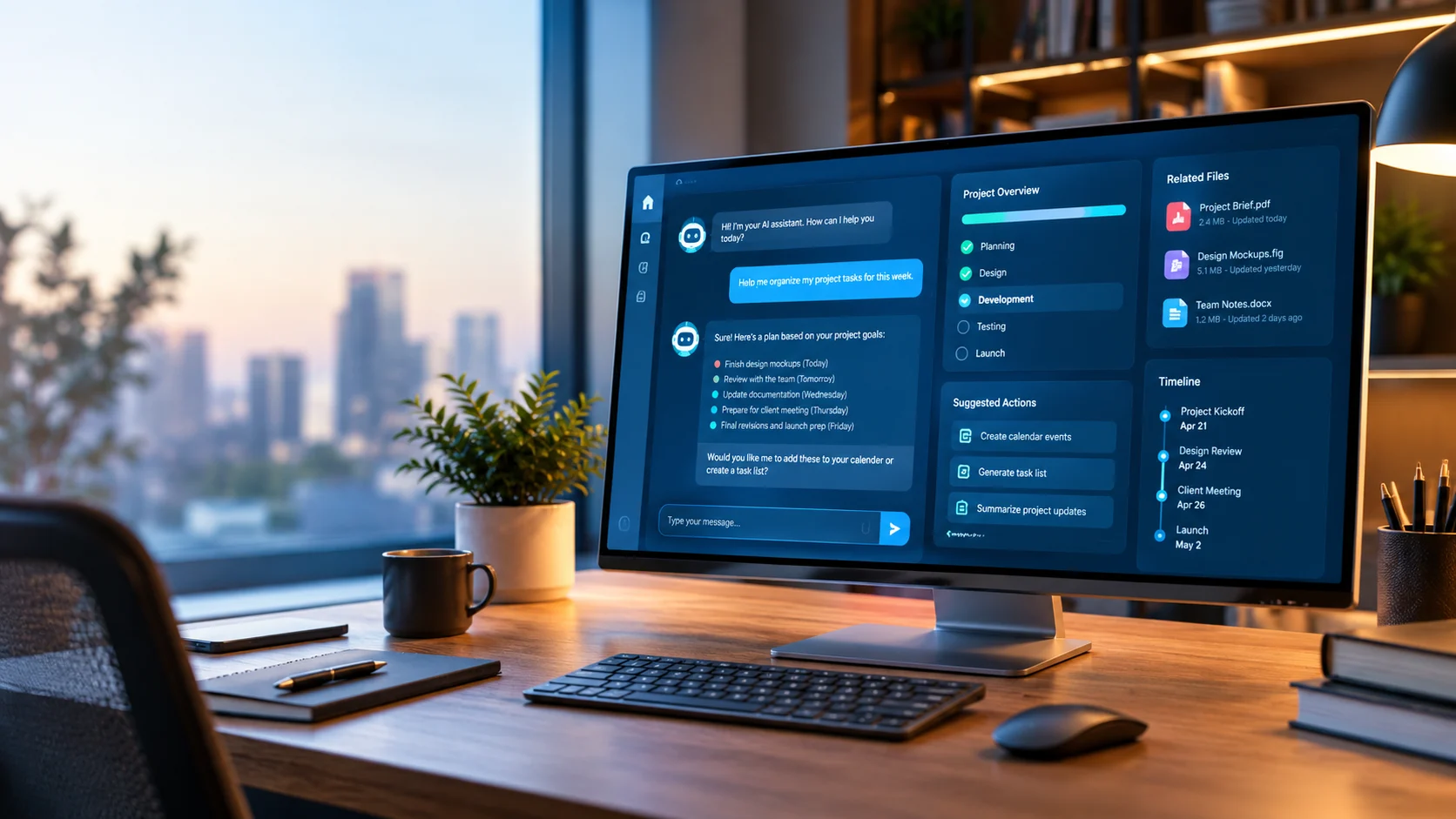
An AI bot is a software application that uses artificial intelligence to understand inputs, generate responses, answer questions, or perform specific tasks. AI bots can help people automate repetitive work, improve customer support, create content, and interact with digital services, but their accuracy and capabilities depend on their design, data, and permissions.
AI Bot at a Glance
- Definition: An AI-powered software application that assists with conversations, information processing, or automated tasks.
- How it works: It processes a user’s input, applies programmed logic or an AI model, and produces a response or action.
- Common types: AI chatbots, customer service bots, personal assistants, coding bots, and task-oriented AI agents.
- Main benefits: Faster responses, reduced repetitive work, scalable support, and improved access to information.
- Key limitations: Incorrect answers, privacy risks, inconsistent results, integration costs, and limited understanding of context.
- Best practice: Choose an AI bot based on a specific task, test its performance, and maintain appropriate human oversight.
What Is an AI Bot?
An AI bot is a software program that uses artificial intelligence to perform tasks that may involve understanding language, interpreting information, generating content, or making recommendations.
Unlike a basic automation script, an AI bot may handle different inputs and respond to variations in how people communicate. However, not every bot uses advanced AI. Some rely on fixed rules, while others use machine learning or large language models.
For example, a conventional customer service bot might display predefined menu options. An AI chatbot can interpret a question written in natural language and generate a relevant response.
More advanced systems can connect to external tools, retrieve information from databases, and complete multi-step workflows.
The term AI bot therefore covers several different technologies. Its exact capabilities depend on the underlying model, software architecture, integrations, and level of autonomy.
How Does an AI Bot Work?
Most AI bots follow a process that converts an input into a useful response or action. The technical details vary by application, but the basic workflow is straightforward.
1. The User Provides an Input
The user enters a question, instruction, message, image, or voice command.
For example, a customer might ask, “How can I track my order?” A writing assistant might receive the instruction, “Draft a professional email requesting a meeting.”
2. The Bot Interprets the Request
The software analyzes the input to identify its meaning and determine what the user wants.
Traditional bots may use keywords, decision trees, or predefined rules. Modern conversational systems can use natural language processing and machine learning to interpret more varied requests.
3. The AI Model Processes the Information
When a bot uses a generative AI model, the model predicts an appropriate response based on the input and its learned patterns.
Some systems also retrieve relevant information from company documents, databases, or external services before generating an answer.
This approach can improve relevance, but it does not guarantee factual accuracy.
4. The Bot Generates a Response or Performs a Task
Depending on its design, the bot may return text, summarize a document, recommend a product, generate code, or call an external tool.
A task-oriented bot might also create a support ticket or update a customer record if it has the required integration and permissions.
5. The System Checks or Delivers the Result
A well-designed implementation may apply validation rules, access controls, content filters, or human approval before completing an action.
For high-impact tasks, the system should not rely solely on an AI-generated answer. Verification and appropriate oversight remain important.
Main Types of AI Bots
Different AI bots serve different purposes. Understanding these categories makes it easier to choose a suitable solution.
AI Chatbots
AI chatbots communicate with users through text or voice. They answer questions, explain concepts, brainstorm ideas, and help users navigate services.
General-purpose conversational assistants are common examples. Businesses also use chatbots on websites and messaging platforms.
Customer Service Bots
Customer service bots help users find information, troubleshoot common problems, check policies, and navigate support processes.
They may retrieve answers from an approved knowledge base or transfer complex requests to a human representative.
Their usefulness depends on the quality of the underlying documentation and the reliability of the escalation process.
Personal AI Assistants
Personal AI assistants help with everyday tasks such as drafting messages, summarizing information, organizing ideas, and planning schedules.
Some assistants integrate with productivity applications. The actions available depend on the specific product and the permissions granted by the user.
AI Writing and Content Bots
Writing bots assist with blog outlines, email drafts, product descriptions, editing, summarization, and content ideation.
They can accelerate the writing process, but users should review factual claims, originality, tone, and the accuracy of cited information before publishing.
AI Coding Bots
Coding bots help developers generate code, explain programming concepts, identify potential errors, and write tests.
Their output still requires review. Generated code can contain bugs, security vulnerabilities, outdated methods, or incorrect assumptions about a project.
AI Agents and Task-Oriented Bots
Some AI systems go beyond answering questions. They can plan a sequence of steps, use connected tools, and work toward a defined goal.
For example, an authorized business agent might gather information, prepare a report, and create a draft task for an employee to approve.
An AI agent is not simply a chatbot with a different name. The important distinction is its ability to take actions and coordinate steps, although terminology varies across products and vendors.
AI Bot vs. Chatbot vs. AI Agent
These terms overlap, but they are not interchangeable in every context.
| Technology | Main purpose | Typical capability |
|---|---|---|
| Traditional bot | Automate predefined tasks | Follows rules or triggers |
| AI chatbot | Communicate using natural language | Answers questions and generates responses |
| AI assistant | Help users complete tasks | Provides guidance and may use connected tools |
| AI agent | Work toward a goal | Plans steps and performs authorized actions |
| Workflow automation | Execute repeatable processes | Runs predefined sequences, sometimes with AI components |
A traditional bot can be useful when a process has predictable inputs and outputs. An AI chatbot is more suitable when users ask questions in varied language.
AI agents may be appropriate for more complex workflows, but they also introduce additional risks because they can interact with other systems.
The right choice depends on the task, not on which technology has the most advanced label.
Common Uses of AI Bots
AI bots are used across consumer applications, education, software development, and business operations.
Education and Learning
Students can use AI bots to explain difficult concepts, practice languages, generate revision questions, and receive feedback on drafts.
Teachers can use them to develop lesson ideas and adapt explanations for different learning levels. However, users should verify educational content and follow their institution’s rules on AI assistance.
Marketing and Content Creation
Marketing teams use AI bots to brainstorm campaign ideas, draft social media posts, summarize customer feedback, and create variations of existing copy.
AI can speed up early-stage production. Human review remains necessary for brand consistency, originality, factual accuracy, and regulatory compliance.
E-Commerce and Online Shopping
Retail businesses can use AI bots to answer product questions, explain shipping policies, recommend relevant products, and assist with order inquiries.
For reliable results, bots should use current product information, inventory data, and approved policy documents. Outdated information can frustrate customers and create costly mistakes.
Customer Support
Support teams can automate answers to common questions and help customers find the correct resources.
More complex cases should move smoothly to a human agent. Businesses should also evaluate resolution rates, customer satisfaction, and escalation quality rather than measuring success only by the number of conversations automated.
Software Development
Developers can use AI bots to explain code, generate test cases, document functions, and investigate errors.
Teams should test generated code, check dependencies, and avoid sharing confidential source code with tools that lack appropriate data-handling protections.
Business Productivity
AI bots can help employees summarize meetings, organize research, prepare reports, and draft internal communications.
When connected to business systems, some can also retrieve records or initiate workflows. Access should be restricted to the information and actions each user is authorized to use.
Benefits of Using AI Bots
The benefits depend on the task, implementation, and quality of the system.
- Faster responses: Bots can answer routine questions without requiring a person to respond to every request.
- Automation: Repetitive activities can be handled with less manual effort.
- Scalability: Automated systems can handle multiple interactions, subject to infrastructure, rate limits, and usage restrictions.
- Natural-language access: Users can request information in everyday language instead of learning complex interfaces.
- Productivity support: Bots can assist with drafting, summarization, research, and routine analysis.
- Consistent workflows: Properly configured bots can follow standard procedures and approved response patterns.
These advantages are not automatic. Poorly designed bots may create additional work through incorrect responses, confusing conversations, or unnecessary escalations.
Organizations should measure actual outcomes before assuming that automation reduces costs or improves service.
Limitations and Risks of AI Bots
AI bots can be useful, but users should understand their limitations before relying on them.
Incorrect or Fabricated Answers
Generative AI can produce convincing responses that contain false information. This is often called a hallucination.
Important claims should be checked against reliable sources, particularly in legal, medical, financial, and technical contexts.
Privacy and Data Security
A bot may process personal information, confidential documents, or business records. How that information is stored, retained, reviewed, or used depends on the provider and configuration.
Before using a service, review its privacy policy, data retention terms, access controls, and applicable contractual protections. Do not assume that a product offers zero data retention unless its documented terms confirm it.
Bias and Inconsistent Responses
AI systems can reflect biases present in training data or produce different answers to similar prompts.
Testing should include diverse inputs, realistic edge cases, and situations in which the bot should acknowledge uncertainty or decline to act.
Limited Context and Integration
A bot may lose track of earlier details, struggle with long documents, or lack access to current information.
Integration problems can also arise when a bot depends on external APIs, outdated documentation, or services with usage limits.
Over-Automation
Not every task should be automated. Sensitive decisions, unusual customer complaints, and consequential actions may require human judgment.
Businesses should define clear boundaries, provide an escalation route, and retain accountability for decisions made with AI assistance.
How to Choose the Right AI Bot
The most suitable AI bot is the one that meets your requirements without introducing unnecessary complexity.
1. Define Your Main Goal
Identify the problem you want to solve. You might need help with writing, customer support, coding, research, or workflow automation.
A specific goal makes evaluation easier than choosing a tool simply because it is popular.
2. Compare Relevant Capabilities
Check whether the bot supports your required tasks, file formats, languages, integrations, and output types.
If you need information from internal documents, investigate whether the service can retrieve those documents accurately and respect access permissions.
3. Review Pricing and Usage Limits
Some products provide free access with restrictions. Paid plans may introduce higher limits, additional features, or business controls.
Check the current pricing page for message caps, credit systems, model access, API charges, and subscription conditions. Prices and features can change, so confirm them before purchasing.
4. Evaluate Privacy and Security
Review data retention, training-use policies, administrative controls, and deletion procedures.
Business users should also consider contractual terms, regulatory obligations, and whether sensitive information can be excluded from prompts.
5. Test Realistic Examples
Run a small evaluation using the kinds of tasks you actually perform.
Measure factual accuracy, completion rate, response quality, latency, cost, and the amount of human correction required. Include difficult examples, not just easy demonstrations.
6. Check Human Oversight
For bots that can take action, confirm that permissions are limited and consequential actions require suitable approval.
A bot that drafts a message presents a different risk from one that can send it automatically or modify business records.
AI Bot Examples and Platforms
The following platforms illustrate different approaches to AI assistance. They are examples rather than a ranking, and their capabilities can change.
| Platform | Typical audience | Main use | What to evaluate |
|---|---|---|---|
| ChatGPT | Individuals and teams | General-purpose assistance, writing, analysis, and other supported tasks | Plan limits, available tools, and data controls |
| Google Gemini | Individuals and organizations | Conversational assistance and supported Google ecosystem workflows | Account availability, integrations, and plan restrictions |
| Microsoft Copilot | Individuals and businesses | AI assistance across supported Microsoft products | Licensing, organizational configuration, and feature availability |
| Hugging Face | Developers and researchers | Discovering, testing, and working with AI models | Model licenses, hardware requirements, and deployment complexity |
| Custom AI bot | Businesses and developers | Specialized applications and workflows | Development costs, maintenance, integrations, and security |
Official product documentation and pricing pages should be consulted before selecting a platform. Features available in one subscription, region, or organizational account may not be available in another.
Ready-Made Bots vs. Custom AI Bots
Ready-made AI bots are often easier to start using because the provider manages much of the underlying infrastructure.
Custom bots can offer more control over workflows, integrations, and data handling. However, they may require development expertise, monitoring, infrastructure spending, and ongoing maintenance.
For many users, a ready-made service is a sensible starting point. A custom implementation becomes more attractive when a clearly defined business requirement cannot be met adequately by an existing product.
How to Use an AI Bot Effectively
Good results depend on both the tool and the way you use it.
- Give clear instructions. State the goal, audience, desired format, and important constraints.
- Provide relevant context. Include the information the bot needs, but avoid unnecessary sensitive data.
- Break down complex tasks. Ask for a plan or handle a complicated request in smaller stages.
- Request evidence when appropriate. Ask for sources and verify that they support the claims.
- Review the output. Check facts, calculations, tone, and completeness before using the result.
- Refine your instructions. If the first answer misses the goal, explain what needs to change.
- Keep humans involved. Use approval steps for consequential decisions and actions.
For example, instead of writing “Create a marketing plan,” provide the product, target audience, budget range, campaign objective, and required format.
Specific instructions make the expected result clearer, although they cannot guarantee correctness.
The Future of AI Bots
AI bots are developing beyond simple question-and-answer interactions. Some systems can now combine language models with document retrieval, external tools, and multi-step workflows.
Retrieval-augmented generation, commonly called RAG, allows a system to retrieve relevant information from a knowledge source before generating a response. This can help a bot answer questions using approved documentation rather than relying entirely on information learned during training.
Tool calling allows a model to request actions from connected software, while the surrounding application determines whether those actions are permitted.
AI agents combine several capabilities to pursue broader goals. As these systems gain access to more tools and data, permission management, monitoring, evaluation, and human approval become increasingly important.
The direction of development is clear, but the practical value of any particular system still depends on reliability, cost, data quality, and the consequences of its mistakes.
FAQs
1. What is an AI bot in simple words?
An AI bot is a computer program that uses artificial intelligence to answer questions, understand instructions, generate content, or help complete tasks. Depending on its design, it may respond to users or interact with other software.
2. Are AI bots free to use?
Some AI bots offer free plans, while others require a subscription or charge for API usage. Free access may include limits on messages, features, model availability, or usage volume, so check the provider’s current terms.
3. What is the difference between an AI bot and an AI chatbot?
An AI chatbot is a type of AI bot designed primarily for conversation. The broader term AI bot can also describe systems that process information, automate tasks, or interact with external applications.
4. Are AI bots safe to use?
AI bots can be useful, but their safety depends on the application, provider, permissions, and information shared with them. Avoid entering sensitive information without checking the service’s data policies, and verify important outputs before relying on them.
5. Can AI bots replace human workers?
AI bots can automate some repetitive tasks and assist with others, but they do not reliably replace human judgment across all situations. Their practical impact depends on the work involved, the quality of the system, and the need for human oversight.
Conclusion
AI bots are software systems that use artificial intelligence to answer questions, generate content, process information, or automate selected tasks. They can support learning, marketing, customer service, software development, and business productivity.
The key is to match the technology to a real need. Evaluate accuracy, privacy, cost, integrations, and usage limits before choosing a solution. For important decisions or actions, retain appropriate human oversight.
Used thoughtfully, an AI bot can be a practical productivity tool rather than a substitute for reliable information and sound judgment.