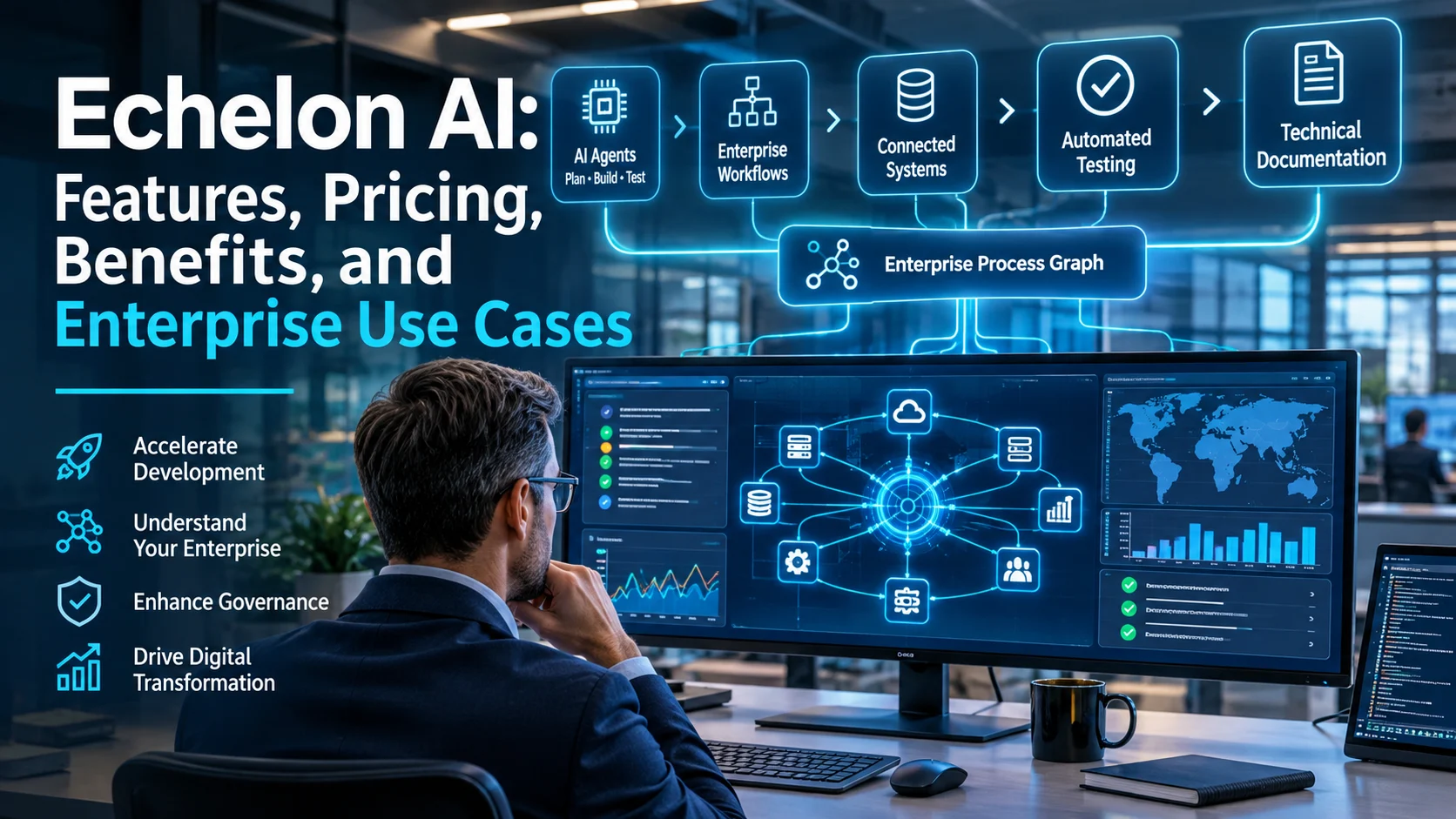
Echelon AI is an enterprise agentic AI platform that helps organizations understand, develop, test, and modernize complex business systems. It combines AI-powered delivery workflows with enterprise system knowledge to accelerate work across platforms such as ServiceNow and SAP.
Echelon AI at a Glance
- Product category: Enterprise agentic AI and systems delivery platform.
- Primary purpose: Automating and accelerating enterprise software development, operations, and modernization.
- Key capabilities: AI-assisted development, automated testing, documentation, process analysis, and system modernization.
- Supported enterprise ecosystems: ServiceNow, SAP, Workday, Oracle, Salesforce, and other business systems, according to the company’s platform materials.
- Target users: Enterprise IT departments, platform owners, developers, consultants, and digital transformation teams.
- Pricing: A free two-week proof of concept is advertised. Commercial plans are presented through Starter, Growth, and Enterprise tiers, without publicly displayed subscription prices on the pricing page.
What Is Echelon AI?
Echelon AI is an enterprise technology platform designed to help businesses manage the complexity of their existing software environments.
Rather than functioning as a standalone conversational assistant, it uses AI agents to support practical IT work. This includes understanding system configurations, translating business requirements into technical tasks, developing applications, testing changes, and maintaining enterprise platforms.
Its central proposition is straightforward: organizations should be able to deliver more technology improvements without continuously expanding their development teams or depending on lengthy consulting projects.
Echelon positions itself as an AI workforce for enterprise systems. Its platform connects technical information with business processes, allowing teams to understand how their systems work and how proposed changes could affect other operations.
The company’s website highlights ServiceNow and SAP as important areas of its platform. It also identifies enterprise applications such as Workday, Oracle, Salesforce, Coupa, SharePoint, and ADP within its supported systems ecosystem.
This makes Echelon AI particularly relevant to organizations managing interconnected enterprise applications.
Official website: https://echelonai.com/
How Does Echelon AI Work?
Echelon AI combines enterprise context, AI agents, and controlled delivery workflows to assist with complex technical work.
Traditional enterprise development often requires several separate activities:
- Business teams describe a requirement.
- Analysts investigate the existing system.
- Developers translate requirements into configurations or code.
- Testing teams validate the changes.
- Technical teams document the implementation.
- Administrators deploy approved changes.
These activities can involve considerable coordination.
Echelon aims to bring more of this process into an AI-assisted environment.
1. Understanding Existing Enterprise Systems
An important part of Echelon’s approach is understanding how an organization’s technology environment operates.
Its Enterprise Process Graph is designed to capture technical configurations, business context, system dependencies, and historical changes.
This matters because enterprise applications rarely operate independently.
For example, changing an employee approval workflow in ServiceNow might affect information stored in Workday or another connected application.
Understanding those dependencies helps teams evaluate changes before implementation.
2. Translating Business Requirements
Echelon allows users to describe business requirements using natural language.
Its AI workforce can investigate the relevant system context and help translate those requirements into technical implementation plans.
Consider a business requesting a new employee equipment approval workflow.
The platform can help identify:
- Required employee information.
- Approval responsibilities.
- Existing application configurations.
- Integration requirements.
- Workflow dependencies.
- Potential testing requirements.
This can reduce the amount of manual investigation required before development begins.
3. Building and Configuring Applications
After understanding the requirements, Echelon’s AI agents can assist with implementation.
Depending on the supported platform and task, this includes generating configurations, workflows, business rules, application components, and code.
The objective is to accelerate development while following the organization’s existing conventions and standards.
4. Testing and Documentation
Enterprise software changes require more than generated code.
They must also satisfy business requirements, security policies, and technical standards.
Echelon highlights automated testing and documentation as important parts of its delivery workflow.
For ServiceNow development, its published materials specifically mention Automated Test Framework (ATF) test generation.
This approach helps teams identify potential problems before promoting changes into production.
5. Reviewing and Governing Changes
Echelon also emphasizes controlled implementation.
Its platform materials describe reviewable changes, documented actions, and approval-oriented workflows.
This is important because AI-generated enterprise configurations should not automatically receive unrestricted production access.
Human oversight remains essential, particularly when changes affect financial processes, employee information, customer records, or business-critical applications.
Key Features of Echelon AI
Echelon AI focuses on enterprise technology delivery rather than general-purpose AI content generation.
The following capabilities represent its main published product areas.
1. AI-Powered Enterprise Development
Echelon helps developers and platform teams accelerate repetitive development work.
Its AI agents can assist with:
- Creating application components.
- Configuring business workflows.
- Generating business rules.
- Developing platform enhancements.
- Preparing implementation requirements.
- Producing technical documentation.
This capability is particularly relevant to organizations with large development backlogs.
Instead of manually completing every routine development task, experienced engineers can use AI assistance to increase their delivery capacity.
2. ServiceNow Automation
ServiceNow is one of Echelon’s prominent platform integrations.
Its ServiceNow-focused capabilities target development, administration, and platform modernization.
Examples include:
- Service catalog development.
- Workflow configuration.
- Business rule creation.
- Access control configuration.
- Automated test generation.
- Application development.
- Platform maintenance.
These capabilities can help organizations reduce repetitive development work.
However, actual task coverage should be evaluated against the organization’s ServiceNow version, customizations, and implementation requirements.
3. SAP Development Support
Echelon also identifies SAP as an important enterprise ecosystem.
Its SAP-related offering is positioned around assisting enterprise teams with development and modernization activities.
The company’s broader platform messaging includes enterprise application development, integration, and maintenance.
Organizations should verify which SAP environments, modules, development languages, and implementation workflows are available for their specific deployment.
4. Enterprise Process Graph
The Enterprise Process Graph is an important part of Echelon’s product positioning.
It aims to create a connected understanding of enterprise systems and their underlying business processes.
Rather than viewing each application as an isolated software product, this approach considers how different platforms exchange information and support business operations.
Its intended capabilities include:
- Capturing technical and business context.
- Understanding enterprise workflows.
- Mapping dependencies.
- Analyzing change impact.
- Identifying data quality issues.
- Supporting vulnerability investigations.
For example, a proposed financial approval change might involve SAP, ServiceNow, and employee information maintained in Workday.
Understanding these relationships before implementation can help teams identify dependencies and testing requirements.
5. Automated Testing
Testing is essential when AI generates enterprise software changes.
Echelon highlights automated test generation and validation as part of its delivery process.
For ServiceNow, this includes ATF-related capabilities.
Automated tests can help validate whether a configuration behaves as expected under defined conditions.
However, passing automated tests does not automatically prove that a complete business process is correct.
Organizations still need suitable test coverage, realistic test data, security reviews, and human acceptance testing.
6. Documentation and Knowledge Management
Enterprise IT environments often contain undocumented customizations and workflows.
This creates problems when developers leave, consultants change, or internal teams reorganize.
Echelon aims to capture technical context and document changes as development progresses.
This can help organizations maintain institutional knowledge and reduce dependency on individual employees.
The long-term value depends on the accuracy, completeness, and continued maintenance of generated documentation.
7. Enterprise Governance
Echelon emphasizes controlled development rather than unrestricted AI-generated changes.
Its security materials describe audit logging, role-based access controls, encryption, and controlled environments.
These capabilities are particularly relevant for organizations with strict internal governance requirements.
Main Use Cases of Echelon AI
Echelon AI is designed for enterprise technology environments where development and maintenance work involve multiple interconnected systems.
ServiceNow Development and Administration
ServiceNow teams can evaluate Echelon for routine development, catalog improvements, workflow automation, testing, and backlog reduction.
This is especially relevant to organizations with extensive ServiceNow customizations.
Enterprise System Modernization
Businesses frequently maintain legacy applications that have become expensive or difficult to upgrade.
Echelon positions its AI workforce as a way to investigate existing configurations, identify unnecessary customizations, and support modernization projects.
Cross-System Integration
Large organizations often operate separate HR, finance, customer service, and enterprise resource planning systems.
Echelon’s process-oriented approach aims to help teams understand how these applications interact.
This can support integration planning and change-impact analysis.
IT Backlog Management
Development backlogs can prevent technology departments from delivering new business capabilities.
By automating parts of development, testing, and documentation, Echelon aims to increase the amount of work existing teams can complete.
Enterprise Process Analysis
Organizations can use system context and process information to investigate how business workflows operate.
This may help technical and business teams identify inefficient processes and prioritize improvements.
Benefits of Using Echelon AI
The value of Echelon AI depends on the complexity of an organization’s technology environment.
Nevertheless, its approach offers several potential advantages.
Reduced Development Bottlenecks
AI-assisted development can reduce the time spent on repetitive configuration and implementation tasks.
This allows experienced engineers to concentrate on architecture, complex integrations, and strategic work.
Improved System Visibility
The Enterprise Process Graph aims to connect technical configurations with business processes.
This can make it easier to investigate dependencies and understand the potential impact of changes.
Faster Testing and Documentation
Automated test generation and documentation can reduce manual administrative work.
They can also help teams establish more consistent development practices.
Better Use of Existing IT Resources
Organizations may increase development capacity without immediately hiring additional engineers or expanding consulting engagements.
However, the actual financial benefit must be measured against licensing, onboarding, governance, and review costs.
More Consistent Enterprise Changes
Applying organizational conventions and standards during development can improve consistency.
This is particularly important when multiple teams maintain the same enterprise platform.
Echelon AI Pricing: Is It Free?
Echelon AI does not publish a complete set of fixed subscription prices on its official pricing page.
Instead, it advertises a free two-week proof of concept for organizations evaluating its ServiceNow development capabilities.
The published pricing structure includes three tiers.
| Plan | Published offering | Main limits and features |
|---|---|---|
| Starter | Free two-week POC | Up to 20 stories monthly, one sandbox, 48-hour turnaround |
| Growth | Free two-week POC followed by commercial engagement | Up to 75 stories monthly, three sandboxes, ATF tests, ACLs, SSO and RBAC |
| Enterprise | Custom commercial arrangement | Unlimited stories and environments, scoped apps, integrations, priority SLA |
Important pricing clarification: These are published plan entitlements, not publicly disclosed monthly subscription prices. Contact Echelon for actual commercial quotations.
What Does the Free POC Include?
The company describes a structured evaluation lasting approximately 10 business days.
Its published process includes:
- Connecting a secured sandbox environment.
- Selecting five development stories.
- Delivering initial implementation artifacts.
- Generating automated tests.
- Reviewing completed work.
- Evaluating time savings and implementation quality.
The company also states that customers can retain the artifacts created during the proof of concept.
This is a useful evaluation model because organizations can compare the results against their actual development requirements rather than relying entirely on demonstrations.
What Should Buyers Check Before Purchasing?
Before selecting a commercial plan, clarify:
- Whether story limits apply to every type of development task.
- Whether integrations require additional fees.
- How usage is measured.
- Whether unused capacity expires.
- What turnaround commitments cover.
- Whether additional environments cost extra.
- What support and service-level agreements include.
- Whether SAP and other enterprise workloads have separate pricing.
These details should be confirmed directly with the vendor.
Echelon AI Security, Privacy, and Data Protection
Security is a major consideration when evaluating enterprise AI software.
Echelon publishes dedicated security and privacy information describing its approach to protecting customer information.
According to its security page, the company reports:
- SOC 2 Type II compliance.
- ISO 27001:2022 compliance.
- GDPR compliance.
- TLS 1.2 or higher encryption in transit.
- AES-256 encryption at rest.
- Role-based access controls.
- Audit logging.
- Zero Data Retention agreements with model providers.
Echelon also states that customer data is not used to improve commercially available large language models.
Its privacy policy identifies AI infrastructure providers including Anthropic, AWS Bedrock, Microsoft Azure OpenAI, and Google Cloud Vertex AI.
These are vendor-published disclosures, not an independent security audit of every customer deployment.
Does Echelon AI Offer Zero Data Retention?
Echelon explicitly states that it has zero data retention arrangements with its AI model providers.
Its published privacy information also describes model-training restrictions and processing arrangements.
However, buyers should distinguish between model-provider retention and the retention of information within Echelon’s own services.
Zero Data Retention does not necessarily mean that every category of customer information is immediately deleted from every system.
Organizations should request clarification about:
- Application-level data retention.
- Operational logs.
- Backups.
- Support records.
- Data residency.
- Subprocessor access.
- Contractual deletion requirements.
- Incident response procedures.
SOC 2 compliance and Zero Data Retention are separate considerations. One does not automatically establish the other.
Echelon AI Limitations and Considerations
Although Echelon presents an interesting approach to enterprise automation, organizations should consider several limitations before adopting it.
1. Enterprise-Focused Positioning
Echelon is not designed primarily for casual users.
Individuals looking for a general AI chatbot, image generator, or writing assistant may find its capabilities unnecessarily specialized.
Its value is more closely connected to enterprise application development and management.
2. Platform Compatibility Matters
Enterprise environments often contain custom configurations, legacy integrations, and platform-specific restrictions.
An AI agent may support a general development task without supporting every customized implementation.
Businesses should test representative workflows in their own environments.
3. Human Review Remains Necessary
AI-generated configurations and code can contain errors.
Even when automated tests pass, teams must validate business logic, access permissions, data handling, and operational behavior.
Production approval should remain under appropriate human control.
4. Pricing Requires Direct Consultation
The official website provides plan structures and usage limits, but does not provide complete public subscription pricing.
This makes it difficult for smaller organizations to estimate total ownership costs without contacting the company.
5. Independent Performance Evidence Is Limited
Echelon publishes customer outcomes and performance claims, including faster delivery and reduced consulting expenditure.
These figures are useful starting points for evaluation, but they should not be interpreted as guaranteed results.
Businesses should independently measure delivery time, test coverage, defect rates, and total project costs.
Echelon AI vs. Competitors and Alternatives
Echelon operates in a developing market involving enterprise AI development, workflow automation, and agentic software delivery.
Its alternatives depend on the specific problem an organization wants to solve.
The following products are relevant comparison points, although they are not identical substitutes.
| Platform | Target user | Key strength | Pricing transparency | Main consideration |
|---|---|---|---|---|
| Echelon AI | Enterprise IT and platform teams | AI-assisted enterprise delivery and modernization | Commercial pricing requires consultation | Evaluate platform and workflow compatibility |
| ServiceNow Build Agent | ServiceNow developers and administrators | Native AI-assisted application development | Depends on ServiceNow licensing and entitlements | Primarily focused on ServiceNow |
| SAP Joule Studio | SAP development and business teams | Building AI agents, applications, and workflows | Confirm current SAP commercial terms | Strong SAP ecosystem orientation |
| UiPath | Enterprise automation teams | Robotic process automation and agentic automation | Commercial plans and licensing apply | Broader automation focus |
| Microsoft Power Automate | Business and IT teams | Workflow automation across Microsoft and connected services | Published plans vary by licensing and usage | Not a direct replacement for enterprise system modernization |
1. ServiceNow Build Agent
ServiceNow Build Agent is a particularly relevant alternative for organizations focused on ServiceNow.
It uses natural-language instructions to help create and modify applications, tables, flows, scripts, and other platform components.
Its main advantage is native integration with the ServiceNow development environment.
Compared with Echelon, it is more directly tied to ServiceNow’s own platform and development ecosystem.
Consider it when: Your organization primarily needs AI-assisted development within ServiceNow.
2. SAP Joule Studio
SAP Joule Studio supports the creation of custom AI agents, applications, and workflows.
It uses SAP business context and provides development approaches that connect business requirements with deployable solutions.
Its strongest relevance is for organizations heavily invested in SAP.
Consider it when: Your primary objective is building and managing AI-driven applications within the SAP ecosystem.
3. UiPath
UiPath provides enterprise automation capabilities, including robotic process automation and agentic automation.
It is relevant to organizations that need to coordinate workflows across different applications.
However, its overall product focus differs from Echelon’s emphasis on enterprise system delivery and modernization.
Consider it when: Your main requirement is automating repetitive business processes across multiple systems.
4. Microsoft Power Automate
Power Automate helps organizations automate workflows using Microsoft and third-party application connections.
It supports business process automation, approvals, notifications, and data movement.
Its accessibility makes it useful for organizations seeking workflow automation without undertaking extensive custom development.
Consider it when: Your priority is connecting business applications and automating everyday processes.
Who Should Use Echelon AI?
Echelon AI is most relevant to organizations managing complex enterprise technology environments.
It may be worth evaluating for:
- Enterprise IT leaders: Teams looking to improve development capacity and modernization timelines.
- ServiceNow administrators: Professionals managing extensive configurations, workflows, and development backlogs.
- SAP development teams: Organizations investigating AI-assisted enterprise application delivery.
- Enterprise architects: Professionals responsible for understanding system dependencies and modernization strategies.
- Managed service providers: Organizations seeking to increase delivery capacity across customer environments.
- Digital transformation teams: Businesses coordinating changes across interconnected enterprise platforms.
It is less suitable for individuals looking for everyday AI assistance or small businesses without complex enterprise systems.
How to Evaluate Echelon AI Before Adopting It
A structured proof of concept is more useful than relying exclusively on marketing demonstrations.
Consider the following evaluation framework.
Step 1: Identify a Real Business Problem
Choose an existing development backlog or modernization requirement.
Avoid testing only simple demonstrations that do not represent your actual technical environment.
Step 2: Verify Platform Compatibility
Confirm support for your specific enterprise applications, versions, customizations, and integration requirements.
Step 3: Measure Development Performance
Compare AI-assisted delivery with your existing process.
Track:
- Development time.
- Human review time.
- Testing coverage.
- Defect rates.
- Rework requirements.
- Documentation quality.
Step 4: Review Security Requirements
Ask for relevant compliance documentation, data-processing agreements, subprocessor information, and retention policies.
Confirm how customer information moves between Echelon and its model providers.
Step 5: Calculate Total Ownership Costs
Consider subscription costs alongside onboarding, integrations, governance, testing, and ongoing human supervision.
Step 6: Test Production Readiness
Determine whether generated artifacts meet your organization’s requirements for security, reliability, maintainability, and deployment approval.
A successful proof of concept should demonstrate measurable improvements without weakening existing governance controls.
FAQs
1. What is Echelon AI used for?
Echelon AI is used to accelerate enterprise software development, testing, documentation, and system modernization. Its AI agents help organizations work with platforms such as ServiceNow and SAP.
2. Is Echelon AI free to use?
Echelon advertises a free two-week proof of concept without requiring a credit card. Its ongoing Starter, Growth, and Enterprise commercial arrangements do not have publicly displayed subscription prices on its pricing page.
3. Does Echelon AI support ServiceNow?
Yes. ServiceNow is a major part of Echelon’s offering. Its published capabilities include application development, catalog items, business rules, workflows, access controls, and Automated Test Framework testing.
4. Is Echelon AI secure for enterprise use?
Echelon reports SOC 2 Type II and ISO 27001:2022 compliance, encryption, role-based access controls, and zero data retention agreements with its AI model providers. Organizations should independently review its security documentation and contractual data-handling arrangements before adoption.
5. What are the alternatives to Echelon AI?
Relevant alternatives include ServiceNow Build Agent, SAP Joule Studio, UiPath, and Microsoft Power Automate. The appropriate option depends on whether an organization prioritizes platform development, SAP integration, robotic process automation, or general workflow automation.
Conclusion:
Echelon AI represents an enterprise-focused approach to agentic software development and IT modernization.
Its central value proposition is helping organizations understand their technology environments while accelerating development, testing, documentation, and maintenance.
Its Enterprise Process Graph and AI workforce approach are particularly relevant to businesses operating complex, interconnected systems.
However, organizations should not evaluate the platform solely through advertised productivity improvements. Platform compatibility, security documentation, human oversight, implementation costs, and measurable proof-of-concept results matter just as much.
For enterprise IT teams working with ServiceNow, SAP, and related business applications, Echelon AI is worth investigating as a potential way to improve delivery capacity.
The most sensible approach is to test it against real development requirements and compare the results with existing workflows before making a long-term purchasing decision.