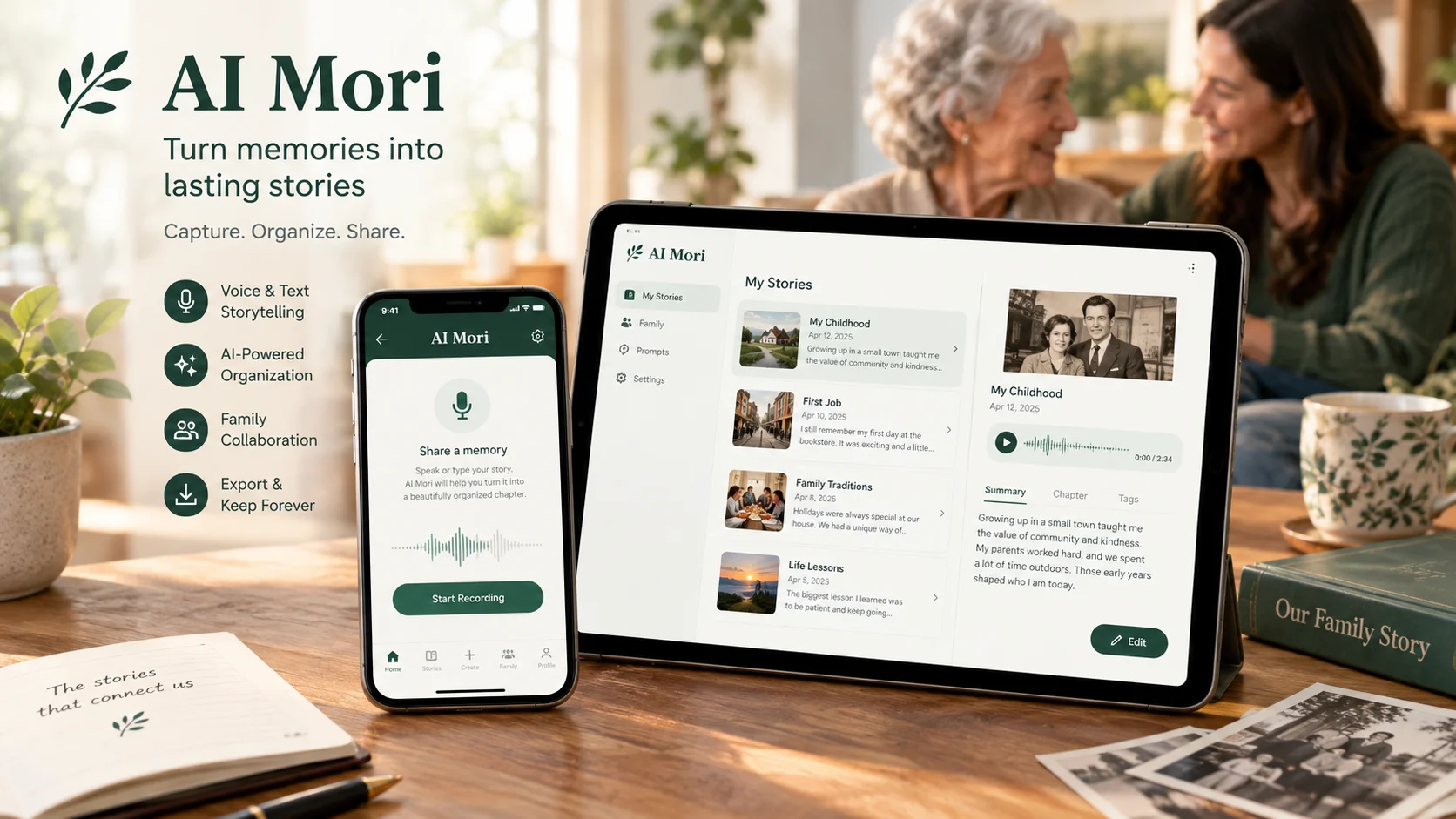
AI Mori is an AI-powered storytelling app that helps individuals and families preserve personal memories through voice recordings, text, and guided prompts. It organizes these memories into editable life-story chapters, making it easier to document family history without writing a full autobiography from scratch.
AI Mori at a Glance
- Main purpose: Preserve personal memories and create family autobiographies.
- Developer: Nanmenba LLC, according to the App Store listing.
- Core features: Voice and text storytelling, guided prompts, story organization, summaries, and editable chapters.
- Family collaboration: The official website describes inviting parents or grandparents through a link and optionally collaborating on stories.
- Availability: An iPhone and iPad app, with Apple listing additional compatibility information for certain devices.
- Pricing: The app is listed as free to download. The official website does not clearly publish a complete paid pricing schedule in the information reviewed.
What Is AI Mori?
AI Mori is a family storytelling and voice-journaling application designed to turn personal experiences into organized, readable stories. Instead of asking users to write a memoir from a blank page, it lets them speak or type their memories and uses AI to help shape them into chapters.
The app is designed for people who want to document their lives, preserve a parent’s memories, or create a record of family history for future generations. Its emphasis is on personal storytelling rather than general-purpose AI assistance.
According to the official AI Mori website, users can invite a parent or grandparent, capture important milestones, organize emerging themes, and export their stories when ready to share or print. The website also describes an option for people to write their own autobiographies.
The product addresses a familiar problem: people often want to preserve family stories but struggle to find the time, confidence, or structure to write them down.
AI Mori attempts to reduce that effort by turning spoken recollections into a more organized written record.
Who Developed AI Mori?
The Apple App Store identifies Nanmenba LLC as the developer of the AI Mori app. The listing categorizes it under Lifestyle and describes it as a tool for reflection, storytelling, voice recording, and preserving family memories.
The developer’s public description is the primary source for understanding the product’s intended functionality. However, the available public documentation does not establish a detailed technical architecture or identify the underlying AI model.
This distinction matters when evaluating AI products. An application can use generative AI without developing its own foundation model.
AI Mori Is Not the Only Product Named Mori
Search results for “AI Mori” can be confusing because several unrelated products use the name Mori.
| Product | Main purpose |
|---|---|
| AI Mori at aimori.app | Family autobiographies and personal storytelling |
| Mori nutrition app at mori-app.com | Food journaling and estimated nutritional information |
| MORI at mori-corp.io | Tools for creators, including AI-generated image detection and artwork protection |
| Mori Journaling AI at mori.to | A separate journaling product associated with a wearable device |
These services should not be treated as versions of the same product. Their features, developers, pricing, and privacy practices differ.
For searchers looking to preserve family memories, the relevant product is AI Mori at aimori.app.
How Does AI Mori Work?
AI Mori’s workflow centers on capturing a memory and turning it into an organized story.
The official website describes a process that combines voice or text input, a follow-up question, AI-assisted organization, and editable chapters.
Step 1: Start With a Memory
A user can speak about an experience or enter it as text.
The memory might describe childhood, a significant family event, a career milestone, a personal challenge, or a lesson learned over time.
Starting with an existing memory makes the process more approachable than writing an entire autobiography at once.
Step 2: Respond to a Guided Follow-Up
AI Mori describes asking one gentle follow-up question per saved memory.
This can help the storyteller add context that might otherwise be missing. For example, someone recalling their first job might be prompted to explain what the experience taught them.
The purpose is to encourage meaningful detail without turning the experience into a lengthy interview.
Step 3: Organize the Story
According to the product website, AI Mori uses AI to help create titles, summaries, tags, and chapters.
These organizational tools can help connect individual memories into a larger narrative. Over time, a collection of separate recollections may develop into a more coherent account of someone’s life.
The precise model, transcription technology, and processing architecture are not publicly identified in the materials reviewed.
Step 4: Review and Edit
AI-generated writing should be treated as a draft, not an unquestionable historical record.
AI Mori says users can edit their stories freely. This is important because automated rewriting may change emphasis, omit context, or misunderstand names and dates.
The storyteller should remain the final authority on how their experiences are represented.
Step 5: Share or Export
The official website says users can invite family members to contribute and export stories for sharing or printing.
This creates a practical route from individual memories to a family archive.
Before starting a large project, users should verify the currently available export formats and whether any collaboration or sharing features require particular account settings.
Key AI Mori Features
Voice-Based Storytelling
Voice input is central to AI Mori’s appeal.
Many people find it easier to describe an experience aloud than to write several polished paragraphs. Voice-first storytelling can also help older family members participate without learning a complicated writing workflow.
However, users should distinguish the convenience of voice capture from the accuracy of transcription. Names, dialects, background noise, and less common expressions can all affect transcription quality.
Text Input and Flexible Story Capture
The official website supports both speaking and typing.
This flexibility matters because not everyone wants to record their voice. Some memories may also be easier to document in writing, particularly when they involve precise dates or details that need careful review.
A combination of voice and text gives families more ways to participate.
AI-Assisted Chapters
AI Mori helps organize memories into editable chapters as a story develops.
For example, several memories about school, early employment, and moving to a new city could form the basis of a chapter about early adulthood.
This organization can reduce the manual work involved in arranging scattered notes into a readable autobiography. Users should still review chapter boundaries and chronological order.
Guided Prompts and Follow-Up Questions
Prompts give users a starting point when they are unsure what to share.
A family member might begin with a childhood memory and gradually add details about the people, places, and events involved. The follow-up process encourages deeper reflection without requiring a formal interview.
Family Collaboration
AI Mori’s website describes inviting a parent or grandparent through a link and optionally collaborating to organize chapters.
This makes the app relevant to adult children who want to preserve a relative’s stories while that person can still share them firsthand.
Before inviting contributors, clarify who can view, edit, or export the resulting stories.
Exportable Personal Archives
The website emphasizes downloadable data and export options.
That is a meaningful feature for a product designed to preserve memories over many years. An exportable archive gives users a way to keep their work outside the application.
The exact export formats, media support, and long-term availability should be checked before relying on the service as the sole repository for irreplaceable family memories.
Benefits of Using AI Mori
AI Mori’s main advantage is that it lowers the practical barrier to preserving personal history.
It makes starting easier. Users can begin with a short spoken memory rather than a blank document.
It adds structure. Titles, summaries, tags, and chapters can make a growing archive easier to navigate.
It encourages reflection. Guided follow-up questions can reveal details that a storyteller might otherwise overlook.
It supports family participation. Inviting relatives creates an opportunity to document memories that might never appear in a conventional diary.
It keeps editing in the user’s hands. The ability to revise AI-generated prose helps preserve the storyteller’s meaning and voice.
These benefits depend on how consistently people use the app and how carefully they review the resulting stories. AI can organize recollections, but it cannot independently verify every personal memory.
AI Mori Pricing: Is It Free?
The Apple App Store lists AI Mori as free to download. The official website provides access to the app but does not clearly establish a complete public pricing schedule in the information reviewed.
That means it would be premature to promise that every feature is permanently free.
| Pricing question | What can be established |
|---|---|
| Is the app free to download? | Yes, according to the App Store listing. |
| Is there a clearly published subscription price? | No complete pricing schedule was identified on the official website reviewed. |
| Are all features free? | Not established by the available public information. |
| Can users export stories? | The official website advertises export functionality. |
| Could pricing change? | Yes. Check the current listing and in-app purchase screen. |
Before investing substantial time in the app, check whether any limits apply to story creation, voice processing, storage, family invitations, or exports.
For a family archive, the most important cost question is not simply the initial download price. It is whether users can continue accessing and exporting their stories over the long term.
AI Mori Privacy and Data Security
Personal stories can contain sensitive information about relationships, family history, health, finances, and difficult life events. Privacy deserves particular attention when choosing a storytelling application.
The AI Mori website describes its service as private and ad-free and states that data is downloadable and accessible only to the user and family. These are developer claims, not independent security audit findings.
Apple’s App Store listing also displays a developer-provided privacy label stating that the app does not collect data. Apple explicitly notes that this information has not been verified by Apple.
These statements should be considered together rather than treated as a comprehensive technical security assessment.
What Should Users Verify?
Before recording sensitive memories, review the current privacy policy and consider these questions:
- Where are recordings, transcripts, and generated stories stored?
- Is audio retained after transcription?
- Are third-party AI providers involved in processing?
- Are conversations or stories used to train AI models?
- Who can access shared family content?
- How can users delete their information?
- What happens to stored content if the service closes?
- Can all stories and associated media be exported?
The available public materials do not establish all these technical details.
Do not assume that an app’s privacy label proves that every part of its AI processing occurs locally. Likewise, a general privacy statement does not automatically establish Zero Data Retention or independent security certification.
For important family records, maintain an independent backup and obtain consent before recording or sharing another person’s private experiences.
AI Mori vs. Alternatives
AI Mori belongs to the broader category of digital memoir and family-history tools. The most relevant alternatives differ in how they capture stories and what users receive at the end.
| Platform or tool | Target user | Key strength | Pricing transparency | Main limitation |
|---|---|---|---|---|
| AI Mori | Families and individual storytellers | AI-assisted chapters from voice or text | Download is free; complete feature pricing needs verification | Limited public technical documentation |
| StoryWorth | People creating a memoir or family gift | Guided questions, story collection, and printed books | Official plans are published | A printed-book workflow may be more than casual diarists need |
| Remento | Families who want a physical keepsake and original voice recordings | AI-assisted written stories linked to recordings through QR codes | Official product pricing is published | Designed around a more structured keepsake-book experience |
| Storii | Older adults and families who prefer telephone-based recording | Automated phone prompts and downloadable story collections | Official plans and gift products are listed | Phone-call workflow may not suit everyone |
| Apple Voice Memos | People who want straightforward recording | Simple audio capture without an AI memoir workflow | Built into compatible Apple devices | Users must organize, transcribe, and edit stories themselves |
StoryWorth currently publishes several memoir plans on its official website. Remento advertises a $99 package for a year of storytelling and a hardcover book, while Storii offers subscription and gift options. Prices and terms can change, so check each provider’s official pricing page before purchasing.
Which Alternative Makes the Most Sense?
Choose AI Mori if you prefer to speak or type memories and want AI assistance organizing them into editable chapters.
Choose StoryWorth if guided questions and a printed memoir are central to your goal.
Consider Remento if preserving the original voice alongside a written story is especially important.
Consider Storii if the storyteller would rather receive telephone prompts than navigate a smartphone app.
Use a basic recording application if you want to preserve original audio and prefer to manage transcription, organization, and backups yourself.
The right choice depends on the storyteller’s comfort, the final format you want, and how much control you need over your archive.
Who Should Use AI Mori?
AI Mori may be useful for several groups.
Families Preserving a Parent’s Life Story
Adult children can use guided storytelling to encourage parents or grandparents to record memories while they can still share them firsthand.
The approach works particularly well when the family starts with short, manageable conversations instead of attempting to document an entire life in one sitting.
People Writing Their Own Autobiographies
Individuals can use the app to collect personal experiences, organize milestones, and gradually develop a life story.
This may suit people who enjoy reflecting on their experiences but find conventional memoir writing difficult.
Families Creating a Shared History
Relatives often remember the same event differently. A shared storytelling project can preserve these perspectives and encourage conversations about family traditions, migration, careers, and important milestones.
Each contributor should be able to review how their own memories are represented.
People Who Prefer Speaking to Writing
Voice-first capture is particularly useful for storytellers who are more comfortable talking than typing long passages.
It can also help people record a memory immediately rather than postponing it until they have time to write.
AI Mori is less suitable for users seeking a general-purpose chatbot, a professional transcription API, enterprise knowledge management, or an advanced AI development platform.
Technical Considerations: What AI Mori Does Not Publicly Disclose
AI Mori’s public product description explains its intended user experience, but it does not provide enough information for a detailed technical evaluation.
The reviewed materials do not identify the underlying large language model, speech-recognition provider, model version, context window, API architecture, or model benchmark results.
That does not mean these technologies are absent. It means the available evidence does not support claims about their implementation.
For technical buyers, this creates several evaluation questions.
Transcription accuracy: Test how well the app captures names, accents, dates, and family-specific terminology.
Editorial fidelity: Compare generated chapters with original recordings to see whether the writing preserves the storyteller’s meaning.
Memory organization: Check whether related stories are grouped sensibly and whether dates and relationships remain consistent.
Data portability: Export a sample project and confirm that the files remain usable outside the app.
Service continuity: Review the terms governing stored stories, account deletion, and access if the product changes or shuts down.
These practical checks provide more useful evidence than unsupported claims about the sophistication of an AI model.
Common Mistakes When Using AI Mori
Treating AI-Generated Prose as a Historical Record
AI can improve readability, but it can also introduce errors. Always compare important names, dates, places, and events with the original account.
Waiting to Record Everything
A complete autobiography can feel overwhelming. Start with one meaningful memory, then add others over time.
Forgetting to Back Up the Archive
A story stored in an application is not automatically a permanent family record. Export your work regularly and keep a second copy in a location you control.
Sharing Sensitive Stories Without Permission
Family collaboration should respect the storyteller’s wishes. Ask before sharing private memories, especially when they involve other people.
Ignoring the Final Format
Decide whether you want editable digital chapters, audio recordings, a printable document, or a professionally produced book. Different tools support different outcomes.
Frequently Asked Questions
What is AI Mori used for?
AI Mori helps individuals and families capture personal memories through voice or text and turn them into organized, editable life-story chapters. It is designed for autobiography writing, family-history preservation, and personal reflection.
Is AI Mori free to use?
AI Mori is listed as free to download on Apple’s App Store. However, the public information reviewed does not establish that every feature is free or provide a complete paid pricing schedule, so check the current app before committing to a long-term project.
Can AI Mori create a family autobiography from voice recordings?
The developer describes voice recording, AI-assisted storytelling, and editable chapters as core features. The app is intended to help users organize spoken memories into a life story, although users should review the generated text for accuracy.
Is AI Mori safe for private family memories?
The developer describes AI Mori as private and ad-free, and Apple’s App Store listing displays a developer-provided privacy label stating that data is not collected. Apple notes that this information has not been verified by Apple, so users should review the privacy policy and avoid assuming that independent security or data-retention guarantees exist.
What are the best alternatives to AI Mori?
Relevant alternatives include StoryWorth for guided memoirs and printed books, Remento for written stories paired with original voice recordings, Storii for telephone-based storytelling, and Apple Voice Memos for basic audio capture. The best option depends on the storyteller’s preferences and the format of the final archive.
Conclusion
AI Mori is a family storytelling app designed to make autobiography writing more approachable. By combining voice or text input with guided prompts and AI-assisted chapter organization, it helps users turn scattered recollections into a more structured personal history.
Its strongest appeal is the focus on meaningful memories rather than generic AI conversation. Families considering the app should pay particular attention to editing accuracy, export options, privacy terms, and long-term access.
AI Mori is worth evaluating for people who want an accessible way to document their lives or preserve a relative’s stories. Before making it the home of an important family archive, test the workflow, export a sample, and keep an independent backup.