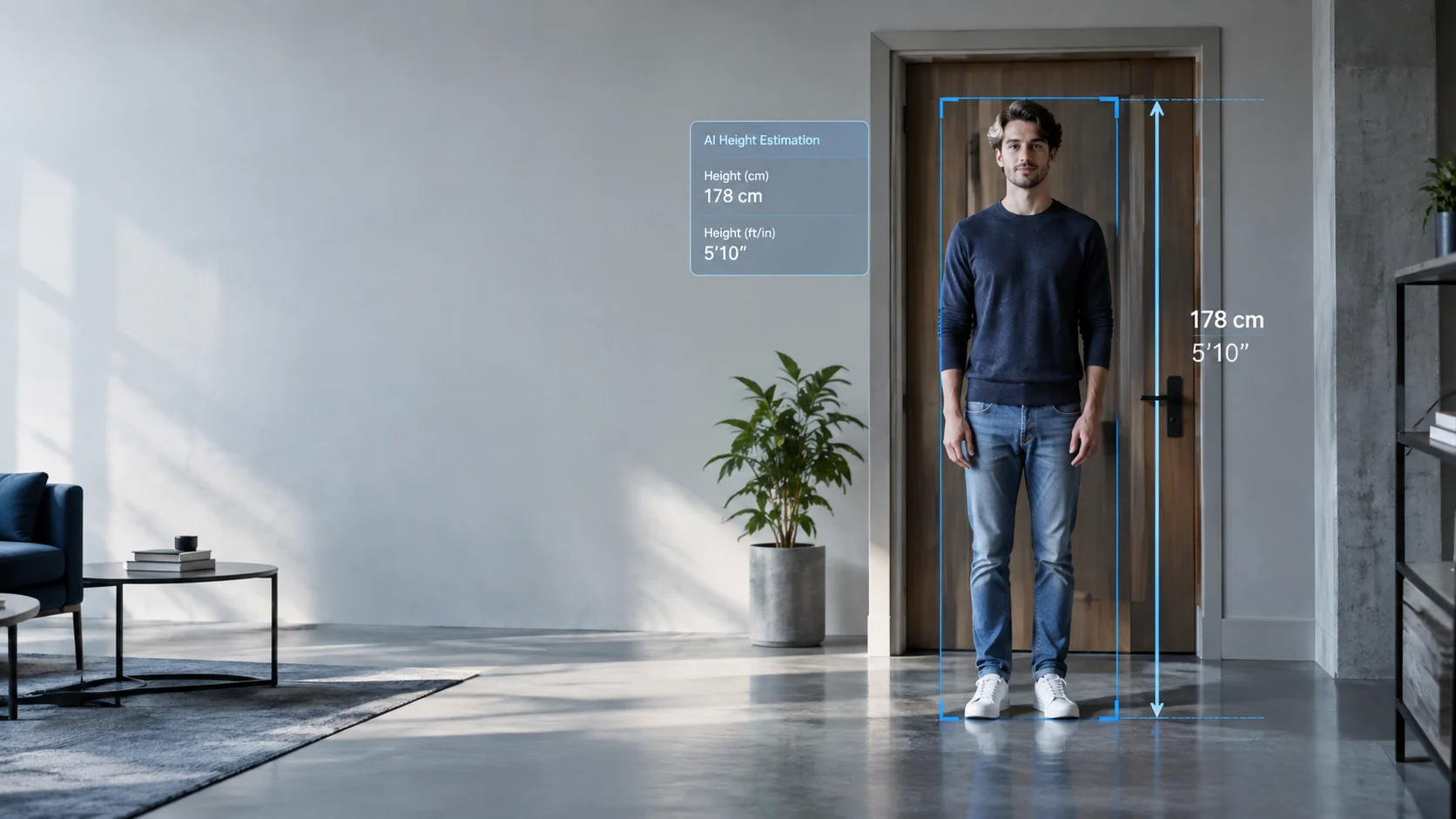
An AI height estimator analyzes a photo to estimate a person’s height or an object’s dimensions using visual proportions, perspective, and reference points. It can provide a convenient approximation, but a photograph without reliable scale information cannot establish someone’s exact real-world height.
At a Glance
- What it does: Estimates height from photographs using AI-powered image analysis.
- Popular use cases: Checking approximate human height, estimating object dimensions, and exploring visual measurements.
- How it works: Analyzes body proportions, camera perspective, and recognizable objects in the scene.
- Accuracy: Depends on image quality, camera angle, visible reference objects, and the tool’s method.
- Tools to explore: Height AI, FindOutMy’s Guess My Height, and Measure Height App.
- Important limitation: AI estimates are not substitutes for physical measurements or professional assessments.
What Is AI Height Estimation?
AI height estimation uses computer vision to estimate how tall a person or object might be from an image. Instead of requiring a measuring tape, an AI-powered tool analyzes visual information and produces an estimated height.
The term “AI height” can describe several different technologies. Some tools estimate a person’s stature from a photograph, while others measure furniture or packages. Separate apps predict future growth or edit photographs to make someone appear taller.
Understanding the difference helps you choose the right tool.
AI height estimation from photos
Photo-based estimators examine the visible subject and surrounding environment. Depending on the tool, they may use body proportions, known-size objects, perspective, and other visual cues.
For example, a photograph showing a standing person beside a clearly visible doorway provides more useful scale information than a tightly cropped portrait.
AI height measurement for objects
Object-measurement apps estimate the dimensions of furniture, plants, boxes, pets, or other visible items. Some tools offer height, width, and depth rather than human stature alone.
These estimates can help with preliminary planning, shopping, or organizing belongings. However, they should not replace a measuring tape when precise dimensions matter.
AI height prediction
Height prediction tools use different inputs, such as a child’s age, current height, growth history, and parents’ heights. They attempt to estimate future adult stature rather than measure someone’s current height from a photo.
These predictions involve biological uncertainty. An app’s advertised prediction accuracy should not be treated as a medically validated result without supporting evidence.
How Does an AI Height Estimator Work?
AI height estimation combines image analysis with assumptions about the physical scene. The exact process varies between products, and many providers do not disclose every technical detail of their systems.
1. The AI identifies the subject
Computer vision helps identify the person or object whose height needs estimating. The system may locate visible body boundaries, recognize the head and feet, or identify the edges of a piece of furniture.
A clear, complete image gives the model more useful information than an image with cropped feet or hidden edges.
2. It analyzes perspective and proportions
The system examines the subject’s apparent size, position, and proportions. Camera height, distance, lens characteristics, and the subject’s position can influence how tall something appears.
A person photographed from a low angle may appear taller than the same person photographed from above. AI may attempt to account for these effects, but correction is not guaranteed to be accurate.
3. It looks for reference objects
Some estimators compare the subject with objects that have typical dimensions, such as doors, counters, or stairs.
A reference object can provide a useful scale, but only if the system can identify it reliably and its dimensions are reasonably known. Door sizes, furniture dimensions, and building standards vary across countries and properties.
4. It generates an estimate
The system combines available visual clues and returns an estimated measurement. Depending on the tool, the result may appear in centimeters, meters, feet, or inches.
Some tools display a single number. Others provide a range or confidence indicator. A range can be more informative when the photograph contains limited scale information.
How to Estimate Height From a Photo
If you want to try an AI height estimator, follow a consistent process.
Step 1: Choose a suitable photograph
Use a full-body image with the person’s head and feet visible. A standing pose is generally easier to analyze than a sitting, crouching, or heavily tilted pose.
Avoid images with strong perspective distortion, unusual camera angles, or extensive cropping.
Step 2: Include useful reference points
Whenever possible, select an image containing a doorway, counter, stair, or another recognizable object with reasonably predictable dimensions.
Do not assume that every door or counter has a standard size. Local construction practices and individual installations can differ.
Step 3: Upload the image to a tool
Choose a service that explicitly supports photo-based height estimation. For example, Height AI describes a workflow in which users upload a full-body photo and receive an estimated height in seconds. These are the provider’s advertised capabilities, not an independent accuracy assessment.
Step 4: Review the result critically
Treat the output as an estimate rather than a verified measurement. If the tool offers a range, consider how wide that range is and which visual references supported the result.
If the estimate seems implausible, try a better photograph or use a physical measurement to establish the person’s actual height.
Best AI Height Estimator Tools to Consider
Different tools address different needs. The following comparison summarizes their published positioning without treating their marketing claims as independently validated performance results.
| Tool | Primary use | Main advertised capability | Pricing transparency | Main limitation |
|---|---|---|---|---|
| Height AI | Estimating a person’s height from a photo | Full-body photo analysis and height estimates | Advertises a free iPhone download | Accuracy depends on the image and available scale cues |
| FindOutMy Guess My Height | Browser-based photo estimation | Uses visible reference objects and returns a height range | Public tool page; verify current access conditions | Results remain estimates, not measurements |
| Measure Height App | Estimating dimensions of people and objects | Height, width, and depth from photos | Free to try, with in-app subscriptions | Developer warns against using estimates where precision is required |
Height AI
Height AI is designed around estimating a person’s height from a full-body photograph. Its website describes potential uses such as checking dating-profile claims and settling casual height guesses.
The service advertises an iPhone download and height estimates in feet and inches or centimeters. Its website also makes privacy assurances about uploaded photos. Review the linked privacy policy and applicable app-store disclosures before uploading identifiable images.
Visit for its current workflow and availability.
FindOutMy Guess My Height
FindOutMy offers a browser-based height estimation tool. Its published explanation emphasizes recognizable objects, such as doors, counters, and light switches, as scale references.
This approach highlights an important technical principle: body proportions alone are a weak basis for determining absolute height. Reference objects can help, but their actual dimensions and the camera perspective still introduce uncertainty.
Try the
Measure Height App
Measure Height App focuses on estimating dimensions from photographs, including height, width, and depth. Its App Store listing describes support for people, furniture, plants, packages, and other objects.
The listing warns that estimates vary with image quality, angle, lighting, and reference objects. It also advises against using the results for professional, medical, construction, or engineering applications where precise dimensions are required.
See the Measure Height App listing for supported devices and current subscription information.
How Accurate Is AI Height Estimation?
AI height estimation can be useful for a rough guess, but accuracy varies substantially between photographs and tools.
A major limitation is that ordinary photographs do not inherently contain an absolute measurement scale. A person photographed against a blank wall could be relatively short or tall while producing a visually similar image.
The system needs additional information to distinguish between these possibilities.
Factors that affect accuracy
Camera angle: A camera positioned above or below the subject can distort apparent height.
Reference objects: Recognizable objects with known dimensions provide stronger scale information than body proportions alone.
Distance and perspective: Objects closer to the camera can appear disproportionately large. A person standing farther from a doorway may be difficult to compare accurately.
Body position: Bent knees, tilted posture, raised heels, and cropped feet can affect the estimate.
Footwear and hair: Thick shoe soles, heels, and hairstyles can change apparent height without changing actual stature.
Image quality: Poor lighting, blur, occlusion, and low resolution can make it harder to identify the subject’s boundaries.
How to evaluate a tool’s accuracy
Do not rely solely on claims such as “high accuracy” or a percentage displayed on a marketing page. Look for independent testing using known measurements and representative photographs.
If you want to evaluate a tool yourself:
- Measure a person’s actual height using a reliable physical method.
- Take several photographs with different camera angles and reference objects.
- Submit them to the estimator under consistent conditions.
- Compare the estimates with the measured height.
- Repeat the test with several people before drawing conclusions.
Record the absolute difference between the estimate and the reference measurement. Testing multiple subjects can reveal whether a tool performs consistently or only produces convincing results in selected examples.
Benefits and Limitations of AI Height Tools
Benefits
- Convenience: Estimate dimensions without immediately finding a ruler or tape measure.
- Speed: Many consumer tools advertise results within seconds.
- Accessibility: Photo-based tools can be easier to use than specialized measurement equipment.
- Flexible applications: Depending on the product, users can estimate human height or object dimensions.
- Useful preliminary screening: An estimate can help determine whether a more accurate measurement is necessary.
Limitations
- No guaranteed precision: A visual estimate can differ materially from the real measurement.
- Dependence on context: Missing reference objects make absolute height difficult to determine.
- Potential bias: A system may perform differently across body types, poses, image conditions, and environments.
- Privacy concerns: Uploaded photographs can contain faces, locations, and other identifying details.
- Limited professional suitability: Consumer photo estimators are not automatically appropriate for medical, engineering, or construction decisions.
The practical value depends on the consequences of getting the answer wrong. A casual guess is different from measuring a doorway for a renovation.
AI Height Estimation vs. Traditional Measurement
| Method | What it requires | Best use | Reliability considerations |
|---|---|---|---|
| Measuring tape or stadiometer | Physical access to the subject or object | Actual height measurement | Depends on correct positioning and technique |
| AI height estimator | A suitable photograph | Quick approximate estimates | Depends on perspective, image quality, and scale references |
| Phone-based AR measurement | Compatible device and a suitable environment | Convenient object or room measurements | Depends on device sensors, calibration, and environmental conditions |
| AI height prediction | Growth-related information | Estimating possible future adult height | Depends on the prediction method and biological uncertainty |
For personal height, a properly performed physical measurement is generally preferable when accuracy matters. A photo-based estimate is useful when direct measurement is unavailable or when only a rough answer is needed.
Privacy and Safety Considerations
An image of a person can reveal more than height. It may contain a face, home interior, workplace, school uniform, location clues, or other identifying details.
Before using an online AI height tool, review its privacy policy and understand what happens to uploaded images.
- Data retention: Check how long photographs and generated results are stored.
- Third-party processing: Determine whether images are sent to external AI or cloud providers.
- Training use: Look for explicit information about whether uploads may be used to improve models.
- Deletion: Confirm how to request deletion and whether backups follow a separate retention schedule.
- Consent: Avoid uploading another person’s private image without appropriate permission.
- Sensitive decisions: Do not use an uncertain height estimate as proof of someone’s identity, health, or honesty.
A website’s privacy statement is a provider claim, not an independent guarantee. If the image is sensitive, using a physical measurement or an appropriate local measurement tool may be the safer option.
Common Mistakes When Using an AI Height Estimator
Trusting a single result
One photograph may produce a misleading estimate because of camera perspective or missing reference objects. Compare results cautiously and seek a physical measurement when the answer matters.
Using a cropped image
If the feet or top of the head are missing, the system may lack the information needed to estimate full height.
Ignoring footwear
A person wearing thick soles or heels may appear taller than their barefoot stature. Consider this distinction when interpreting the output.
Confusing prediction with measurement
An app that predicts adult height is not performing the same task as an image-based estimator. Check which input data the tool requires and what its result actually represents.
Treating an AI estimate as proof
A height estimate from a dating profile or social-media image cannot reliably prove that someone has misrepresented their height. Camera position, shoes, and perspective can explain apparent differences.
FAQs
Can AI measure height accurately from a photo?
AI can estimate height from a photograph, especially when the full subject and useful reference objects are visible. However, a photo-based result is not a guaranteed measurement, and accuracy varies with perspective, image quality, and the tool’s method.
Is there a free AI height estimator?
Some services advertise free access or free downloads. Height AI advertises a free iPhone download, while other tools offer browser-based estimation or free-to-try apps. Check current access restrictions and subscription terms before use.
Can AI estimate someone’s height without a reference object?
It can produce a guess from body proportions and visual context, but confidence should be limited. Without an object of known size or another reliable scale reference, a photograph cannot establish absolute height on its own.
Can AI predict a child’s adult height?
Some height-prediction tools estimate future stature using information such as age, current measurements, growth history, and parental heights. These predictions are uncertain and should not replace a healthcare professional’s assessment when growth concerns arise.
Is an AI height estimator suitable for professional measurements?
Consumer photo estimators should not be relied on for construction, engineering, medical, or other high-precision tasks unless the specific system has been validated for that use. Use an appropriate measuring instrument when accuracy is important.
Conclusion
AI height estimation offers a convenient way to approximate a person’s stature or an object’s dimensions from a photograph. Tools such as Height AI and Find Out My provide accessible options, while object-measurement apps address broader sizing tasks.
The key limitation is the lack of guaranteed scale in an ordinary image. Camera perspective, reference objects, and image quality all influence the result.
Choose a tool based on the task, check its privacy terms, and treat estimates as approximate. When a reliable measurement matters, use a physical measuring method instead.