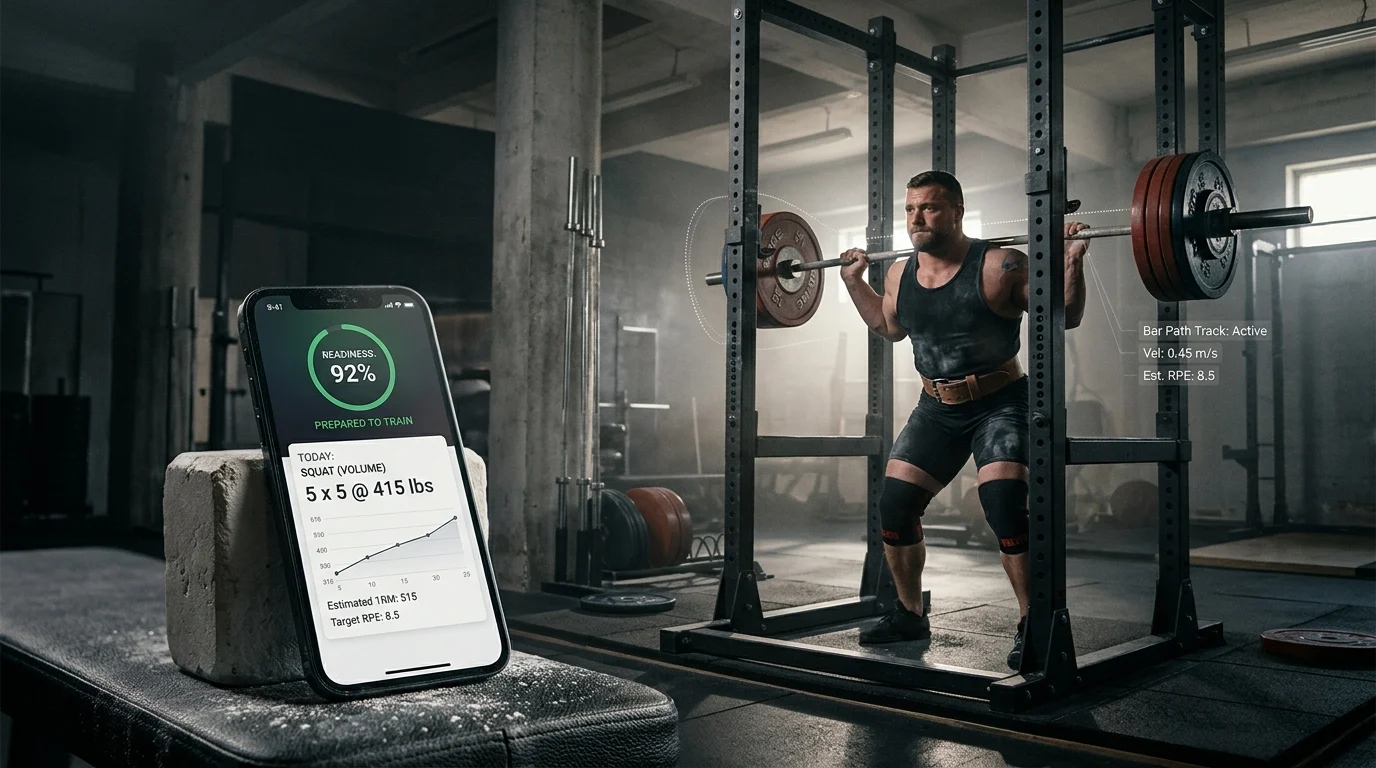
Juggernaut AI is an adaptive strength-training app that creates personalized powerlifting and powerbuilding programs based on your goals, training history, and workout feedback. It helps lifters plan exercises, manage training volume, track readiness, and prepare for competitions, with paid subscriptions listed at $34.99 monthly or $349.99 annually on its official website.
Juggernaut AI at a glance

JuggernautAI
AI-assisted strength programming for iOS and Android
Developed by Juggernaut Apps and associated with Juggernaut Training Systems.
Official website · View pricing
Primary purpose
Personalized powerlifting and powerbuilding programs.
Adaptive programming
Training adjustments informed by workout feedback and readiness ratings.
Training schedule
Programs covering two to six training days per week, according to the official pricing-page FAQ.
Published US pricing
$34.99/month or $349.99/year
A two-week free trial is advertised. Confirm the checkout terms before subscribing.
Sources:
+2 Pricing is in US dollars and may vary by region, platform, or offer.
What is Juggernaut AI?
Juggernaut AI is a strength-training application designed to make structured coaching more accessible through personalized workout programming. Rather than giving every user the same routine, it uses information about training goals, experience, strength, and recovery to guide exercise selection and progression.
The product focuses on two main training styles:
- Powerlifting: Building strength in the squat, bench press, and deadlift, with programming that can support competition preparation.
- Powerbuilding: Combining strength development with muscle growth through targeted accessory exercises and body-part priorities.
The app is associated with Juggernaut Training Systems, a strength-coaching organization. Its official app listing credits coach Chad Wesley Smith with the programming approach and Tim Arnold with the underlying technology.
Is Juggernaut AI a chatbot?
No. Juggernaut AI is primarily a structured training and coaching application, not a general-purpose conversational AI assistant.
It should also not be confused with Juggernaut XL, a name associated with AI image-generation models, or Juggernaut AI Solutions, a separate business-automation provider. These products serve different purposes.
This distinction matters because searches for “Juggernaut AI” can return unrelated products. Anyone looking for personalized gym programming should verify that the developer is Juggernaut Apps and the website is juggernautai.app.
How does Juggernaut AI work?
Juggernaut AI combines established strength-training principles with software-driven programming adjustments. The app’s official descriptions explain the workflow in three broad stages.
1. Set your goals and training profile
You provide information about your experience, strength levels, preferred training frequency, and objectives. These details help the system establish a starting program.
Your initial answers matter. Unrealistic strength estimates or incomplete training information can produce a plan that does not match your current ability.
2. Follow a structured training program
The app generates workouts using several programming concepts:
- Training volume: How much work you perform through sets and repetitions.
- Training frequency: How often you train particular lifts or muscle groups.
- Periodization: How training emphasis changes over time to balance progress and fatigue.
- Exercise selection: Choosing movements intended to address specific strength weaknesses or physique goals.
The goal is to organize training into a coherent progression rather than rely on isolated workouts.
3. Submit feedback and adjust your training
Juggernaut AI uses a readiness rating system and workout feedback to modify programming. Depending on the situation, adjustments may affect a session, a training week, or a longer training block.
This is an important distinction from a static workout spreadsheet. However, adaptive programming does not guarantee better results. Its usefulness depends on accurate feedback, consistent training, adequate recovery, and sensible execution.
Key Juggernaut AI features
The following features are relevant to lifters comparing a personalized training app with conventional workout plans.
Individualized workout programming
The app builds a training plan around the user’s goals and experience. It also considers training volume, frequency, exercise selection, and progression.
This can reduce the time spent creating or modifying a program manually. It is especially useful for lifters who understand basic barbell movements but want more structure.
Readiness-based adjustments
Training performance changes with sleep, stress, fatigue, and recovery. Juggernaut AI’s readiness system is designed to account for feedback instead of assuming every workout will go exactly as planned.
The practical benefit is flexibility. The limitation is that subjective feedback is not a complete medical assessment or a guarantee that a particular workload is safe.
Competition preparation
Powerlifters preparing for a meet can use structured training blocks and competition-oriented programming. The official pricing page also describes a meet-preparation approach that organizes training around a target competition date.
This is relevant to athletes who need more than a generic strength routine. They should still confirm their federation’s rules, equipment requirements, and competition schedule independently.
Exercise demonstrations and coaching resources
The official website advertises more than 300 exercise technique videos, alongside coaching resources and community support. Its materials also list tools such as a warm-up planner and an RPE calculator.
These resources can help users follow the prescribed program and understand its exercises. Video demonstrations, however, cannot replace individualized observation of lifting technique.
Training customization and health integrations
A product update announcing JuggernautAI v2.0 describes Apple Health and Google Health Connect integration, including support for pre-filling questionnaires and logging workouts. The same update announces customizable training-day order, user-created exercises, and a bench-only program.
These are documented release announcements, but availability and behavior can change across app versions and devices. Check the current app listing and in-app settings before relying on a particular integration.
Juggernaut AI pricing in 2026
The official pricing page lists two subscription options in US dollars. Both display a two-week free trial and access to the core powerlifting and powerbuilding program.
juggernautai.app
| Plan | Published price | Approximate annual cost |
|---|---|---|
| Monthly | $34.99/month | $419.88 for 12 months |
| Annual | $349.99/year | $349.99 per year |
The annual plan costs approximately $69.89 less than paying the monthly rate for 12 months, a saving of about 16.6%.
The website also advertises coaching Q&A sessions, community access, training manuals, online seminars, and a consultation as part of its subscription offer. Confirm the exact eligibility and redemption conditions for these extras before purchasing.
Is Juggernaut AI free?
The app can be downloaded without an upfront purchase, but access to its full coaching and programming features requires a subscription. The official website advertises a two-week trial.
Before starting, check:
- When the trial ends and whether it converts automatically to a paid subscription.
- Which price and renewal period appear at checkout.
- Whether the subscription is managed through the app store or the website.
- The cancellation deadline and applicable refund policy.
- Whether regional taxes or currency conversion affect your final cost.
Editorial assessment: The annual plan makes more financial sense for someone committed to using the program throughout the year. The monthly plan offers more flexibility for people who want to test the coaching approach over a shorter period.
Benefits and limitations of Juggernaut AI
No training app is ideal for every athlete. Evaluating the trade-offs is more useful than relying on marketing claims or star ratings alone.
Benefits
1. Less guesswork in programming. The app creates a structured plan, helping users avoid constantly switching routines or improvising every workout.
2. Feedback-informed progression. Its readiness system can adjust training in response to reported performance and recovery, rather than treating every session identically.
3. Strength-focused expertise. Its programming is designed around powerlifting and powerbuilding, making it more specialized than a general fitness tracker.
4. Competition-oriented structure. Lifters can organize their preparation around a meet date instead of relying on an unrelated sequence of workouts.
5. Educational resources. Exercise demonstrations and coaching materials support users who want guidance without arranging every session with a personal trainer.
These advantages reflect the product’s documented features, not a guarantee of individual strength gains.
Limitations to consider
The subscription is a recurring expense. At $34.99 monthly, the app represents a meaningful commitment, particularly for users who need only a basic workout plan.
The experience is specialized. People whose primary goals involve running, endurance training, mobility, or general cardiovascular fitness may need another application or coaching resource.
Feedback quality affects usefulness. Inconsistent workout logging, inaccurate strength estimates, or poorly reported readiness can undermine the value of personalized programming.
It is not a human coach. Software can prescribe workouts and respond to submitted information, but it cannot reliably replace direct coaching, individualized injury assessment, or clinical advice.
Training can demand substantial time. A structured strength program may involve warm-ups, multiple exercises, accessory work, and recovery periods. Users should assess their actual schedule rather than assuming personalization always means shorter workouts.
Some features require verification. Integrations, subscription benefits, and program customization can change. Confirm the current version’s capabilities before making a purchase.
These limitations are especially important for beginners, athletes managing injuries, and people with limited training time.
Juggernaut AI vs. other strength-training options
The right comparison is not between Juggernaut AI and every product marketed as artificial intelligence. It is between training methods that solve the same problem.
The following options have different strengths and pricing models. Prices and feature availability for alternatives should be checked directly with their providers.
| Platform or approach | Target user | Main strength | Pricing transparency | Main limitation |
|---|---|---|---|---|
| JuggernautAI | Powerlifters and powerbuilders | Adaptive, individualized programming | Official subscription prices published | Recurring cost and strength-focused scope |
| Boostcamp | Lifters following established training programs | Access to a variety of workout programs | Check current free and paid tiers | Experience depends on the chosen program and its customization |
| Stronger By Science | Evidence-focused strength trainees | Educational resources and structured programming | Check the specific product or program | Less of an all-in-one adaptive app experience, depending on the product |
| RP Hypertrophy App | Bodybuilders focused on muscle growth | Hypertrophy-oriented training organization | Check current subscription terms | Less directly aligned with a powerlifting-first objective |
| A qualified human strength coach | Lifters needing individual oversight | Direct feedback, communication, and context | Usually depends on the coach and service | Often higher cost and availability constraints |
These are category-level comparisons, not controlled performance rankings. Product capabilities and commercial terms can change, so verify each provider’s current offering before deciding.
Which alternative should you choose?
- Choose Juggernaut AI if you want a structured powerlifting or powerbuilding plan that responds to training feedback.
- Consider Boostcamp if you prefer exploring established programs and comparing different programming approaches.
- Consider Stronger By Science resources if understanding training principles and evidence-based programming matters more than having an adaptive app.
- Consider RP Hypertrophy App if muscle growth is your primary objective and you want a dedicated hypertrophy-oriented training experience.
- Consider a human coach if you need close technique feedback, accountability, or help managing complex training circumstances.
You do not necessarily need an AI-powered system to make progress. A well-designed conventional program can also support consistent, measurable improvements.
Who should use Juggernaut AI?
Juggernaut AI is most relevant to people who already have some familiarity with strength training and want a more structured approach.
Powerlifting competitors
Useful for organizing squat, bench press, and deadlift training, including preparation for a planned meet.
Intermediate lifters
Suitable for people who understand basic barbell movements and want progression without writing their own program.
Powerbuilding enthusiasts
A potential fit for lifters balancing strength goals with accessory exercises and physique development.
People seeking general fitness or rehabilitation
The app may not address their main needs. General conditioning, injury rehabilitation, and clinical exercise guidance may require different resources.
The official website describes the app as suitable for a broad range of experience levels but recommends having performed squats, deadlifts, and bench presses before starting.
juggernautai.app
Beginners can still benefit from structured training, but they should prioritize learning safe technique before increasing load or following demanding programming independently.
Privacy, security, and data considerations
Fitness applications can process personal information, workout history, performance metrics, and device-related data. Users should understand how that information is handled before creating an account.
Google Play’s developer-provided data safety disclosure for JuggernautAI states that the app may collect personal information, app information and performance data, and device identifiers. It also indicates that some device-related data may be shared with third parties. The listing says data is encrypted in transit and that users can request deletion.
Apps on Google Play
These disclosures are useful, but they do not establish every detail of the company’s data practices.
Before subscribing, review the official app privacy policy and check:
- What personal and training data the app collects.
- Whether information is shared with analytics providers or other third parties.
- How long workout history and account data are retained.
- How to request account deletion or exercise applicable privacy rights.
- What information may be transferred through Apple Health or Google Health Connect integrations.
Do not assume that encryption in transit guarantees complete privacy. Similarly, do not infer SOC 2 certification or Zero Data Retention from an app-store disclosure; neither claim is established by the cited information.
Practical tips for getting better results
The quality of a training program depends partly on how consistently and accurately you use it.
Start with realistic strength estimates
Enter your current capabilities rather than aspirational numbers. Unrealistic estimates can distort training loads and make progression harder to manage.
Log workouts consistently
Record the requested sets, repetitions, loads, and feedback as accurately as possible. This gives the adaptive system more useful information than sporadic or incomplete entries.
Treat readiness feedback honestly
Do not report an excellent session simply because you want the program to prescribe heavier weights. Likewise, do not assume every difficult workout indicates a need to reduce training indefinitely.
Review progress over several weeks
Strength can fluctuate from session to session. Evaluate trends in performance, technique, recovery, and consistency rather than judging the entire program by a single workout.
Keep safety ahead of automation
Stop an exercise if you experience concerning pain, and seek appropriate professional guidance when needed. An adaptive algorithm does not eliminate injury risk.
Latest developments: JuggernautAI v2.0
One notable product announcement is the release of JuggernautAI v2.0, which introduced several updates according to the developer’s official blog.
juggernautai.app
The announcement covers:
- Apple Health and Google Health Connect integration.
- Customizable training-day order.
- The ability to add exercises and separate combination sets.
- A bench-only program spanning approximately 10 to 11 weeks.
- Updated questionnaires and a strength-level classification tool.
These changes suggest a continued emphasis on training customization and data-assisted programming. They do not, by themselves, demonstrate superior results compared with competing training systems.
For the latest availability, consult the official JuggernautAI website and the relevant app-store listing.
FAQs
1. Is Juggernaut AI worth the money?
Juggernaut AI may be worth the subscription for lifters who value individualized strength programming, readiness-based adjustments, and competition preparation. Its value is lower for people who need only a simple workout tracker or a basic training template. Compare the subscription cost with the time and coaching support you expect to receive.
2. Does Juggernaut AI work for beginners?
Yes, the developer states that the app supports lifters at different experience levels. However, it recommends having performed squats, deadlifts, and bench presses before starting. Beginners should learn proper lifting technique and choose appropriate weights before following a demanding strength program.
3. How much does Juggernaut AI cost per month?
The official pricing page lists a monthly subscription of $34.99 or an annual subscription of $349.99, both in US dollars. It also advertises a two-week free trial. Confirm the amount, renewal terms, and cancellation conditions displayed during checkout.
4. Is Juggernaut AI better than a personal trainer?
It depends on your needs. Juggernaut AI offers structured programming and feedback-based adjustments, while a qualified human coach can provide direct technique observation, personalized communication, and context that software may miss. Lifters who need close supervision or specialized support may benefit more from human coaching.
5. Is Juggernaut AI the same as Juggernaut XL?
No. JuggernautAI is a strength-training application for powerlifting and powerbuilding. Juggernaut XL is associated with AI image-generation models. They serve different audiences, so check the product name, developer, and official website before signing up.
Conclusion:
Juggernaut AI is a specialized training application that combines individualized powerlifting and powerbuilding programs with feedback-informed adjustments. Its main appeal is the ability to follow a structured plan without designing every training block yourself.The strongest fit is a lifter who values programming guidance, trains consistently, and wants to improve strength or prepare for competition. Its subscription price, specialized scope, and reliance on accurate user feedback deserve careful consideration.Before subscribing, review the current features, test the advertised trial if eligible, and confirm the renewal terms. Compare the experience with a conventional training program or a qualified coach to determine whether the additional structure justifies the cost.