Artificial intelligence is changing how businesses manufacture products, manage equipment, operate supply chains, and deliver services. However, industrial organizations need more than AI chatbots and general-purpose assistants. They need intelligent technology that can understand operational data, predict problems, coordinate complex workflows, and support decisions in real business environments.
This is where IFS.ai comes into the picture.
IFS.ai is an industrial artificial intelligence platform developed by IFS. It brings AI capabilities into enterprise operations, helping organizations improve asset performance, automate business processes, optimize logistics, and make better operational decisions.
Unlike general-purpose AI platforms designed primarily for conversations and content generation, IFS.ai focuses on industries where equipment reliability, workforce productivity, supply chain performance, and operational efficiency directly affect business results.
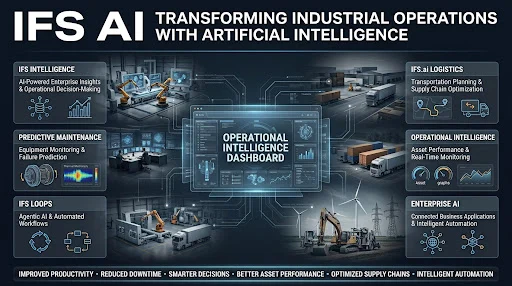
Its expanding ecosystem includes IFS Intelligence, IFS.ai Logistics, IFS.ai Operational Intelligence, and IFS Loops, which introduces agentic AI and digital workers into industrial workflows.
As industrial companies increasingly adopt AI-driven automation in 2026, IFS.ai is becoming an important platform to understand.
In this guide, we explore what IFS.ai is, how it works, its major features, real-world applications, benefits, limitations, pricing considerations, and alternatives.
What Is IFS AI?
IFS AI, commonly written as IFS.ai, is an industrial AI platform that integrates artificial intelligence, machine learning, predictive analytics, and intelligent automation into enterprise software.
It is designed to help organizations make better decisions using operational information collected from equipment, employees, production systems, supply chains, and enterprise applications.
The platform focuses particularly on asset-intensive and service-intensive industries, including:
- Manufacturing and industrial production
- Energy and utilities
- Aerospace and defense
- Oil and gas
- Telecommunications
- Construction and engineering
- Transportation and logistics
- Field service management
IFS.ai connects intelligence with operational workflows. Instead of simply generating recommendations, its capabilities can help organizations turn insights into practical actions.
For example, a manufacturing company could use AI-powered insights to identify equipment that may require maintenance. A logistics organization could optimize transportation decisions, while a field service provider could improve technician scheduling and resource allocation.
The overall objective is to make industrial operations more predictive, connected, efficient, and responsive.
According to IFS, its Industrial AI ecosystem combines contextual intelligence, advanced decision-making, and governed digital workers to improve mission-critical business processes. IFS.ai+1
How Does IFS.ai Work?
IFS.ai works by bringing together enterprise information, AI models, intelligent orchestration, and operational applications.
Rather than operating as an isolated chatbot, it connects intelligence with the systems businesses already use to manage their operations.
Its general workflow can be understood through four stages.
1. Collecting and Understanding Operational Data
Industrial businesses generate enormous amounts of information through machinery, sensors, enterprise resource planning systems, maintenance records, inventory platforms, and customer service applications.
IFS.ai uses relevant business and operational information to provide context for AI-powered analysis.
This context is important because industrial decisions depend on more than general information. An equipment maintenance recommendation, for example, should consider equipment history, operating conditions, maintenance schedules, and available resources.
2. Applying Artificial Intelligence and Machine Learning
The platform uses different AI technologies depending on the business requirement.
These can include:
- Machine learning for predictive analysis
- Large language models for conversational assistance and content generation
- Historical data analysis for identifying operational patterns
- Anomaly detection for identifying unusual conditions
- Predictive models for forecasting demand and potential failures
- Optimization algorithms for improving operational decisions
This combination allows organizations to apply AI to specific industrial challenges rather than relying on one general-purpose model.
3. Generating Contextual Insights
After analyzing relevant information, IFS.ai can provide recommendations, predictions, alerts, and decision support.
For example, an organization may identify a potential equipment problem before it causes an unexpected shutdown.
Similarly, supply chain managers can use operational information to understand inventory requirements, delivery risks, and procurement opportunities.
4. Turning Insights Into Business Actions
The final stage connects AI-generated intelligence with operational workflows.
Through its agentic AI capabilities, IFS Loops can coordinate tasks across connected enterprise systems, with appropriate controls, approvals, and monitoring.
This is an important distinction: the objective is not simply to tell employees what might happen, but to help businesses take appropriate action.IFS+2
Key Features of IFS AI
IFS.ai includes several AI-powered capabilities designed for different operational requirements.
New IFS Cloud 25R1 Update – Industrial AI in Action – Aveso Oy
#ifsloops #digitalworkers #industrialai | IFS
AI Industrial Predictive Maintenance – The Future of Equipment Reliability
10
1. IFS Intelligence
IFS Intelligence is part of the platform’s industrial intelligence ecosystem.
It helps organizations apply AI to complex operational challenges by connecting business context, data, and decision-making.
Its purpose is to make intelligence useful within actual business processes rather than keeping AI separate from everyday operations.
Potential applications include operational analysis, intelligent recommendations, and more informed enterprise decisions.
2. Predictive Maintenance
Predictive maintenance is one of the most valuable industrial AI applications.
Traditional maintenance strategies often rely on fixed schedules or respond after equipment failures occur.
IFS.ai supports a more predictive approach by using operational information and historical patterns to help identify potential equipment problems.
Businesses can use predictive insights to:
- Identify potential equipment failures.
- Plan maintenance activities earlier.
- Reduce unexpected downtime.
- Improve equipment availability.
- Allocate maintenance resources more effectively.
- Support longer asset lifecycles.
The actual results depend on equipment data quality, implementation, and the specific AI capabilities deployed.
3. IFS Loops and Agentic AI
IFS Loops is one of the particularly important developments in the IFS AI ecosystem.
It is an agentic AI platform designed to deploy industrial digital workers capable of executing complex workflows across connected enterprise systems.
Unlike conventional automation that follows predefined steps, agentic AI can use context and operational information to coordinate multiple tasks toward a defined goal.
Examples of IFS Loops digital workers include:
- Supplier Order Manager: Supports supplier communications, order confirmations, and follow-ups.
- Customer Order Manager: Helps manage customer orders, updates, and issue resolution.
- Inventory Replenisher: Supports inventory forecasting and replenishment activities.
- Material Replenisher: Helps identify parts, check availability, and coordinate replenishment.
- Supplier Invoicing Manager: Supports invoice processing, validation, and exception management.
- Knowledge Manager: Searches internal information and provides contextual answers.
- Dispatcher Assistant: Supports scheduling, routing, and service resource allocation.
- Service Planning Assistant: Helps improve service planning and workforce capacity decisions.
IFS states that its platform provides prebuilt skills, integrations, governance controls, and monitoring capabilities for digital workers. IFS+1
4. IFS.ai Logistics
IFS.ai Logistics focuses on improving transportation and supply chain operations.
Managing transportation across multiple carriers, locations, and regions can create complicated operational challenges.
The platform brings together logistics planning, execution, freight auditing, cost management, and network optimization.
Its applications include:
- Transportation planning
- Carrier selection
- Shipment tracking
- Route optimization
- Freight invoice validation
- Dispute management
- Logistics cost visibility
- Emissions reporting
IFS announced IFS.ai Logistics on March 10, 2026, positioning it as an AI-powered platform for complex enterprise transportation networks. dev.ifs.com
5. IFS.ai Operational Intelligence
Operational intelligence helps businesses understand the condition and performance of their industrial assets.
Organizations can use relevant operational signals to identify potential problems, understand equipment performance, and improve maintenance decisions.
This is particularly useful in industries where equipment downtime can interrupt production, affect safety, or create significant financial losses.
6. AI-Powered Enterprise Assistance
IFS.ai also supports AI-assisted interactions within enterprise workflows.
IFS Copilot, for example, provides conversational assistance and contextual guidance within IFS Cloud.
Depending on the implementation, users can access information, understand business processes, and receive role-specific assistance without manually searching through multiple applications.
7. AI Governance and Security
Enterprise AI requires more than intelligent features. Businesses also need controls over data access, privacy, security, and accountability.
IFS describes a security architecture that includes dedicated customer environments, encryption, role-based access, and enterprise cloud controls.
Its published trust information also identifies ISO/IEC 27001 certification and SOC 1 and SOC 2 Type II attestations for its cloud operations.
Organizations should still review the specific deployment, contractual terms, data residency arrangements, and compliance requirements before adoption. IFS
Real-World Applications of IFS.ai
IFS.ai is designed for practical industrial use cases rather than only experimental AI projects.
Here are some important applications.
Manufacturing
Manufacturers can use AI-powered intelligence to improve production planning, equipment maintenance, inventory management, and operational visibility.
For example, an organization could analyze historical machine performance to identify maintenance requirements and reduce unexpected production interruptions.
AI-assisted planning can also help businesses coordinate production schedules with material availability and customer demand.
Energy and Utilities
Energy companies operate complex infrastructure that requires continuous monitoring and maintenance.
IFS.ai can support asset performance management, predictive maintenance, operational planning, and service coordination.
These capabilities are relevant to organizations managing power generation facilities, energy infrastructure, and other critical industrial assets.
Oil and Gas
Oil and gas operations depend on expensive equipment, specialized personnel, and reliable industrial infrastructure.
AI-powered operational intelligence can help identify potential equipment problems, improve maintenance planning, and support operational decisions.
Reducing unplanned downtime is especially important in this sector because interruptions can have significant financial consequences.
Logistics and Transportation
Logistics businesses must coordinate shipments, transportation providers, delivery schedules, and freight expenses.
IFS.ai Logistics helps connect these activities through intelligent planning, execution, and cost management.
Businesses can use the platform to improve transportation visibility and manage complex logistics networks.
Field Service Management
Field service organizations need to send the right technicians to the right locations with the correct equipment and information.
AI-powered scheduling and assistance can help improve workforce coordination.
Digital workers can also support administrative activities, allowing technicians to spend more time performing valuable service work.
Benefits of Using IFS AI
IFS.ai offers several potential advantages for industrial organizations.
| Benefit | Business value |
|---|---|
| Predictive intelligence | Helps identify operational problems earlier |
| Automation | Reduces repetitive administrative work |
| Better planning | Supports informed resource allocation |
| Asset optimization | Helps improve equipment reliability |
| Supply chain visibility | Improves understanding of logistics operations |
| Workforce productivity | Reduces time spent on repetitive activities |
| Decision support | Provides contextual operational insights |
| Governance | Supports controlled enterprise AI adoption |
Improved Operational Efficiency
AI can help businesses identify inefficiencies and automate repetitive processes.
Employees can spend less time searching for information or completing routine administrative work.
Reduced Equipment Downtime
Predictive insights can help maintenance teams identify possible problems earlier and plan maintenance activities more effectively.
Better Business Decisions
IFS.ai can bring operational information together to support decisions based on relevant business context.
Increased Workforce Productivity
Digital workers can support repetitive tasks across procurement, inventory, customer orders, and service planning.
Stronger Supply Chain Management
AI-powered logistics capabilities can help businesses improve transportation planning, cost visibility, and operational coordination.
IFS AI Pricing: Is It Free or Paid?
One of the common questions about IFS.ai is whether it is free.
IFS.ai is an enterprise-focused commercial technology offering, not a general-purpose free AI chatbot.
IFS does not publish one universal public subscription price covering every IFS.ai product, deployment, and enterprise requirement.
Pricing can depend on several factors:
- Number of users and business units
- Selected IFS Cloud products
- AI capabilities and modules
- Deployment requirements
- Data and integration complexity
- Enterprise licensing agreements
- Implementation and consulting services
- Support and maintenance requirements
Companies interested in IFS.ai generally need to contact IFS or an authorized implementation partner for a tailored quotation.
It is important to distinguish between a product demonstration, an evaluation arrangement, and a fully licensed enterprise deployment.
For accurate pricing, consult the official IFS website.
IFS AI Advantages and Limitations
Although IFS.ai offers substantial enterprise potential, it is not necessarily the right solution for every business.
Advantages
- Designed for industrial and asset-intensive environments.
- Integrates AI into enterprise operational workflows.
- Supports predictive and contextual decision-making.
- Includes agentic AI and digital worker capabilities.
- Provides specialized logistics and asset intelligence applications.
- Offers enterprise-oriented security and governance features.
- Supports complex operational processes.
Limitations
- Enterprise implementation can require substantial investment.
- Pricing is not universally available as a public subscription.
- Successful deployment depends on relevant business data.
- Integration with existing systems requires planning.
- Smaller businesses may not need its extensive capabilities.
- AI-generated recommendations still require appropriate oversight.
- Benefits can vary depending on implementation quality and operational readiness.
The most important consideration is whether an organization has a specific operational problem that IFS.ai can solve economically.
IFS AI Alternatives and Competitors
IFS.ai operates in a competitive enterprise software and industrial AI market.
Businesses evaluating the platform may also consider other enterprise technology providers.
Homepage
Modernise Cloud Environments | Colt Technology Services
#d365 #d365fo #dynamics365 #microsoftdynamics365 #dynamics365 #systemsaccountants #erp #financetransformation #businesscentral #d365bc | Danny Jones
4
1. SAP
SAP provides enterprise applications for finance, manufacturing, supply chain management, procurement, and business operations.
Its AI ecosystem supports enterprise productivity, business automation, and data-driven decisions.
SAP may be suitable for organizations already operating extensive SAP infrastructure.
2. Oracle
Oracle offers enterprise applications, cloud infrastructure, database technologies, and AI-powered business solutions.
Its products support finance, supply chain, human resources, and other enterprise functions.
3. Microsoft Dynamics 365
Microsoft Dynamics 365 combines ERP and CRM applications with AI capabilities and Microsoft ecosystem integrations.
It can be attractive to organizations looking for connected business applications and productivity tools.
4. IBM Maximo
IBM Maximo focuses on enterprise asset management and asset lifecycle optimization.
It is particularly relevant for organizations managing complex equipment, infrastructure, and maintenance operations.
IFS.ai vs. Its Alternatives
| Platform | Main focus | Potential strength |
|---|---|---|
| IFS.ai | Industrial AI | Operational intelligence and industrial workflows |
| SAP | Enterprise applications | Broad ERP and business processes |
| Oracle | Enterprise cloud and applications | Database, ERP, and cloud ecosystem |
| Microsoft Dynamics 365 | ERP and CRM | Connected business applications |
| IBM Maximo | Asset management | Asset lifecycle and maintenance |
The best choice depends on an organization’s existing technology environment, industry requirements, implementation budget, and operational priorities.
Is IFS.ai Worth It?
IFS.ai can be worth considering for medium-to-large organizations that manage complex industrial operations, expensive assets, large workforces, and interconnected supply chains.
Its strongest potential value comes from connecting AI with the processes that directly affect operational performance.
For example, a manufacturing company that experiences frequent equipment interruptions may benefit from predictive maintenance capabilities.
A logistics organization managing complicated transportation networks may find IFS.ai Logistics relevant.
A service business struggling with repetitive administrative work may investigate IFS Loops and its digital workers.
However, organizations should evaluate the total cost of ownership, integration requirements, data readiness, governance, and measurable business outcomes before making a purchasing decision.
A practical pilot focused on one clearly defined workflow is often a better starting point than attempting to automate an entire enterprise immediately.
The Future of IFS AI and Industrial Artificial Intelligence
Industrial AI is moving beyond basic predictive analytics and conversational assistance.
The next stage involves systems that can understand operational context, coordinate tasks, and execute defined workflows with appropriate human oversight.
IFS Loops reflects this direction through its agentic AI platform and digital worker approach.
Several developments are likely to shape the future of IFS.ai.
More Autonomous Industrial Workflows
AI agents may increasingly coordinate procurement, inventory, scheduling, and customer service activities.
Smarter Predictive Maintenance
More connected operational data can improve the ability to identify equipment risks and support maintenance planning.
Greater Supply Chain Intelligence
Businesses will continue looking for better visibility into transportation costs, delivery performance, inventory, and supplier activity.
Human and AI Collaboration
Digital workers are likely to become more integrated into industrial teams, supporting employees instead of simply replacing existing software interactions.
Stronger AI Governance
As AI becomes more involved in important operational decisions, transparency, access controls, monitoring, and accountability will become increasingly important.
Ultimately, the future of industrial AI will depend on whether platforms can deliver measurable improvements in real operating environments.
FAQs
1. What is IFS AI?
IFS AI, also known as IFS.ai, is an industrial artificial intelligence platform developed by IFS. It integrates AI, machine learning, predictive intelligence, and automation into enterprise operations.
2. What does IFS.ai stand for?
IFS.ai refers to IFS’s industrial artificial intelligence ecosystem. It is a brand and platform name rather than a separate general-purpose AI chatbot.
3. Is IFS.ai free to use?
No universal free consumer version is offered as its main product. IFS.ai is an enterprise-focused commercial offering, and pricing depends on the selected products and deployment requirements.
4. What is IFS Loops?
IFS Loops is an agentic AI platform that enables businesses to deploy digital workers for coordinating and executing operational workflows across enterprise systems.
5. How does IFS.ai help manufacturers?
It can support predictive maintenance, production planning, operational intelligence, inventory management, and workflow automation.
6. Can IFS.ai reduce equipment downtime?
It can help identify potential equipment problems through predictive insights and support better maintenance planning. Actual downtime reduction depends on the data, equipment, and implementation.
7. What is IFS.ai Logistics?
IFS.ai Logistics is an AI-powered enterprise logistics solution designed to connect transportation planning, execution, freight auditing, cost governance, and network optimization.
8. Does IFS.ai use machine learning?
Yes. IFS describes its AI ecosystem as using machine learning, large language models, historical data, and other AI technologies depending on the application.
9. Is IFS.ai suitable for small businesses?
It may be more appropriate for medium-to-large organizations with complex industrial operations. Smaller businesses should evaluate whether its enterprise capabilities justify the investment.
10. What are the main IFS.ai competitors?
Relevant competitors include SAP, Oracle, Microsoft Dynamics 365, and IBM Maximo. The closest alternative depends on the particular business function being evaluated.
11. Is IFS.ai secure?
IFS describes enterprise security measures including isolated customer environments, encryption, access controls, and independent security assurance. Customers should review the specific deployment and contractual security documentation.
12. What is the future of IFS.ai?
Its future direction includes agentic AI, digital workers, predictive intelligence, intelligent logistics, and greater automation of complex industrial workflows.
Conclusion
IFS AI (IFS.ai) is changing how modern businesses use artificial intelligence to manage industrial operations, improve productivity, and make smarter decisions. With capabilities such as predictive maintenance, intelligent automation, AI-powered logistics, and agentic digital workers through IFS Loops, the platform helps organizations connect AI technology with real business workflows. Although implementation costs, integration requirements, and data readiness are important considerations, IFS.ai offers significant potential for manufacturing, energy, transportation, and other asset-intensive industries. As industrial AI continues to evolve, IFS.ai could play an important role in building more intelligent, efficient, and connected enterprises.