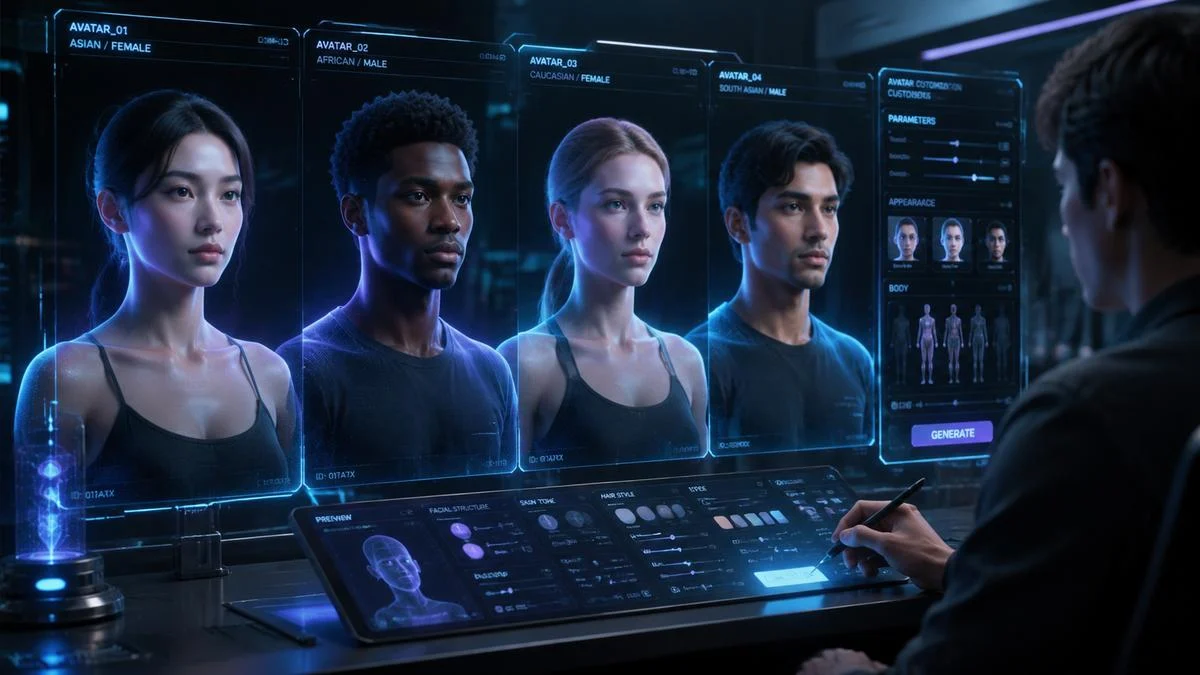
AI-tranny is a search phrase associated with AI-generated transgender-themed characters, virtual companions, and synthetic adult-oriented content. It does not identify one verified AI product, so users should evaluate the actual platform, its technology, privacy practices, and treatment of transgender representation.
At a Glance
- Meaning: A search phrase associated with transgender-themed AI characters and virtual experiences.
- Technology: May involve generative AI, large language models, image synthesis, and conversational systems.
- Applications: Character creation, virtual conversations, creative storytelling, and synthetic media.
- Availability: Related experiences exist across different AI platforms, but there is no verified single product behind the keyword.
- Main concerns: Privacy, consent, misleading representations, content moderation, and image misuse.
- Best practice: Use respectful terminology and choose platforms with transparent privacy and content policies.
What Does AI-Tranny Mean?
The phrase AI-tranny appears in searches related to artificial intelligence and transgender-themed digital characters. It is a search label rather than a clearly established technical category.
Depending on the website, the search may lead to several different experiences:
- AI-generated transgender character images.
- Conversational virtual companions.
- AI-powered character roleplay.
- Synthetic video and image generation.
- Adult-oriented AI character experiences.
- Community-created digital characters.
These experiences are not necessarily connected. Each platform may use different models, interfaces, moderation systems, and business models.
Understanding the terminology
An important distinction concerns the language used to describe transgender people.
The word included in this search phrase is considered a derogatory slur in mainstream media guidance. GLAAD recommends avoiding it when describing transgender people, except when discussing the word itself or accurately reporting its contextual use. GLAAD+1
For technology publications, more appropriate descriptions include:
- Transgender AI characters.
- AI-generated trans characters.
- Transgender virtual companions.
- AI character-generation tools.
- AI-powered digital personalities.
Using respectful terminology does not require ignoring the keyword. Publishers can address the search phrase while maintaining professional editorial standards.
How Does Transgender AI Character Technology Work?
AI character platforms can combine several technologies to create digital personalities and visual characters.
The exact implementation depends on the service. Not every platform offers all these capabilities.
Best AI Avatar Video Creator Reviews: 2026 Top Picks
I thought I’d found friendship with a Replika AI chatbot. Then it tried to turn up the heat – CNA
AI Influencer Secrets: Launch a Viral Digital Persona!
1. Generative AI Models
Generative AI creates new content based on user instructions.
Image-generation systems interpret prompts describing appearance, clothing, environments, lighting, and artistic styles. They then produce synthetic images.
Some systems use diffusion models, which gradually transform random noise into an image that follows the requested description.
2. Large Language Models
Large language models (LLMs) power conversational experiences.
They interpret written instructions and generate responses based on their training and available conversational context.
A virtual companion may use an LLM to maintain a character’s personality, respond to questions, and participate in fictional conversations.
However, an AI character does not possess human experiences, emotions, or personal identity.
3. Character Customization
Some character-generation systems allow users to customize:
- Facial appearance.
- Hairstyles and clothing.
- Visual presentation.
- Personality descriptions.
- Communication styles.
- Fictional backgrounds.
- Conversation settings.
Available controls differ significantly between providers.
Customization should also avoid using another person’s likeness without permission.
4. Image and Video Generation
Image-generation tools create individual visual outputs. Video-generation systems extend this process by producing moving sequences.
Depending on the model, users may describe movement, camera angles, environments, and character actions.
Video consistency remains a technical challenge. A character may look different between scenes, especially when the platform does not support persistent character references.
5. Conversational Memory
Some AI companions maintain conversation history or summaries.
This helps a character retain details from earlier interactions. However, memory is not necessarily permanent.
Providers may restrict context length, delete old conversations, or use separate storage systems for account information and conversation history.
Users should examine these limitations before sharing personal information.
Key Features of AI-Generated Transgender Characters
There is no universal feature list for the AI-tranny search category. Capabilities depend on the individual application.
Nevertheless, several features commonly appear in AI character-generation products.
Visual Character Creation
Image-generation systems can create fictional characters using descriptive prompts.
Users may specify visual styles, clothing, facial features, backgrounds, and artistic direction.
Results depend on model capabilities, prompt quality, and content restrictions.
Interactive Conversations
AI companions can simulate conversations through text-based interfaces.
Some products offer predefined personalities, fictional scenarios, and conversational customization.
Their responses are generated rather than expressions of genuine human understanding.
Personalized Characters
Character customization allows users to develop fictional personalities and visual identities.
Some applications provide reusable character profiles, making it easier to maintain consistency across conversations.
Creative Storytelling
AI characters can support fictional writing, dialogue development, interactive storytelling, and world-building.
Writers can use these tools to explore different character perspectives without treating generated personalities as representations of real transgender experiences.
Multiple Content Formats
Depending on the platform, AI-generated content may include:
- Static images.
- Character descriptions.
- Text conversations.
- Fictional dialogue.
- Short synthetic videos.
- Voice-based interactions.
A platform advertising several formats should be evaluated carefully. Marketing descriptions do not establish that every feature works reliably.
Main Uses and Applications
The technology behind transgender-themed AI characters has several potential applications beyond adult-oriented entertainment.
Free Character Sheet Generator | Customize for RPG, D&D & Tabletop Games
AI chatbot on smart phone screen
Original Character Design Guide: Build Characters With Motivation, Voice, and Continuity – Headcanon Blog
Digital Art and Character Design
Artists can use generative image tools to experiment with fictional character appearances.
These systems can accelerate early concept development and help creators explore different visual directions.
Human editing remains important for anatomical accuracy, artistic consistency, and originality.
Interactive Entertainment
AI characters can participate in fictional conversations and interactive experiences.
Game developers and independent creators may use conversational models to prototype non-player characters.
This can make fictional environments more responsive than traditional dialogue systems.
Creative Writing
Writers can experiment with dialogue, character backgrounds, and fictional scenarios.
AI can help generate initial ideas, but writers should review the output for stereotypes and inaccurate portrayals.
Digital Companionship
Some applications position AI characters as virtual companions.
Users may interact with these systems through text or voice, depending on the service.
However, simulated companionship should not be confused with human relationships or professional emotional support.
Research and Prototyping
Researchers can examine how generative systems represent gender, appearance, language, and identity.
They can also investigate biases in training datasets and how prompt wording influences generated outputs.
These applications require careful evaluation rather than assuming that generated characters accurately represent real communities.
Benefits of AI Character Generation
When used responsibly, AI character technology can provide practical creative benefits.
| Benefit | Practical value |
|---|---|
| Faster prototyping | Creates initial character concepts quickly |
| Creative flexibility | Supports different fictional appearances and styles |
| Interactive storytelling | Enables dynamic character conversations |
| Accessibility | Reduces the technical barrier to basic character creation |
| Experimentation | Helps creators test visual and narrative ideas |
| Content development | Supports early-stage creative workflows |
Reduced Technical Barriers
Traditional character design can require specialized artistic skills and software.
AI tools can make early experimentation easier through natural-language prompts.
Users can describe an idea rather than manually creating every visual element.
Faster Creative Iteration
Generative systems can produce multiple variations from related prompts.
Creators can compare these variations and refine their preferred direction.
The final output may still require manual correction.
Flexible Story Development
Conversational AI can help writers explore different dialogue styles and narrative possibilities.
This is particularly useful during brainstorming and early development.
Limitations and Challenges
AI character technology has meaningful limitations. Understanding them helps users avoid unrealistic expectations.
Inconsistent Image Generation
AI image models can produce visual inconsistencies.
A character’s facial features, clothing, proportions, or other details may change between generations.
Maintaining a consistent identity often requires reference images, specialized workflows, or additional editing.
Stereotypical Representation
Training datasets may contain biased or incomplete representations of gender-diverse people.
Consequently, generated characters can reproduce stereotypes or emphasize exaggerated physical characteristics.
This is a concern when fictional characters are presented as representative of real transgender people.
Limited Conversational Understanding
LLMs generate responses based on learned patterns and available context.
They can misunderstand questions, invent information, or produce repetitive dialogue.
A convincing conversational style does not guarantee factual accuracy.
Content Restrictions
Different providers apply different content policies.
A platform may allow fictional character creation but restrict explicit imagery, certain prompts, or specific interactions.
Users should review these policies before purchasing credits or subscriptions.
Character Consistency
Maintaining the same personality and appearance across different sessions can be difficult.
Some platforms offer memory and character profiles, while others generate each interaction with limited continuity.
These capabilities should be tested rather than assumed.
Pricing and Subscription Considerations
There is no verified universal price for AI-tranny because the phrase does not identify one particular service.
Related character-generation applications may use different pricing models.
| Pricing model | How it works | What to check |
|---|---|---|
| Free access | Limited features without payment | Daily limits and restrictions |
| Subscription | Recurring monthly or annual payment | Renewal and cancellation terms |
| Credit-based | Users purchase generation credits | Credit expiry and generation costs |
| Pay-per-generation | Charges depend on individual outputs | Cost per image or video |
| API pricing | Developers pay for model usage | Token, image, and infrastructure costs |
Hidden Costs to Consider
A low advertised subscription price does not necessarily represent the total cost.
Before paying, investigate:
- Whether image generation consumes separate credits.
- Whether video creation costs more than image creation.
- Whether unused credits expire.
- Whether premium models require additional payment.
- Whether subscriptions automatically renew.
- Whether commercial usage requires another license.
- Whether cancellation immediately ends access.
Editorial recommendation: Do not assume that a free trial includes unrestricted generation or that a paid subscription includes commercial usage rights.
Privacy and Security Considerations
Privacy is particularly important when using AI companion and character-generation platforms.
Users may submit prompts, photographs, voice recordings, personal descriptions, and conversation histories.
That information can reveal more than users initially expect.
Understand Data Collection
Read the platform’s privacy policy before creating an account.
Look for information about:
- Personal information collection.
- Conversation storage.
- Uploaded image retention.
- Third-party service providers.
- Advertising and analytics.
- Account deletion.
- Data-sharing practices.
Check Data Retention
Some services retain user-generated content after a session ends.
Others may store conversation histories to support account features.
Do not assume that deleting a conversation automatically deletes every associated copy.
Protect Personal Images
Avoid uploading photographs of other people without permission.
Never use AI tools to create deceptive intimate imagery of real individuals.
AI-generated content should not be used to impersonate, harass, threaten, or humiliate someone.
Understand AI Provider Policies
Some character applications use third-party AI models through APIs.
This means the application and underlying model provider may have separate data-handling policies.
A platform’s marketing claims do not establish how every connected provider processes information.
SOC 2 reporting, where applicable, also does not automatically guarantee zero data retention.
Ethical Issues in AI-Generated Transgender Representation
One of the most important aspects of this topic is the difference between fictional character creation and the representation of real communities.
AI-generated characters can provide creative flexibility. However, they can also reproduce harmful assumptions when developers prioritize stereotypes over realistic representation.
Avoid Reducing Identity to Appearance
Being transgender is not defined by a particular appearance, body type, clothing style, or voice.
A character generator that treats a single physical appearance as representative of all transgender people presents an incomplete picture.
Distinguish Fiction from Reality
AI-generated characters are fictional digital creations.
They should not be presented as real people or authentic representations of individual transgender experiences.
Address Nonconsensual Image Generation
One serious concern is using AI to create intimate or misleading images of identifiable people.
A person’s publicly available photograph does not automatically grant permission to create synthetic sexual imagery.
News coverage has documented concerns about AI-generated sexual content and the objectification of transgender women. newsgram.com+1
Encourage Responsible Development
Developers can improve representation by:
- Reviewing training data for harmful stereotypes.
- Providing clear content policies.
- Respecting the rights of people whose likenesses appear in content.
- Offering accessible reporting mechanisms.
- Clearly labeling synthetic media.
- Consulting diverse perspectives during product development.
Responsible development requires more than adding a gender-related customization option.
AI-Tranny Alternatives and Related Platforms
Since the keyword does not identify one verified product, users should compare actual AI platforms according to their intended application.
The following are relevant technology categories and established services, not verified one-to-one replacements for a product called AI-Tranny.
| Platform | Target user | Key strength | Pricing transparency | Main limitation |
|---|---|---|---|---|
| Character.AI | Interactive character users | Character-based conversations | Check current plans | Features and content depend on platform policies |
| SeaArt AI | Digital artists | AI image and character creation | Check current credit plans | Output quality and restrictions vary |
| Hugging Face | Developers and researchers | Model discovery and experimentation | Varies by model and service | Requires technical evaluation |
| Stable Diffusion | Image creators | Flexible image-generation workflows | Depends on hosting and implementation | Setup and model selection can require technical skills |
| Janitor AI | Character roleplay users | Character-oriented interactions | Verify current service terms | Availability and model integrations can change |
These platforms should not be treated as equivalent products.
For example, a conversational character application and an image-generation model solve different problems.
How to Choose an Alternative
Start by identifying the content you want to create.
For image creation: Evaluate image quality, reference-image support, editing controls, and usage rights.
For conversations: Examine character memory, response quality, customization, and moderation.
For development: Review model availability, API documentation, licensing, and hosting requirements.
For research: Examine model documentation, datasets, evaluation methods, and reproducibility.
A useful comparison should focus on demonstrated capabilities rather than promotional claims.
Who Should Explore This Technology?
AI character-generation technology can serve different audiences, depending on the platform and its capabilities.
General AI Enthusiasts
People interested in generative AI can explore how models create fictional personalities and visual characters.
Digital Artists
Artists can use character-generation systems to experiment with designs, illustrations, and fictional concepts.
Content Creators
Writers and creators can use conversational AI for brainstorming, character development, and interactive storytelling.
Developers
Developers can investigate model APIs, character memory, image-generation pipelines, and conversational interfaces.
Researchers
Researchers can study algorithmic bias, synthetic media, representation, and the social effects of AI-generated content.
Common Mistakes When Exploring AI Character Platforms
Several mistakes can lead to disappointing results or unnecessary privacy risks.
- Assuming every platform is the same: Image generators and AI companions have different technical capabilities.
- Trusting promotional descriptions: Advertised features should be tested before purchasing.
- Ignoring privacy policies: Uploaded images and conversations may be retained.
- Expecting perfect realism: AI-generated images can contain inconsistencies.
- Confusing simulated emotions with real feelings: AI companions generate responses rather than experience human emotions.
- Ignoring usage licenses: Personal access does not automatically include commercial rights.
- Using disrespectful prompts: Stereotypical descriptions can produce misleading representations of transgender people.
- Uploading other people’s photographs without consent: This creates ethical and potentially legal problems.
Latest Developments in AI Character Technology
AI character technology continues to develop through improvements in generative models, conversational systems, and multimodal applications.
Three areas deserve particular attention.
Multimodal AI Experiences
Multimodal AI combines different types of information, such as text, images, audio, and video.
This allows applications to move beyond traditional text-only conversations.
However, multimodal functionality varies between models and products.
Better Character Consistency
Developers are working on methods that help AI systems preserve character appearance across multiple generations.
Reference images, character embeddings, and improved conditioning techniques can help maintain visual consistency.
Results still depend on the model and implementation.
More Advanced Conversational Systems
Newer conversational architectures can support richer context and more natural interactions.
Some applications combine language models with memory systems and external tools.
These features can improve continuity, but they do not eliminate hallucinations or guarantee accurate responses.
Important distinction: These are broader AI industry developments, not confirmed features of a specific AI-tranny product.
FAQs
1. What is AI-tranny?
AI-tranny is a search phrase associated with AI-generated transgender-themed characters, virtual companions, and synthetic content. It does not identify one independently verified AI product or company.
2. Can AI generate transgender characters?
Yes. Generative AI image models and character-generation applications can create fictional transgender characters using descriptive prompts. Results depend on model capabilities, training data, and platform restrictions.
3. Is AI-tranny a free AI tool?
There is no verified single AI-tranny product with an established pricing structure. Related applications may offer free access, subscriptions, credit-based generation, or paid services.
4. Is it safe to use AI character generators?
Safety depends on the platform’s privacy practices, security controls, content moderation, and data-retention policies. Users should review these policies and avoid uploading private images or sensitive personal information unnecessarily.
5. What are the alternatives to AI-tranny?
Related alternatives include Character.AI for conversational characters, SeaArt AI for image generation, Hugging Face for AI model discovery, and Stable Diffusion for customizable image-generation workflows. Their capabilities and usage policies differ.
Conclusion
AI-tranny is a search phrase associated with transgender-themed AI characters, virtual companions, and generative media rather than a clearly established standalone AI product.The underlying technology can include generative image models, large language models, conversational memory, and synthetic media tools.Its potential applications include creative design, interactive storytelling, character development, and AI research.However, users should consider privacy, content restrictions, model limitations, consent, and responsible representation before choosing a platform.The most important step is to evaluate the actual service rather than relying on an ambiguous search label. Understanding its technology, data policies, pricing, and intended use will help users make better decisions.