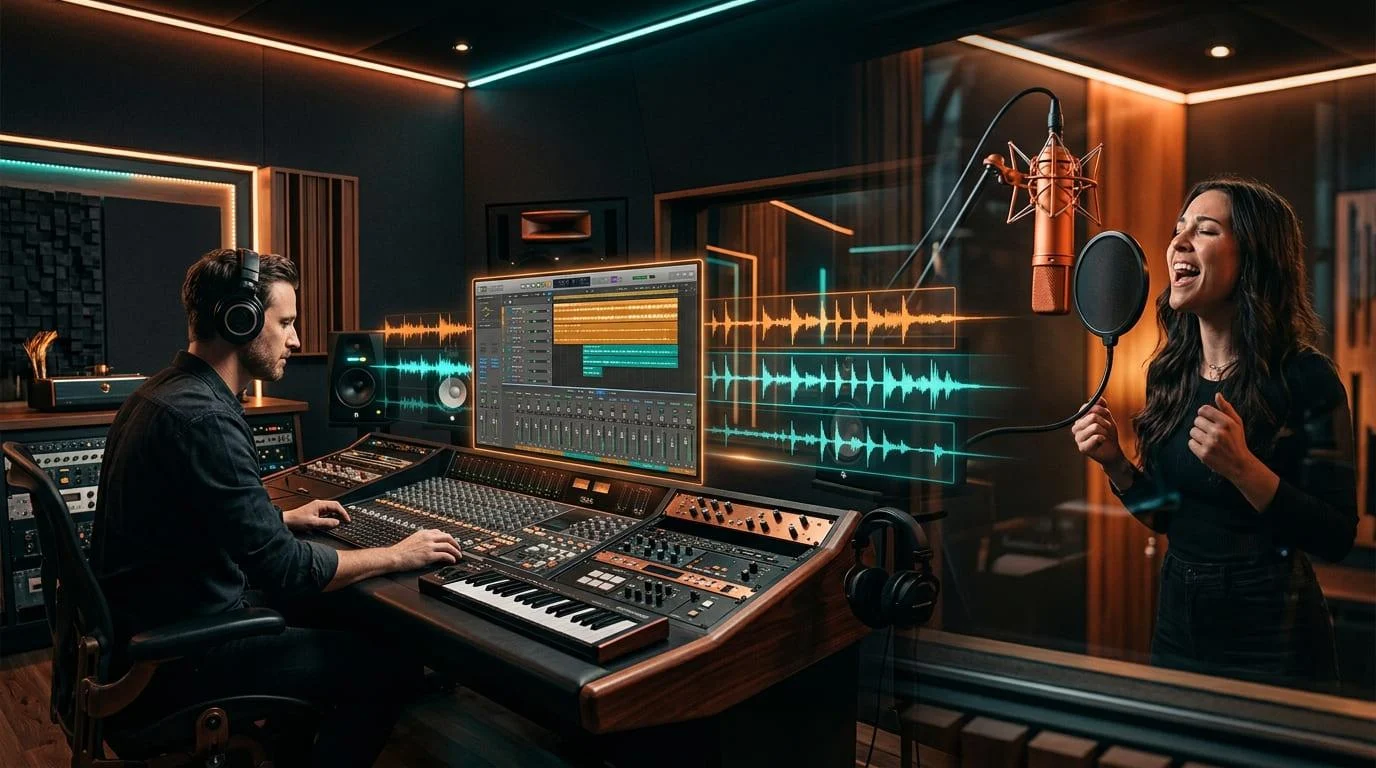
AI singers are artificial intelligence systems that generate singing voices, reproduce vocal performances, or create entirely synthetic musical artists. They allow creators to produce songs, experiment with different vocal styles, and develop music without always recording a traditional singer.
At a Glance
- AI singers use machine learning and voice synthesis to generate artificial singing performances.
- They can create vocals from written lyrics, melodies, recordings, or musical instructions.
- Some tools generate complete songs, while others focus on vocal synthesis and voice conversion.
- Musicians use AI vocals for demos, independent music, multilingual content, and creative experimentation.
- Voice cloning raises important questions about consent, copyright, ownership, and artist identity.
- AI-generated vocals can support human creativity, but they do not eliminate the importance of musical direction and production skills.
What Are AI Singers?
AI singers are computer-generated vocal performers created through artificial intelligence. They can sing original lyrics, reproduce melodies, generate harmonies, and produce vocal performances that resemble human singing.
The term covers several different technologies. It does not refer to one specific application or company.
Some AI singers are entirely fictional musical identities. Others are synthetic versions of existing vocal styles or authorized digital replicas of real performers.
How AI Singers Differ From Traditional Singers
Traditional singers use their voices and musical abilities to perform songs. AI singers generate or transform vocal performances through trained computational models.
| Category | Traditional singers | AI singers |
|---|---|---|
| Vocal production | Human performance | Synthetic or converted audio |
| Lyrics | Written or interpreted by people | Human-written or AI-assisted |
| Melody | Sung by a performer | Generated or supplied as input |
| Voice identity | Human artist | Synthetic or licensed identity |
| Performance editing | Recording and vocal processing | AI generation and digital editing |
| Availability | Depends on the performer | Depends on software and licensing |
AI singers do not necessarily replace human musicians. They offer another way to develop, arrange, and produce musical ideas.
How Do AI Singers Work?
AI singing technology combines machine learning, digital signal processing, and audio generation.
The exact process depends on the software. However, most systems follow a similar workflow.
Synthesizer V Studio 2 Pro Review: AI Vocals Perfected? – Audiofanzine
How to Modify Music Generated by Suno Using ACE Studio
ACE Studio: Der ultimative KI-gestützte Vocal Production Workflow 2025
1. Voice Model Training
An AI singing model learns patterns from audio recordings and other training material.
These patterns can include:
- Vocal tone and texture
- Pitch and melody
- Pronunciation
- Singing rhythm
- Breathing patterns
- Vibrato and vocal expression
- Different musical styles
The model learns relationships between sounds and vocal characteristics. It then uses those patterns to generate or transform audio.
The quality and diversity of the training material influence the output.
2. Lyrics and Melody Processing
Some platforms accept written lyrics and generate a complete song. Others require users to provide a melody through MIDI notes or audio recordings.
For example, MIDI-based vocal synthesis lets producers specify individual notes, lyrics, and timing.
This gives creators greater control over how the synthetic singer performs.
3. AI Vocal Generation
The system converts musical instructions into singing audio.
Depending on the model, it may generate:
- Lead vocals
- Background vocals
- Harmonies
- Choir arrangements
- Different vocal registers
- Genre-specific singing styles
More advanced tools allow users to adjust pronunciation, pitch, timing, and expression.
4. Audio Editing and Production
Generated vocals often require additional production work.
Creators may use equalization, compression, reverb, pitch correction, and other audio effects.
Professional editing helps synthetic vocals fit naturally into a musical arrangement.
5. Final Music Export
After reviewing and editing the generated vocals, users can combine them with instruments and other production elements.
The finished track can then be exported for personal projects, videos, demos, or commercial distribution, subject to the applicable platform licenses and third-party rights.
Main Types of AI Singers
Not every AI singing platform performs the same task. Understanding the different categories helps users select the appropriate technology.
1. AI Vocal Synthesis
AI vocal synthesis generates singing from musical instructions, such as MIDI notes and lyrics.
It is particularly useful for music producers who want control over individual notes, pronunciation, and vocal expression.
2. AI Voice Cloning
AI voice cloning attempts to reproduce the characteristics of a particular voice using reference recordings.
Authorized voice cloning can help singers create additional performances without recording every vocal part manually.
However, cloning another person’s voice without permission creates serious ethical and legal risks.
3. AI Voice Conversion
Voice conversion transforms an existing vocal performance into another synthetic voice.
The original recording supplies the performance, including much of its timing and phrasing. The AI changes the perceived vocal identity.
This approach can help producers experiment with different vocal textures.
4. AI Song Generation
AI song generators create broader musical compositions from text descriptions, lyrics, or other inputs.
They may generate singing, instrumentation, arrangements, and complete musical tracks.
Unlike dedicated vocal synthesizers, these tools generally provide less detailed control over every individual vocal note.
5. Virtual AI Singers
Virtual AI singers are digital musical identities designed to release music, perform online, and interact with audiences.
They may have fictional names, visual identities, personalities, and musical styles.
Some are powered by AI-generated vocals, while others combine human performers with digital characters and production technology.
Popular AI Singer Tools and Platforms
Several platforms provide AI singing, vocal generation, or voice conversion capabilities. Their workflows and intended audiences differ.
ACE Studio Artist 2.0 AI Music Studio Software – Lifetime License | Sweetwater
Kits AI — Studio-quality AI music tools
1. ACE Studio
Detailed vocal control
ACE Studio focuses on AI-powered vocal synthesis and music production.
Its Vocal Synth workflow allows users to create singing from MIDI notes and lyrics. The platform also provides voice models, vocal editing, and voice-cloning capabilities.
Its documentation describes controls for editing notes, lyrics, pitch, and vocal performance.
Best suited for: Music producers, composers, and creators who want detailed control over synthetic singing.
Official website: ACE Studio. ACE Studio+2
2. Kits AI
Voice conversion
Kits AI provides AI voice conversion, voice cloning, and generative vocal tools.
Musicians can experiment with different vocal identities and transform existing recordings.
Its pricing structure also illustrates an important consideration: conversion minutes and downloadable audio minutes can have separate limits.
Best suited for: Singers, producers, and content creators working with existing vocal recordings.
Official website: Kits AI. Kits AI+1
3. Suno
Complete song generation
Suno focuses on generating complete musical compositions using AI.
Its features include song generation, vocal creation, editing, remixing, and voice-related capabilities.
Its Voices feature allows eligible users to record or upload their own voice and incorporate it into generated songs.
Commercial usage rights depend on the applicable subscription and terms. Users should check the current plan before publishing music commercially.
Best suited for: Beginners, independent musicians, and creators who want to generate songs without building every musical component manually.
Official website: Suno. Pricing+1
4. Synthesizer V Studio
Synthesizer V Studio belongs to the dedicated singing-synthesis category.
It is relevant to composers who want to build vocal performances through note-based musical composition rather than simply generate a complete song from a text prompt.
Its suitability depends on the available voice databases, supported languages, licensing, and the production workflow.
Best suited for: Composers and producers who prefer structured vocal composition.
Official product information: Dreamtonics.
AI Singer Platform Comparison
| Platform | Main capability | Target user | Pricing transparency | Main consideration |
|---|---|---|---|---|
| ACE Studio | Vocal synthesis | Producers and composers | Published plans | Voice-specific licensing |
| Kits AI | Voice conversion and cloning | Vocal producers | Published plans | Download limits |
| Suno | Complete song generation | General creators | Published plans | Commercial rights depend on plan |
| Synthesizer V Studio | Singing synthesis | Composers | Product and voice licensing | Voice database compatibility |
These platforms are not direct replacements for one another. A complete song generator and a MIDI-based vocal synthesizer solve different production problems.
What Can You Create With AI Singers?
AI singers have applications across several areas of the music and entertainment industries.
Music Production and Songwriting
Producers can use synthetic vocals to test melodies, experiment with arrangements, and develop song demonstrations.
A songwriter can create a melody, add lyrics, and generate a vocal performance before hiring a professional singer.
This can make early-stage experimentation more accessible.
Independent Music Creation
Independent musicians can explore vocal arrangements without organizing a full recording session.
They can test different vocal tones, harmonies, and musical directions.
However, synthetic vocals still require thoughtful composition and production to sound convincing.
Multilingual Music
AI vocal technology can support songs in multiple languages.
For example, a producer may create different vocal versions of a composition for international audiences.
Pronunciation quality, language support, and cultural interpretation still require careful review.
Video Games and Animation
Game developers and animation studios can experiment with synthetic singing for fictional characters.
This can support musical storytelling, temporary vocal performances, and character development.
Commercial projects still require appropriate licensing for the voices and generated material.
Advertising and Social Media
Content creators can use AI vocals for promotional videos, original jingles, short-form entertainment, and branded content.
They should check commercial usage terms before monetizing or distributing generated audio.
Benefits of AI Singers
AI singing technology offers practical advantages for musicians and digital creators.
1. Lower Barriers to Music Production
Traditional recording can require singers, studio time, equipment, and production budgets.
AI vocal tools give creators another option. They can experiment with synthetic performances before investing in a full recording session.
2. Faster Creative Experimentation
Producers can test multiple vocal arrangements and musical directions.
This is especially useful during songwriting and pre-production, when creators are still deciding how a track should sound.
3. Flexible Vocal Styles
Depending on the platform, users can experiment with different vocal characteristics, including:
- Male and female vocal ranges
- Pop and electronic singing
- Soul and R&B vocals
- Classical-inspired performances
- Choirs and harmonies
- Different accents and languages
The actual selection depends on each platform’s available voice models.
4. Support for Independent Creators
Independent musicians may not have access to professional singers for every project.
AI vocal synthesis can help them produce demonstrations, explore arrangements, and develop musical concepts.
5. Creative Accessibility
People without traditional singing skills can experiment with vocal music.
They can focus on songwriting, melodies, and musical direction while AI handles some aspects of vocal performance.
Limitations of AI Singers
Despite significant improvements, AI singers have technical and creative limitations.
1. Unnatural Vocal Expression
Some generated vocals sound mechanical or emotionally inconsistent.
AI may struggle with subtle phrasing, breathing, emotional delivery, and expressive transitions.
These problems become more noticeable in complex musical performances.
2. Pronunciation Problems
AI-generated vocals may mispronounce words, particularly in less-supported languages.
Unusual names, regional accents, and complicated lyrics can also create problems.
Human review remains important.
3. Limited Artistic Interpretation
A human singer interprets lyrics through personal experience, emotion, and performance choices.
AI can imitate aspects of expression, but convincing vocal output does not automatically represent genuine human experience.
4. Voice Consistency
Some tools may produce slightly different results across generations.
Maintaining the same vocal identity, pronunciation, and expressive quality throughout a complete album can require additional editing.
5. Copyright and Licensing Uncertainty
AI-generated music can involve several different rights:
- Rights to the original lyrics
- Rights to the musical composition
- Rights to reference recordings
- Rights associated with a cloned voice
- Rights to the generated sound recording
A subscription does not automatically resolve every copyright or personality-rights issue.
Creators should review platform terms and obtain permission for material they do not own.
AI Voice Cloning, Copyright, and Ethical Concerns
Voice cloning is one of the most controversial aspects of AI singing technology.
It can reproduce recognizable vocal characteristics using recorded examples. This creates creative opportunities but also introduces risks involving identity and consent.
Spotify Secures Merlin Partnership to Expand AI Remix and Covers Tool to Independent Artists | Music News | MusicNews.com
musicnews.com
Unauthorized Artist Voice Cloning
An AI-generated song may imitate a famous singer without that person’s permission.
The resulting audio can mislead listeners into believing the artist recorded or approved the performance.
This creates potential problems involving reputation, commercial exploitation, and false endorsement.
A notable example is the unauthorized AI-generated track Heart on My Sleeve, which imitated Drake and The Weeknd.
The UK government’s copyright and AI report discusses this incident alongside the wider risks of digital voice replicas. GOV.UK
The Importance of Artist Consent
Responsible AI music production should prioritize permission and transparency.
Before using a voice model, creators should establish:
- Whether the voice belongs to a real individual.
- Whether the person authorized its use.
- Whether commercial use is permitted.
- Whether the license covers distribution and monetization.
- Whether the generated performance requires disclosure.
A voice being available online does not mean it is free to clone.
Music Streaming Platforms and AI Disclosure
Streaming services are also responding to AI-generated music.
In September 2025, Spotify announced stronger protections against unauthorized vocal impersonation. Its policy states that vocal impersonation is allowed only when the impersonated artist authorizes it.
Spotify also announced support for industry-standard AI disclosures in music credits through DDEX. These disclosures can distinguish AI-generated vocals from other AI-assisted production activities. Spotify
This distinction matters because using AI for mastering is not the same as cloning an artist’s voice.
Copyright Ownership and Legal Questions
Copyright rules vary between countries.
In the United States, the Copyright Office has emphasized the importance of human authorship when determining whether creative work qualifies for copyright protection.
AI assistance does not automatically prevent copyright protection. However, purely AI-generated material may not qualify without sufficient human creative contribution. Copyright+1
India is also developing important legal precedents concerning performers’ identities.
The World Intellectual Property Organization discussed the 2024 Arijit Singh case, which addressed unauthorized AI-based voice replication and personality rights. WIPO+1
Practical takeaway: Creators should not assume that generated music is automatically copyright-free or that a platform’s commercial license grants permission to imitate a real artist.
AI Singers Pricing: What Does It Cost?
There is no universal price for AI singers. Costs depend on whether users need complete song generation, vocal synthesis, or voice conversion.
Some services offer free access with limited functionality. Others use monthly subscriptions, annual billing, credits, or download allowances.
The following examples reflect publicly listed prices checked for this article in November 2026. Prices may change and may exclude taxes.
| Platform | Published pricing example | Important limitation |
|---|---|---|
| ACE Studio | Artist plan approximately $16.58/month with annual billing | Credit-based features and voice-cloning slots |
| Kits AI | Free, $10, $30, and $60 monthly tiers | Conversion and download allowances differ |
| Suno | Free and paid subscription options | Commercial rights depend on subscription terms |
| Synthesizer V Studio | Product and voice-specific licensing | Costs depend on selected products |
ACE Studio+2
Understanding Hidden Costs and Usage Limits
The advertised subscription price does not always represent the complete production cost.
Before purchasing, investigate these details:
- Download limits: Some platforms separate audio generation from downloadable minutes.
- Voice slots: Custom voice storage may be restricted by subscription.
- Monthly credits: Additional generation features may consume separate credits.
- Commercial licensing: Free-tier outputs may have different usage permissions.
- Voice licensing: Certain voice models may require separate commercial permission.
- Cancellation restrictions: Custom voices or advanced tools may become unavailable after cancellation.
For example, Kits AI lists separate conversion and download allowances. Its pricing documentation also explains that custom voices can become frozen after a subscription ends. Kits AI+1
ACE Studio similarly distinguishes between royalty-free voices and selected voices requiring a third-party license. ACE Studio Docs
These details matter when selecting a platform for recurring commercial projects.
Privacy and Security Considerations
AI singing platforms may process personal recordings, vocal samples, lyrics, and other creative material.
These inputs can contain commercially valuable or personally identifiable information.
Before uploading recordings, examine the platform’s privacy policy and terms.
Pay particular attention to:
- Whether uploaded recordings are retained.
- Whether audio can be used for model training.
- Whether voice models remain accessible after cancellation.
- Whether third-party processors receive uploaded files.
- Whether users can delete their recordings and custom models.
- Whether commercial voice cloning requires identity verification.
Never upload another person’s recording for voice cloning without appropriate authorization.
Also, do not assume that a platform’s security statements guarantee a particular data-retention policy. Read the actual terms governing your account and uploaded material.
How to Choose the Right AI Singer Tool
Choosing the right AI singer depends on your creative requirements.
A beginner generating a complete song has different needs from a professional producer creating a precise vocal arrangement.
Consider these factors before subscribing.
Define Your Production Goal
Start by identifying what you want to create.
- Complete songs from text prompts: Consider Suno.
- Detailed MIDI-based singing: Consider ACE Studio.
- Converting existing vocals: Consider Kits AI.
- Structured singing synthesis: Explore Synthesizer V Studio.
Evaluate Vocal Quality
Listen to actual examples rather than relying exclusively on marketing demonstrations.
Check pronunciation, emotional expression, vocal clarity, and consistency.
Test the software with lyrics similar to those you intend to publish.
Check Commercial Rights
Read the license for the exact voice and feature you intend to use.
Confirm whether it covers:
- Monetized streaming releases
- YouTube videos
- Advertising campaigns
- Client projects
- Commercial redistribution
- Voice cloning and derivative performances
Test the Editing Workflow
A convincing vocal is not enough if the software makes revisions difficult.
Look for pitch editing, timing adjustments, phoneme control, audio exports, and compatibility with your digital audio workstation.
Compare Long-Term Costs
Calculate the cost of generating and downloading finished tracks.
A low-priced plan may become expensive if it restricts downloads, custom voices, or commercial use.
Real-World Examples of AI Singers
AI singing is no longer limited to experimental demonstrations.
Different creative applications show how the technology can fit into modern music production.
Example 1: Creating a Song Demo
A songwriter develops lyrics and a melody but does not have a singer available.
They use a vocal synthesizer to generate a temporary performance.
The producer then evaluates the melody, arrangement, and emotional direction before arranging a human recording.
Example 2: Producing an AI Vocal Cover
A musician records an original vocal performance and uses an authorized voice-conversion model to transform its sound.
The resulting version can explore a different vocal identity.
The creator must still verify rights to the source recording and the target voice.
Example 3: Developing a Virtual Music Artist
A digital creator develops a fictional singer with a consistent visual identity and musical direction.
AI tools assist with vocals and music production, while human creators manage songwriting, branding, artwork, and distribution.
This approach combines digital storytelling with synthetic music production.
Example 4: Creating Multilingual Music
A producer prepares different language versions of a song.
AI vocal tools help generate alternative performances, reducing the need to rebuild every vocal arrangement manually.
Human review remains essential for pronunciation and cultural accuracy.
Latest Developments in AI Singer Technology
The AI music industry is moving beyond simple text-to-song generation.
Several developments are shaping the next generation of synthetic singers.
More Detailed Vocal Control
Dedicated vocal synthesizers are giving producers more control over notes, lyrics, pitch, and expression.
ACE Studio’s documented MIDI-based workflow is one example of this approach. ACE Studio+1
Personalized AI Voices
Platforms are introducing workflows that allow users to incorporate their own voices into generated music.
Suno’s Voices feature, for example, supports recording or uploading a voice for use in songs, with voice verification and eligibility restrictions. Suno
Licensed Artist Collaborations
The industry is also exploring agreements that allow participating artists to authorize AI-based uses of their voices.
In November 2025, Udio announced licensing arrangements with Warner Music Group and Universal Music Group for its next-generation AI music service.
The announcement described plans for licensed remixes, covers, and songs involving participating artists. This represents a platform announcement, not evidence that every artist’s voice is available for unrestricted AI use. Udio Help Center+1
Better Transparency and Artist Protection
Streaming services and music industry organizations are working toward clearer AI disclosures and stronger impersonation protections.
These developments could help listeners understand how AI contributed to a recording and whether a recognizable voice was authorized.
However, technology and regulation continue to evolve. Creators should review current platform policies rather than rely on outdated assumptions.
Who Should Use AI Singers?
AI singers can serve different audiences, depending on their creative goals.
| Audience | Potential application | Main consideration |
|---|---|---|
| Independent musicians | Song demos and vocal arrangements | Vocal quality |
| Music producers | Synthetic lead vocals and harmonies | Editing control |
| Songwriters | Testing melodies and lyrics | Creative direction |
| Video creators | Original songs and jingles | Commercial licensing |
| Game developers | Fictional character vocals | Voice consistency |
| Music researchers | Studying synthetic vocal technology | Dataset and model transparency |
| Digital artists | Virtual musical identities | Identity and disclosure |
AI singers are especially useful when creators need flexibility and experimentation.
They are less suitable when a project depends on a distinctive human performance, live interaction, or nuanced artistic interpretation that synthetic vocals cannot reliably reproduce.
FAQs
1. What are AI singers?
AI singers are artificial intelligence systems that generate or transform singing voices. They can produce vocals from lyrics, melodies, MIDI notes, or existing audio recordings.
2. Can AI singers create complete songs?
Yes. Some AI music platforms generate complete songs, including vocals, instruments, and arrangements. Other tools specialize in vocal synthesis and require users to provide lyrics or melodies.
3. Are AI-generated singing voices free to use commercially?
Not always. Commercial permissions depend on the platform, subscription plan, voice license, and rights associated with uploaded material. Always review the applicable terms before distributing or monetizing a track.
4. Can AI singers copy famous singers’ voices?
AI voice-cloning technology can imitate recognizable vocal characteristics. However, technical capability does not establish legal permission. Unauthorized imitation can create serious ethical, copyright, and personality-rights concerns.
Conclusion:
AI singers are changing how people experiment with vocals, produce songs, and develop digital musical identities.They make vocal production more accessible and provide new creative opportunities for independent musicians, producers, and content creators.However, synthetic singing still has limitations involving emotional expression, pronunciation, consistency, and artistic authenticity.The most important consideration is choosing technology that matches your production requirements while respecting voice ownership, consent, copyright, and commercial licensing.AI singers are most valuable when they support creative decisions rather than replace thoughtful musical direction.