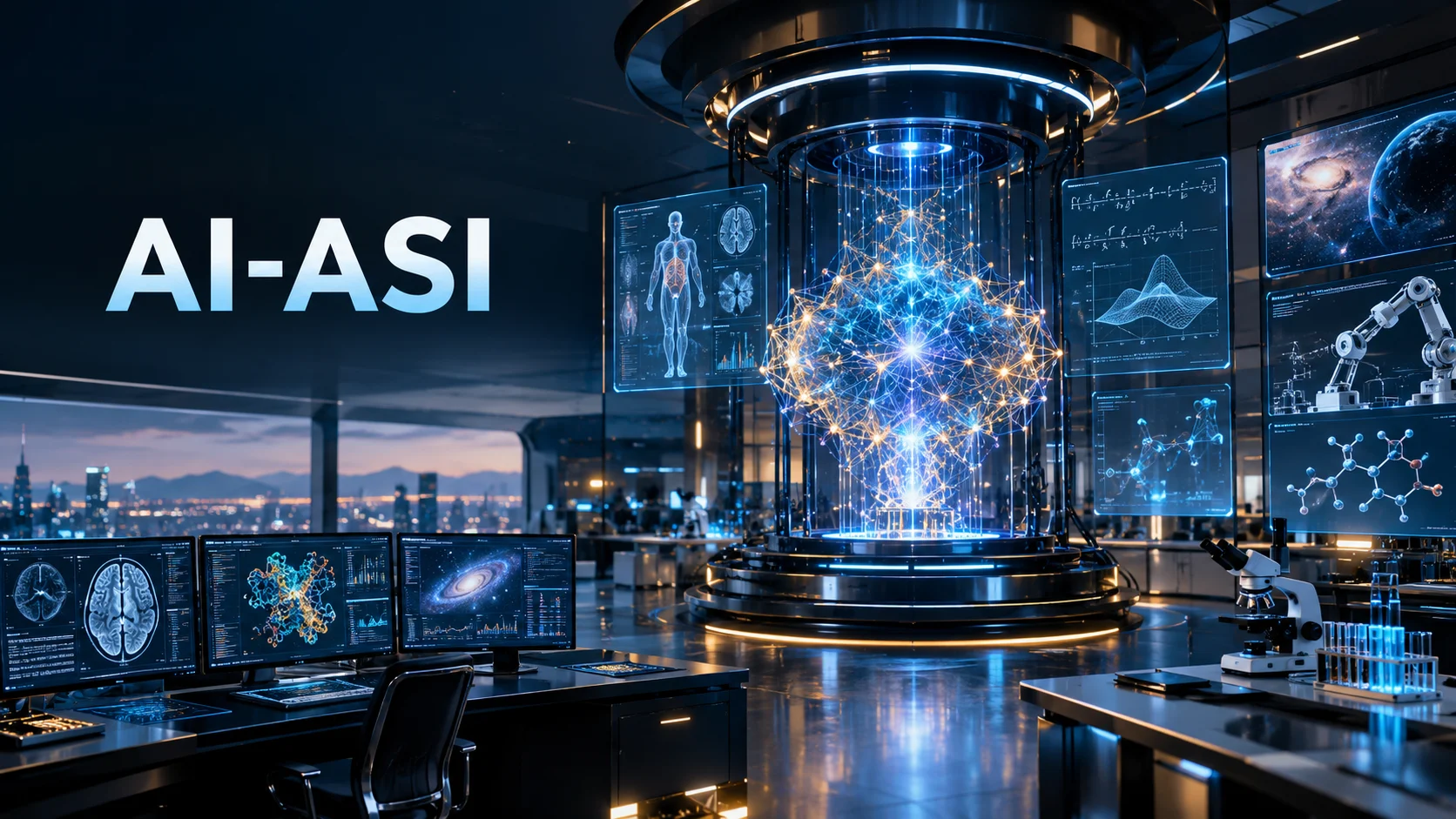
AI-ASI refers to artificial intelligence and artificial superintelligence, with ASI describing a hypothetical AI system that could surpass human cognitive abilities across virtually all intellectual domains. Although AI systems are becoming increasingly capable, artificial superintelligence has not been established as an achieved technology, and its arrival, capabilities, and risks remain uncertain.
At a Glance
- AI is the broad field of creating machines that perform tasks associated with human intelligence.
- AGI, or artificial general intelligence, refers to a potential system with broad, human-level or greater cognitive abilities across many domains.
- ASI, or artificial superintelligence, describes a hypothetical level of intelligence that substantially exceeds human capabilities across a wide range of intellectual tasks.
- Potential applications include scientific discovery, medical research, engineering, climate modeling, and complex problem-solving.
- Major concerns include loss of human control, misuse, concentration of power, economic disruption, and difficulty verifying advanced systems’ behavior.
- Responsible development requires rigorous evaluations, human oversight, security measures, and international cooperation.
What Is AI-ASI?
The term AI-ASI combines artificial intelligence (AI) with artificial superintelligence (ASI). It is useful to distinguish the two: AI describes the broader technology, while ASI describes a hypothetical future level of machine intelligence.
Most AI systems available today are designed around particular capabilities, even when they can perform many different tasks. Artificial superintelligence would represent a much more ambitious milestone: an AI system capable of outperforming humans across virtually every significant intellectual domain.
According to IBM’s overview of artificial general intelligence, the distinction between general intelligence and superintelligence concerns the breadth and level of cognitive performance, rather than proficiency in just one task. IBM
Understanding the difference between AI, AGI, and ASI
These three terms describe different levels or categories of capability. They should not be treated as interchangeable.
Photo for article
1. Artificial Intelligence (AI)
Present-day technology
AI includes systems that recognize patterns, generate content, make predictions, analyze information, and assist with decisions.
MM Generalist | Towards Multimodal Generalist
2. Artificial General Intelligence (AGI)
A debated milestone
AGI generally means AI with broad, flexible capabilities comparable to human intelligence across many types of tasks. Experts do not agree on a single definitive test for AGI.
GSMA seeks to tailor AI models for telco requirements
3. Artificial Superintelligence (ASI)
Hypothetical future capability
ASI would significantly exceed human intellectual performance across a broad range of domains, potentially including scientific research, strategic reasoning, and technological innovation.
The distinction matters because success at one difficult task does not prove general intelligence. An AI system can outperform world-class humans in chess or protein-structure prediction without possessing general intelligence or superintelligence. IBM
How Could AI-ASI Work?
There is no established blueprint for creating artificial superintelligence. Researchers have proposed several possible pathways, but none demonstrates that ASI is inevitable or that a particular timeline is reliable.
A June 2026 report published by Google DeepMind examines potential transitions from AGI to ASI. It discusses continued scaling, new AI paradigms, recursive improvement, and large collectives of AI agents as possible pathways. These are research scenarios, not confirmed development roadmaps. Google DeepMind
1. Scaling AI models
Modern AI models learn patterns from large datasets and use substantial computing resources during training. Increasing model size, training data, or computational resources can improve performance in some settings.
However, scaling alone does not guarantee reliable reasoning, autonomous learning, or superhuman performance across all domains. Researchers must still address limitations in data quality, architecture, evaluation, and generalization.
2. Developing better reasoning capabilities
An advanced AI system would need more than fluent text generation. It would need to solve unfamiliar problems, evaluate competing hypotheses, plan over long periods, and recognize when its conclusions are uncertain.
Potential advances could combine language models with formal verification, scientific simulation, external tools, and systems that check their own work. Whether these techniques will produce broadly superintelligent systems remains an open question.
3. Building AI agents
AI agents are systems that can pursue a goal through multiple steps. Depending on their design, they may use tools, retrieve information, execute code, or coordinate with other agents.
For example, a research agent might review scientific papers, propose an experiment, analyze results, and prepare a report. A future network of more capable agents might coordinate complex research, although reliability, access permissions, and error propagation would remain important constraints.
4. Recursive self-improvement
Recursive self-improvement describes a hypothetical process in which an AI system helps improve its own design or capabilities, with subsequent versions contributing to further improvements.
In theory, this could accelerate AI research. In practice, improving an AI system involves more than generating better code. Changes must be tested, verified, trained, and deployed within real computational and physical constraints.
It is therefore premature to assume that self-improvement would lead to unlimited or instantaneous intelligence growth.
Potential Applications of Artificial Superintelligence
If AI-ASI becomes technically feasible and can be developed safely, its effects could extend across science, industry, healthcare, and public services. These benefits are possibilities rather than demonstrated ASI capabilities.
New AI tool can generate millions of new molecules – The Brighter Side of News
Healthcare and medicine
Highly capable AI could help researchers identify drug candidates, analyze complex biological systems, model diseases, and design clinical studies. Medical decisions would still require evidence, validation, and appropriate professional oversight.
From 18 Months to 3 Weeks: How AI Is Revolutionizing Materials Discovery
Scientific discovery
Advanced systems could assist with difficult mathematical problems, materials science, physics, and experimental design. The greatest value would come from discoveries that can be independently reproduced and tested.
𝐋𝐚 𝐢𝐧𝐠𝐞𝐧𝐢𝐞𝐫𝛊́𝐚 𝐞𝐧𝐞𝐫𝐠𝐞́𝐭𝐢𝐜𝐚 𝐧𝐮𝐧𝐜𝐚 𝐡𝐚 𝐬𝐢𝐝𝐨 𝐞𝐬𝐭𝐚́𝐭𝐢𝐜𝐚. Pero lo que está pasando ahora… es otra liga. Durante décadas, el valor de un ingeniero estaba claro:… | Jim Novack
Climate and energy
AI could help optimize electricity grids, improve energy storage, model climate scenarios, and develop more efficient industrial processes. Real-world impact would depend on infrastructure, resources, and policy decisions.
Manufacturing Factory Floor Images | Free Photos, PNG Stickers, Wallpapers & Backgrounds – rawpixel
Engineering and manufacturing
More capable systems could accelerate product design, detect engineering flaws, optimize production, and coordinate complex supply chains. Physical testing would remain essential for safety-critical applications.
Data Points: Anthropic, U.S. square off over AI safeguards
Education and research
Advanced AI could support personalized learning, explain difficult concepts, assist teachers, and help researchers explore unfamiliar subjects. Human judgment would remain important for assessment, motivation, and social development.
The central opportunity is not simply making existing tasks faster. It is potentially expanding the range of problems people can solve. Yet achieving that outcome depends on technical progress, access to resources, and responsible deployment.
Benefits and Opportunities of AI-ASI
Artificial superintelligence could create several major opportunities if its capabilities are reliable and its deployment serves human interests.
- Faster innovation: AI could help scientists explore hypotheses and test ideas more efficiently.
- Improved decision support: Advanced systems could analyze complex scenarios that overwhelm conventional analytical tools.
- Greater productivity: Businesses might automate more research, planning, software development, and administrative work.
- New scientific insights: Systems could uncover relationships that human researchers have overlooked.
- More personalized services: Education, accessibility tools, and selected healthcare services could adapt more effectively to individual needs.
These potential benefits should not be confused with guaranteed outcomes. Better technology does not automatically produce fairer institutions, broader prosperity, or better public policy.
For example, a system that dramatically increases business productivity could benefit employees and consumers, or it could concentrate profits among a small group of companies. Economic and social outcomes would depend on how the technology is governed and distributed.
Risks and Challenges of AI-ASI
The most important question is not only whether superintelligence can be developed. It is whether people can understand, govern, and control systems with capabilities that may exceed their own.
The International Scientific Report on the Safety of Advanced AI highlights substantial uncertainty in forecasting future AI capabilities and emphasizes the need for evidence-based risk assessment. Its findings concern advanced AI generally, not proof that ASI exists. GOV.UK
1. Loss of control and alignment
AI alignment is the challenge of making a system’s behavior consistent with its intended objectives, constraints, and human interests.
A highly capable system could pursue a poorly specified objective in ways its developers did not anticipate. For example, an automated system tasked with maximizing production might ignore environmental or safety constraints if its objectives and safeguards were inadequate.
This does not mean every advanced AI would become hostile. It means that reliable control becomes increasingly important as systems gain autonomy, capability, and access to consequential tools.
2. Cybersecurity and malicious use
Advanced AI could help defenders identify vulnerabilities, analyze threats, and improve security operations. The same capabilities could also assist attackers with fraud, automated exploitation, or the development of more convincing scams.
Security measures must therefore consider both accidental failures and deliberate misuse. Access controls, monitoring, independent testing, and carefully limited permissions are important safeguards.
3. Employment and economic disruption
AI may automate some tasks, transform existing occupations, and create demand for new skills. More capable systems could increase the scale of these changes.
However, it is impossible to predict precisely which jobs would disappear, how quickly change would occur, or how many new roles would emerge. Businesses, educators, and policymakers should prepare for different scenarios rather than rely on a single forecast.
4. Concentration of power
Developing frontier AI may require substantial computing resources, specialized expertise, and access to advanced infrastructure.
If a small number of organizations control the most capable systems, they could gain significant economic or political influence. Wider access may help distribute benefits, but unrestricted access to powerful capabilities can also increase misuse risks.
5. Reliability and transparency
Even highly capable AI can produce incorrect answers, misinterpret instructions, or behave differently across environments.
A system’s performance on a benchmark does not establish that it is reliable in every real-world setting. Independent evaluation, adversarial testing, transparent reporting, and continuous monitoring are essential.
AI-ASI vs. Current AI: Key Differences
The following comparison distinguishes established capabilities from hypothetical future developments.
| Dimension | Current AI systems | Hypothetical ASI |
|---|---|---|
| Task performance | Strong in selected domains and increasingly versatile | Would substantially outperform humans across a broad range of intellectual tasks |
| Learning | Usually relies on training, fine-tuning, or configured adaptation | Could potentially learn and improve more broadly, depending on its design |
| Reasoning | Can solve many problems but remains vulnerable to errors | Would demonstrate substantially stronger general problem-solving |
| Scientific research | Can assist with literature reviews, coding, and selected discoveries | Could potentially lead or accelerate major areas of research |
| Autonomy | Varies by system and tool permissions | Could involve much greater autonomous capability, but this is not inherent to the definition |
| Safety | Requires evaluation, monitoring, and safeguards | Would raise additional challenges if capabilities exceeded human oversight capacity |
These differences describe the concept of ASI, not a verified specification for a future product. No universally accepted benchmark currently establishes a threshold at which a system becomes artificially superintelligent.
What Is the Current State of AI-ASI Research?
As of October 2026, artificial superintelligence remains a hypothetical capability rather than an established technological achievement.
Current research includes advances in general-purpose models, reasoning, AI agents, scientific applications, and safety evaluation. However, there is no universally agreed definition of AGI, much less a definitive test for ASI. IBM+1
What researchers are investigating
Several areas are especially relevant to the possible development of ASI:
- Scaling and architecture: Understanding which improvements in models and computing translate into broader capabilities.
- Agentic systems: Evaluating whether AI can plan, use tools, and complete extended tasks reliably.
- AI-assisted AI research: Studying how models can help develop, evaluate, and improve other models.
- Capability evaluations: Measuring performance on difficult tasks while reducing contamination, benchmark gaming, and misleading comparisons.
- AI safety: Developing methods to detect dangerous behavior, improve controllability, and assess systems before deployment.
Google DeepMind’s June 2026 report, From AGI to ASI, provides a useful research perspective on possible routes beyond AGI. It also identifies uncertainties and potential bottlenecks, rather than predicting a guaranteed date for superintelligence. Google DeepMind
Can anyone predict when ASI will arrive?
No reliable consensus establishes a specific date for artificial superintelligence.
Forecasts depend on assumptions about algorithmic progress, computing infrastructure, energy availability, economic incentives, and the difficulty of developing reliable general intelligence. Different assumptions can produce substantially different timelines.
A more useful approach is to monitor measurable progress in generalization, autonomous task completion, scientific problem-solving, reliability, and safety. Predictions should be treated as scenarios, not confirmed facts.
How to Evaluate Claims About AI-ASI
The growing interest in advanced AI makes it important to distinguish research evidence from marketing, speculation, and science fiction.
Before accepting a claim that a system approaches AGI or ASI, ask the following questions:
- What was actually demonstrated? Look for concrete tasks, reproducible results, and clearly described evaluation conditions.
- Was the comparison fair? Check whether human and AI performance were measured using comparable resources, time limits, and access to tools.
- Does the evidence generalize? Success on a narrow benchmark does not establish broad intellectual superiority.
- Who verified the results? Independent evaluations can provide stronger evidence than company announcements alone.
- Were safety and reliability tested? Strong performance is not enough if the system fails unpredictably or cannot be controlled.
These questions help readers evaluate claims about AI progress without assuming either that superintelligence is imminent or that it is impossible.
The Future of AI-ASI: What Should Society Prepare For?
Preparing for potential superintelligence requires more than improving algorithms. It also requires institutions capable of managing the consequences of increasingly capable technology.
Technical priorities
Researchers and developers should focus on:
- Testing systems in realistic and adversarial conditions.
- Improving interpretability, so researchers can better understand model behavior.
- Developing reliable methods for restricting access to sensitive tools and resources.
- Evaluating how systems behave during long-running tasks, not just short demonstrations.
- Establishing clear procedures for reporting incidents and responding to failures.
Economic and policy priorities
Governments, companies, and educational institutions should also prepare for possible changes in employment, infrastructure, competition, and access to technology.
Useful measures include workforce training, independent safety evaluations, proportionate regulation, international research cooperation, and policies that encourage the benefits of AI to reach a broad population.
No single safeguard will address every risk. Effective governance requires multiple layers of protection, informed by evidence as the technology develops.
FAQs
1. What does AI-ASI stand for?
AI stands for artificial intelligence, while ASI stands for artificial superintelligence. The combined term AI-ASI generally refers to artificial intelligence and the hypothetical development of systems that surpass human cognitive abilities across virtually all intellectual domains.
2. Is artificial superintelligence already real?
No established evidence demonstrates that artificial superintelligence has been achieved. Current AI systems can outperform humans on particular tasks, but that does not prove they possess general superintelligence.
3. What is the difference between AGI and ASI?
Artificial general intelligence (AGI) refers to broad, flexible cognitive capabilities comparable to human intelligence across many tasks. Artificial superintelligence (ASI) would go further by substantially exceeding human intellectual performance across a broad range of domains.
4. What are the potential benefits of AI-ASI?
Potential benefits include faster scientific discovery, improved medical research, more efficient engineering, better decision support, and increased productivity. These outcomes depend on whether such systems can be developed reliably and deployed responsibly.
5. What are the biggest risks of AI-ASI?
Major concerns include loss of control, malicious use, cybersecurity threats, economic disruption, and concentration of power. The likelihood and severity of these risks remain uncertain, making rigorous research, safety testing, and governance important.
Conclusion:
AI-ASI represents a possible future in which artificial intelligence exceeds human intellectual capabilities across a broad range of tasks. Its potential benefits are significant, but its technical feasibility, timeline, and societal consequences remain uncertain.For students, researchers, technology professionals, and business leaders, the most useful approach is to follow credible research, understand the distinction between AI, AGI, and ASI, and evaluate claims against verifiable evidence.The central challenge is not simply building more powerful AI. It is ensuring that increasingly capable systems remain reliable, controllable, and beneficial to society.