Sunoh.ai is an artificial intelligence-powered medical documentation platform designed to address this challenge. Developed by healow, Sunoh.ai uses ambient listening technology, speech recognition, and natural language processing to transform conversations between healthcare providers and patients into structured clinical documentation.
Instead of manually typing notes throughout an appointment, physicians can use Sunoh.ai to capture conversations, generate draft clinical notes, summarize important medical information, and streamline documentation workflows.
The platform aims to make clinical documentation faster and more convenient while allowing healthcare professionals to concentrate on patient care.
But what exactly is Sunoh.ai? How does it work, what features does it offer, how much does it cost, and is it worth considering for medical practices?
This comprehensive guide explores Sunoh.ai’s technology, features, benefits, limitations, integrations, pricing considerations, and potential role in the future of healthcare.
What Is Sunoh.ai?
Sunoh.ai Reviews 2026: Details, Pricing, & Features | G2
g2.com
Sunoh.ai is an AI-powered ambient medical scribe that converts natural conversations between healthcare providers and patients into structured clinical documentation.
Developed by healow, the platform uses artificial intelligence and voice recognition to capture relevant information during medical consultations and organize it into draft clinical notes.
Its primary purpose is to reduce the administrative workload associated with medical documentation.
Traditional clinical documentation often requires physicians to divide their attention between patients and computer screens. Sunoh.ai offers an alternative by listening to consultations and preparing documentation for providers to review.
Its capabilities include:
- Ambient listening and voice recognition.
- Patient-provider conversation transcription.
- AI-generated clinical summaries.
- Structured SOAP and progress notes.
- Medical history and examination documentation.
- Suggested medication, laboratory, and imaging orders.
- Follow-up appointment information.
- Electronic health record (EHR) workflow support.
- Mobile and desktop accessibility.
Sunoh.ai is designed for different healthcare environments, including primary care practices, specialty clinics, behavioral health services, dental practices, and other medical organizations.
The platform is particularly relevant to healthcare providers who want to reduce repetitive documentation without replacing professional clinical judgment.sunoh.ai+2
Who Developed Sunoh.ai?
Sunoh.ai was developed by healow, a healthcare technology company associated with the eClinicalWorks ecosystem.
The platform emerged in response to a growing challenge across healthcare: clinicians were spending too much time documenting appointments instead of concentrating on patients.
Sunoh.ai was introduced in November 2023 as an ambient listening solution for clinical documentation.
Its development reflects the broader adoption of artificial intelligence in healthcare administration, particularly technologies that automate repetitive tasks while keeping healthcare professionals responsible for clinical decisions.
The company’s approach focuses on helping providers:
- Reduce documentation workloads.
- Improve clinical workflow efficiency.
- Spend more time interacting with patients.
- Complete medical notes more efficiently.
- Reduce the burden of after-hours charting.
Microsoft has also published a customer story describing healow’s use of Azure AI Speech and Azure OpenAI technologies in its Sunoh.ai solution.sunoh.ai+1
How Does Sunoh.ai Work?
How does Sunoh.ai AI medical scribe, that integrates with eCW EHR, work? Take a look at this 5-step graphic. Experts are standing by to discuss how it can revolutionize your practice ➡️… | eClinicalWorks
linkedin.com
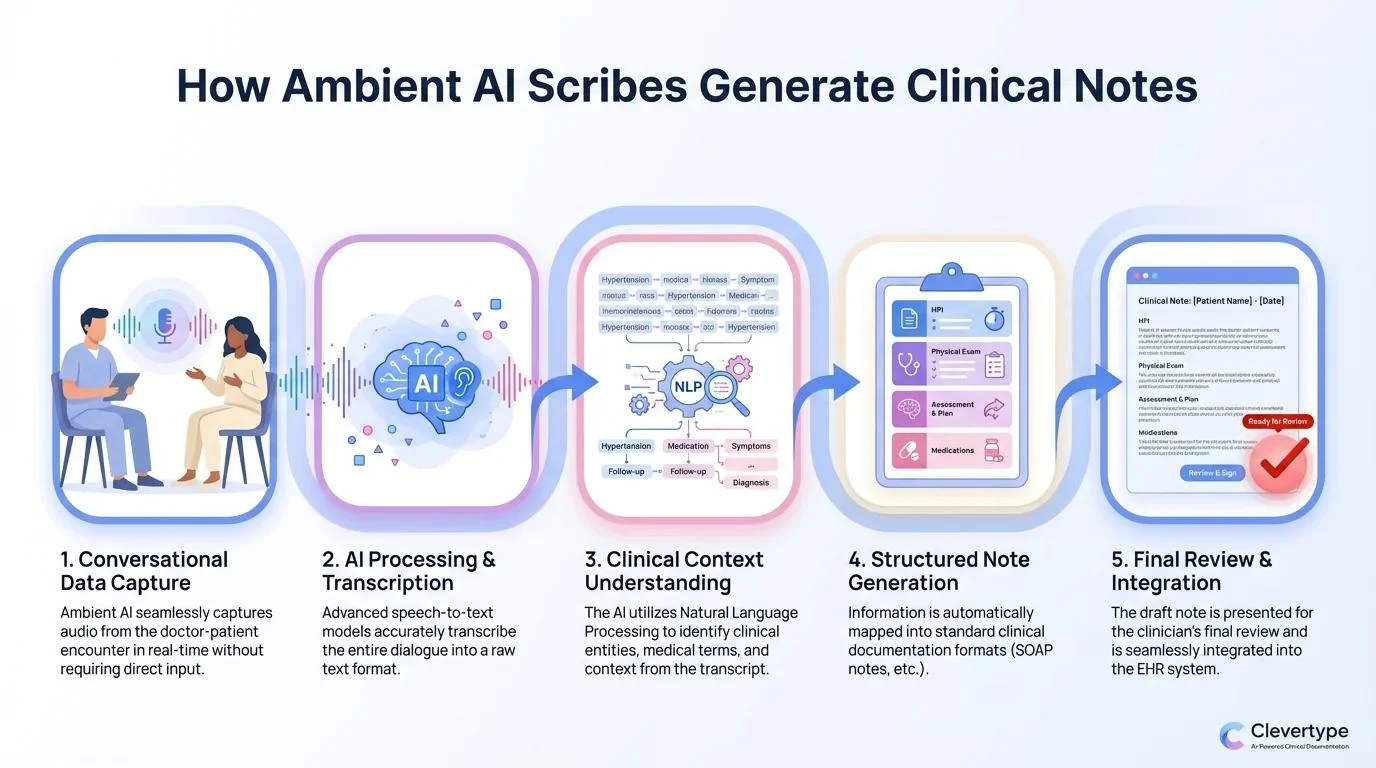
Sunoh.ai follows an AI-assisted documentation workflow. It captures a clinical conversation, processes spoken information, generates structured notes, and allows the healthcare provider to review the results.
Here is how the process works.
1. Capturing Patient-Provider Conversations
The process begins when a healthcare provider starts an ambient listening session.
Sunoh.ai captures the conversation between the doctor and patient using a supported device, such as a smartphone, tablet, or computer.
The technology is designed to recognize natural speech without requiring the physician to dictate every sentence manually.
Appropriate patient consent and organizational recording policies should be established before using ambient recording.
2. Converting Speech Into Text
After capturing the conversation, Sunoh.ai uses speech recognition technology to convert spoken language into text.
The system processes the dialogue and distinguishes relevant information from the conversation.
This creates a textual record that can be used to prepare clinical documentation.
3. Analyzing and Organizing Medical Information
The AI processes the conversation using natural language understanding and summarization capabilities.
It identifies clinically relevant information, such as:
- Presenting symptoms.
- Medical history.
- Patient concerns.
- Examination findings.
- Assessment information.
- Treatment discussions.
- Follow-up recommendations.
The objective is to organize information into appropriate sections rather than leave physicians with an unstructured transcript.
4. Generating Clinical Notes
Sunoh.ai converts the processed information into a draft clinical document.
Depending on the workflow, this may include SOAP notes and structured Progress Note sections.
SOAP documentation generally consists of:
- Subjective: Symptoms and information reported by the patient.
- Objective: Observations, examination findings, and relevant measurements.
- Assessment: The provider’s clinical assessment.
- Plan: Proposed treatment, medication, testing, and follow-up.
The resulting document is a draft that requires professional review.
5. Assisting With Orders and Follow-Ups
Sunoh.ai can identify discussed medication orders, laboratory tests, imaging, procedures, referrals, and follow-up appointments.
This helps organize important next steps from the patient encounter.
However, identifying an order in conversation does not independently establish that it is clinically appropriate. Providers must verify the information before approving or submitting it.
6. Reviewing and Importing Documentation
The final stage involves reviewing the AI-generated documentation.
Healthcare professionals can edit the content, correct inaccuracies, and incorporate the information into the appropriate patient record through supported EHR workflows.
This human-review process is essential because AI-generated clinical notes should not be treated as automatically verified medical records.sunoh.ai+2
Key Features of Sunoh.ai
Sunoh.ai offers several features intended to simplify clinical documentation and support healthcare workflows.
1. Ambient AI Listening
Ambient listening is one of the platform’s central capabilities.
The technology captures patient-provider conversations and uses AI to identify information relevant to clinical documentation.
This reduces the need for continuous manual typing and allows physicians to maintain more natural conversations with patients.
2. AI-Powered Medical Transcription
Sunoh.ai converts spoken conversations into written text using speech recognition.
Unlike conventional dictation software, which primarily converts speech into text, an AI medical scribe also organizes and summarizes the information for clinical documentation.
This distinction makes it useful for practices that need structured medical records rather than simple transcripts.
3. Automated SOAP Notes
The platform generates draft SOAP notes and organizes information into clinical documentation sections.
This helps providers prepare consistent records without manually creating every section from scratch.
4. Clinical Summarization
Sunoh.ai generates summaries of patient encounters, helping physicians identify important information without reviewing an entire conversation.
The summary can include:
- History of present illness.
- Medical and surgical history.
- Allergies.
- Vital signs.
- Physical examination findings.
- Clinical assessments.
- Treatment plans.
- Follow-up information.
5. Medication and Laboratory Order Assistance
Another important capability is identifying orders discussed during consultations.
Sunoh.ai can help organize information related to:
- Medication orders.
- Laboratory tests.
- Imaging requests.
- Medical procedures.
- Referrals.
- Follow-up appointments.
Healthcare providers must verify these details before finalizing orders.
6. Multilingual Support
Healthcare providers frequently work with patients who speak different languages or dialects.
Sunoh.ai offers multilingual speech-processing capabilities, with support for multiple languages and dialect variations.
Its language capabilities have expanded over time. However, practices should confirm that their specific language combinations and clinical terminology are supported before deployment.
7. Mobile and Desktop Compatibility
Sunoh.ai is available across multiple devices, making it suitable for different clinical environments.
Supported platforms include:
- iPhones.
- Android smartphones.
- iPads.
- Desktop computers.
- Web browsers.
This flexibility allows healthcare professionals to document consultations in offices, clinics, and supported telehealth workflows.
8. Customizable Documentation
Different medical specialties require different documentation formats.
Sunoh.ai supports customization options, including templates and fields, to accommodate practice-specific workflows.
This can help healthcare organizations align generated documentation with their existing clinical requirements.sunoh.ai+4
Sunoh.ai EHR Integrations and Compatibility
Doctor Carefully Reviewing Patient’s Electronic Health Records
Electronic health record compatibility is an important consideration when selecting an AI medical scribe.
Sunoh.ai is designed to work with multiple EHR environments, reducing the need for healthcare providers to change their existing record-management systems.
Its published integration ecosystem includes:
| EHR platform | Integration information |
|---|---|
| Epic | Supported integration |
| athenahealth | Marketplace and EHR integration |
| eClinicalWorks | Native integration |
| Oracle Cerner | Supported integration |
| ModMed | Listed compatibility |
| Practice Fusion | Listed compatibility |
| Tebra | Listed compatibility |
One particularly useful feature is Sunoh.ai EHR Sync, a browser extension that allows providers to transfer documentation into browser-based EHR systems.
The extension is described by the company as a free installation for existing Sunoh.ai subscribers.
The exact integration method and available features can vary depending on the EHR platform and practice configuration.
For example, athenahealth integration uses SMART on FHIR and OAuth 2.0 authentication workflows.sunoh.ai+3
Benefits of Using Sunoh.ai
AI medical scribes are becoming increasingly relevant because documentation is a major part of modern healthcare administration.
Sunoh.ai addresses several common challenges faced by physicians and medical organizations.
1. Reduces Administrative Workload
Manual clinical documentation can consume substantial time.
Sunoh.ai automates parts of the transcription, summarization, and note-preparation process, reducing repetitive administrative tasks.
This can help physicians manage documentation more efficiently.
2. Improves Patient Interaction
Physicians sometimes need to look at computer screens while patients are explaining their symptoms.
Ambient documentation offers an opportunity to reduce this distraction.
With less manual typing, providers may have more opportunities to maintain eye contact and engage in meaningful conversations.
3. Supports Physician Work-Life Balance
Completing clinical notes after appointments can extend working hours.
By preparing draft documentation during or immediately after consultations, Sunoh.ai may help providers reduce unfinished paperwork.
The company reports that some providers save up to two hours daily, although individual results depend on consultation volume, workflow, and editing requirements.
4. Streamlines Clinical Documentation
Structured notes are important for maintaining organized patient records.
Sunoh.ai helps categorize information into relevant documentation sections, potentially reducing the time required to prepare clinical records.
5. Supports Different Medical Specialties
The platform is designed for multiple healthcare specialties rather than one particular medical discipline.
Its published specialty applications include:
- Primary care.
- Family medicine.
- Internal medicine.
- Cardiology.
- Dermatology.
- Orthopedics.
- Pediatrics.
- Behavioral health.
- Dental practices.
- Vision clinics.
- Urgent care.
Different specialties may require different templates and levels of customization.
6. Reduces Dependence on Manual Transcription
Traditional documentation workflows may involve dictation, manual typing, or dedicated transcription personnel.
Sunoh.ai offers an AI-assisted alternative that can automate portions of this process.
However, it does not eliminate the need for qualified clinical professionals to verify documentation.
7. Supports More Efficient EHR Workflows
Integration with existing electronic health record systems can reduce repetitive copying and pasting.
This is particularly useful for practices that want to introduce AI documentation without completely replacing their current software infrastructure.sunoh.ai+3
Sunoh.ai Pricing: How Much Does It Cost?
Abo-Verwaltung & Subscription Management | SaaS-Billing
Pricing is an important consideration for individual physicians, independent clinics, and larger healthcare organizations.
According to Sunoh.ai’s published pricing page, its advertised starting price is:
Advertised starting subscription
$149
Per user, per month
Limited-time advertised pricing
The official pricing page advertises this rate against a higher $199 price. Confirm current availability and terms directly with the company.
Check official Sunoh.ai pricing
The advertised subscription includes capabilities such as:
- Ambient voice capture.
- Speech recognition.
- Conversation transcription.
- AI-generated clinical summaries.
- Draft SOAP notes.
- Editing before EHR import.
- PDF note export.
- Implementation support.
- Customer support.
Sunoh.ai also advertises a Business Associate Agreement (BAA) as part of its offering.
Is Sunoh.ai Worth the Price?
The value depends on how much documentation time a healthcare provider currently spends.
For example, a physician who handles numerous daily consultations may benefit more from automation than a provider with a relatively small patient volume.
Before purchasing, medical practices should evaluate:
- Monthly subscription costs.
- Number of clinicians requiring access.
- EHR integration requirements.
- Specialty-specific documentation needs.
- Accuracy of generated notes.
- Training and implementation requirements.
- Privacy and data-handling policies.
The advertised price should not be assumed to cover every possible enterprise or implementation requirement.Start a Free Trial!+1
Is Sunoh.ai Safe and HIPAA Compliant?
Patient privacy is one of the most important considerations when introducing AI into healthcare environments.
Medical consultations contain sensitive information, including personal details, medical histories, diagnoses, prescriptions, and treatment discussions.
Sunoh.ai states that it follows administrative, physical, and technical safeguards required under HIPAA and signs Business Associate Agreements where required.
The company also describes its use of industry-standard encryption and security protocols.
Its published security information states that:
- Patient information is protected through security measures.
- Business Associate Agreements are available as required.
- Recordings and transcripts are deleted after seven days, according to the company’s published policy.
- Patient data is not used to train AI models, according to its stated data-use policy.
- Final reviewed clinical notes are maintained in the practice’s EHR.
These statements should be evaluated against the latest contractual terms and applicable organizational policies.
An important distinction: No software product automatically makes a healthcare organization HIPAA compliant. Providers and healthcare organizations remain responsible for consent, access controls, appropriate configuration, staff training, and compliance with applicable regulations.
Before using Sunoh.ai, practices should:
- Establish appropriate patient consent procedures.
- Review the BAA and data-processing terms.
- Understand recording and retention policies.
- Limit access to authorized personnel.
- Verify data transmission and storage safeguards.
- Establish procedures for correcting inaccurate documentation.
sunoh.ai+1
Limitations of Sunoh.ai
Although Sunoh.ai offers useful automation capabilities, healthcare organizations should understand its limitations before adopting the technology.
1. AI-Generated Notes Require Human Review
AI can misunderstand spoken information, misinterpret medical terminology, or omit relevant details.
A physician must review the generated documentation before signing or approving it.
2. Background Noise Can Affect Transcription
Clinical environments are not always quiet.
Conversations may include interruptions, multiple speakers, background noise, or unclear speech.
These conditions can affect speech recognition quality.
3. Specialty-Specific Accuracy May Vary
Different specialties use different terminology, abbreviations, and documentation formats.
A workflow that performs well in primary care may require additional customization in dentistry, cardiology, or behavioral health.
4. Integration Availability Can Differ
Although Sunoh.ai supports several EHR platforms, the depth of integration is not necessarily identical across all systems.
Practices should verify their exact EHR version, workflow, and available integration capabilities.
5. Subscription Costs Can Add Up
A per-user subscription may become a significant expense for large healthcare organizations.
Organizations should calculate the total cost against measurable improvements in documentation efficiency.
6. Patient Consent and Privacy Require Attention
Ambient listening introduces additional privacy considerations.
Healthcare organizations need clear procedures for informing patients, obtaining appropriate consent, and handling sensitive recordings.
7. It Cannot Replace Clinical Judgment
Sunoh.ai is a documentation assistant, not an autonomous physician.
It cannot independently take responsibility for diagnoses, treatment decisions, prescriptions, or patient safety.
Its outputs must remain subject to qualified clinical oversight.
Sunoh.ai vs. Traditional Medical Scribes
Traditional medical scribes and AI medical scribes both support clinical documentation, but they operate differently.
| Comparison | Sunoh.ai | Traditional human scribe |
|---|---|---|
| Documentation | AI-generated drafts | Human-prepared notes |
| Conversation processing | Ambient listening | Human listening |
| Availability | Software-based | Depends on staffing |
| Editing | Provider reviews AI output | Human and provider collaboration |
| Scalability | Software subscriptions | Additional staffing |
| Clinical judgment | Requires provider oversight | Human scribe does not replace provider |
| Operating costs | Subscription-based | Employment or service costs |
Sunoh.ai can reduce dependence on traditional transcription workflows, but it is not necessarily a complete replacement for every human scribe.
Some complex clinical environments may continue to benefit from human assistance.
Who Should Use Sunoh.ai?
Sunoh.ai may be useful for healthcare professionals and organizations that manage frequent patient encounters and substantial documentation workloads.
Independent physicians: Individual practitioners may use it to streamline daily notes and reduce repetitive typing.
Primary care clinics: High-volume primary care environments may benefit from faster encounter documentation.
Specialty practices: Clinics with specialty-specific documentation requirements can explore its customizable workflows.
Behavioral health providers: Practitioners may find its conversation summarization and DAP-note capabilities useful, subject to suitability and privacy requirements.
Dental practices: Dental professionals can explore its documentation and treatment-planning capabilities.
Healthcare organizations: Larger organizations may evaluate it for standardizing documentation workflows across multiple clinicians.
Ultimately, suitability depends on clinical accuracy, integration quality, specialty requirements, and the organization’s privacy policies.
Sunoh.ai and the Future of AI in Healthcare
Amrita University launches AI clinical assistant to turn doctor-patient talks into medical records – Education News | The Financial Express
financialexpress.com
Artificial intelligence is changing how healthcare organizations manage administrative responsibilities.
AI-powered medical scribes represent an important development because they address a practical problem: the time clinicians spend documenting patient encounters.
The future of this technology may involve several developments.
More Advanced Ambient Clinical Intelligence
Future systems may become better at understanding medical context, identifying important clinical information, and organizing conversations into more useful documentation.
Better EHR Interoperability
Improved interoperability could make it easier to move clinical information between healthcare applications.
Standards such as FHIR can help support more connected healthcare workflows.
Greater Multilingual Capabilities
Advancements in speech recognition may improve support for different languages, accents, and regional terminology.
This could make AI documentation more accessible to diverse patient populations.
More Personalized Clinical Documentation
AI systems may increasingly support specialty-specific templates, custom terminology, and organization-specific documentation requirements.
Improved Administrative Automation
Beyond generating notes, future AI systems may assist with appointment summaries, follow-up workflows, order preparation, and other administrative activities.
However, healthcare AI must continue to prioritize accuracy, privacy, transparency, and human oversight.
Sunoh.ai illustrates how ambient AI can support these goals by reducing documentation friction while keeping providers involved in the final clinical record.
FAQs
1. What is Sunoh.ai used for?
Sunoh.ai is an AI-powered medical scribe used to convert patient-provider conversations into structured clinical documentation. It helps healthcare professionals prepare progress notes, summaries, and other clinical records.
2. Is Sunoh.ai an AI medical scribe?
Yes. Sunoh.ai is an ambient AI medical scribe that uses speech recognition and artificial intelligence to capture conversations and generate draft clinical notes.
3. Who developed Sunoh.ai?
Sunoh.ai was developed by healow, a healthcare technology company associated with the eClinicalWorks ecosystem.
4. How much does Sunoh.ai cost?
Sunoh.ai advertises a starting price of $149 per user per month under a limited-time offer. Check its official pricing page for current subscription terms.
5. Does Sunoh.ai integrate with Epic?
Yes. Sunoh.ai has an integration with Epic’s interoperability platform, allowing supported workflows for clinical documentation.
6. Does Sunoh.ai work with athenahealth?
Yes. Sunoh.ai supports athenahealth integration, including workflows using SMART on FHIR and OAuth 2.0.
7. Is Sunoh.ai HIPAA compliant?
Sunoh.ai states that it follows HIPAA-required administrative, physical, and technical safeguards and provides Business Associate Agreements where required. Healthcare organizations must also fulfill their own compliance responsibilities.
8. Can Sunoh.ai generate SOAP notes?
Yes. It generates draft SOAP notes by organizing relevant information from patient-provider conversations into subjective, objective, assessment, and plan sections.
9. Does Sunoh.ai support smartphones?
Yes. Sunoh.ai offers applications for iOS and Android devices, as well as iPad and web-based access.
10. Can Sunoh.ai replace human medical scribes?
It can automate many documentation tasks traditionally performed by human scribes. However, some practices may still require human assistance for complex clinical workflows or additional administrative responsibilities.
11. Does Sunoh.ai support multiple medical specialties?
Yes. The platform is designed for multiple specialties, including primary care, cardiology, dermatology, behavioral health, dentistry, pediatrics, and orthopedics.
12. Does Sunoh.ai automatically make medical decisions?
No. Sunoh.ai assists with clinical documentation and organizing information. Qualified healthcare professionals remain responsible for diagnoses, treatment decisions, and approving clinical records.
13. Does Sunoh.ai store patient recordings permanently?
According to the company’s published security information, recordings and transcripts are deleted after seven days. Practices should verify the current retention policy and contractual terms.
14. Is Sunoh.ai available for small medical practices?
Yes. Its per-user subscription model and mobile applications make it an option for individual physicians and smaller practices, subject to their integration and workflow requirements.
15. Is Sunoh.ai worth using in 2026?
Sunoh.ai may be worthwhile for healthcare professionals who spend considerable time preparing clinical documentation. Its value depends on transcription quality, EHR compatibility, subscription costs, and the amount of time saved in actual clinical workflows.
Conclusion:
Sunoh.ai represents an important application of artificial intelligence in modern healthcare. By combining ambient listening, speech recognition, natural language processing, and EHR integration, it helps healthcare professionals automate parts of the clinical documentation process.Its ability to generate draft SOAP notes, summarize patient conversations, organize medical information, and support order preparation makes it a useful option for practices looking to improve administrative efficiency.The platform also offers practical advantages through mobile accessibility, multilingual capabilities, specialty-specific documentation, and compatibility with several established EHR systems.However, AI-generated documentation is not automatically error-free. Physicians must review every draft, verify clinical information, and maintain responsibility for the final medical record. Patient consent and data protection must also remain central to implementation.