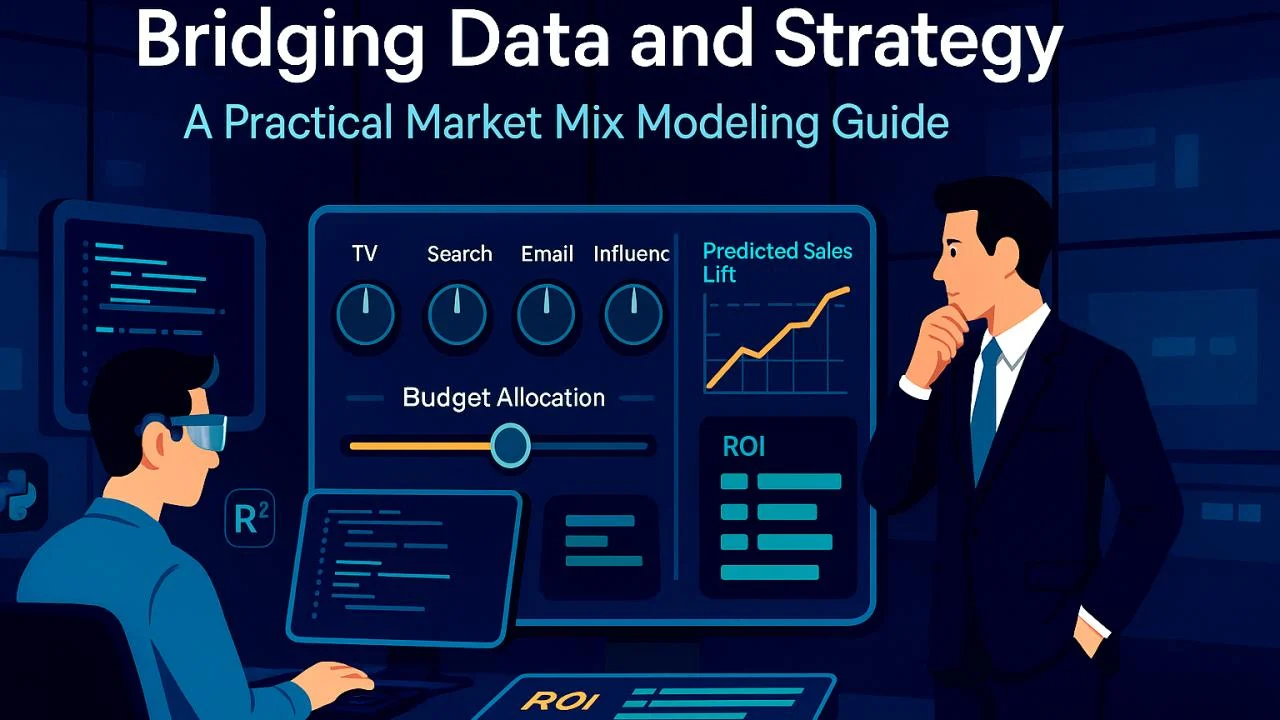
Prescient AI is an AI-powered marketing measurement and forecasting platform designed to help businesses understand how advertising investments influence revenue, identify profitable marketing channels, and make smarter budget allocation decisions.
Unlike traditional marketing analytics tools that primarily report clicks, impressions, conversions, and advertising costs, Prescient AI uses Marketing Mix Modeling (MMM) to estimate the incremental contribution of different marketing channels. It also measures indirect revenue effects, forecasts potential outcomes, and helps marketing teams identify opportunities to improve advertising efficiency.
For eCommerce companies, direct-to-consumer (DTC) brands, retailers, and omnichannel businesses, understanding which marketing activities actually generate additional revenue is essential. Prescient AI aims to make this process more measurable, transparent, and forward-looking.
What Is Prescient AI?
Prescient AI Reviews 2026: Details, Pricing, & Features | G2
g2.com
Prescient AI is a marketing measurement, forecasting, and optimization platform that uses statistical modeling and artificial intelligence to help organizations understand the business impact of their advertising investments.
The platform focuses on Marketing Mix Modeling, a measurement methodology that evaluates how different marketing activities contribute to business outcomes over time.
For example, an eCommerce company might advertise through:
- Google Ads
- Meta Ads
- TikTok Ads
- YouTube
- Amazon advertising
- Connected TV
- Other digital and traditional media channels
Each channel can influence customer behavior differently. Some advertisements generate immediate purchases, while others increase brand awareness, encourage product searches, or influence customers to purchase through another sales channel.
Prescient AI attempts to measure these direct and indirect effects rather than relying exclusively on last-click attribution.
Its platform combines modeled performance data, forecasting tools, budget optimization, and AI-assisted insights to help marketing teams make more informed decisions.
According to its official product documentation, the platform can evaluate incremental media contribution, campaign response curves, channel interactions, saturation, and forecast uncertainty. Prescient Product Education+1
In simple terms: Prescient AI helps businesses understand where their advertising money is working, where it may be wasted, and how changing their marketing budgets could affect future business performance.
How Does Prescient AI Work?
Prescient AI works by collecting marketing and business data, processing it through statistical models, measuring advertising contributions, and forecasting possible outcomes under different budget scenarios.
Its workflow can be understood through five major stages.
Implement Marketing Mix Modeling in Four Steps | Checkmedia
checkmedia.com
1. Connect Marketing and Business Data
The first step involves connecting the advertising, eCommerce, analytics, and revenue sources used by a business.
Supported data sources include:
- Google Ads and Microsoft Ads
- Meta advertising
- TikTok and Pinterest
- Snapchat and YouTube
- Amazon Ads
- Shopify and Recharge
- Google Analytics
- Snowflake and BigQuery
- Custom APIs and other data sources
These integrations provide information about advertising expenditure, impressions, clicks, sales, subscriptions, customer acquisition, and other business metrics.
Prescient also supports retailer data, marketplaces, offline media providers, and custom data connections. Prescient Product Education
2. Analyze Data Through Marketing Mix Modeling
After connecting the data, Prescient uses Marketing Mix Modeling to evaluate relationships between marketing activities and business performance.
The models consider factors such as:
- Advertising expenditure
- Historical revenue
- Seasonal patterns
- Campaign performance
- Marketing channel interactions
- Customer acquisition
- Promotional activities
- Delayed advertising effects
This process helps businesses understand how different advertising activities contribute to revenue.
3. Measure Direct and Indirect Advertising Impact
One important part of Prescient AI is its ability to evaluate both direct and indirect marketing contributions.
For example, a customer might see a YouTube advertisement, search for the advertised product on Google, and eventually purchase it through Amazon.
A last-click attribution system might credit the final search interaction. However, the original YouTube advertisement may also have influenced the purchase.
Prescient uses its modeling approach to estimate these additional effects, helping marketers understand the broader influence of their campaigns. Prescient Product Education
4. Forecast Future Marketing Performance
Once the models are established, businesses can evaluate different spending scenarios.
For example, a marketing manager might want to know what could happen if the company:
- Increases Google Ads spending.
- Reduces an underperforming campaign.
- Moves budget from one channel to another.
- Expands investment in TikTok advertising.
- Changes its overall marketing mix.
Prescient’s forecasting tools estimate the potential revenue, ROAS, and customer acquisition outcomes associated with different scenarios.
5. Generate AI-Assisted Insights
Finally, Prescient AI helps users interpret analytical results through natural-language questions and AI-generated performance summaries.
Marketing teams can ask questions such as:
- Why has Meta advertising performance declined?
- Which campaigns generate the most incremental revenue?
- Which channels have opportunities for growth?
- Where could we reallocate our advertising budget?
- Which campaigns need more data before making decisions?
The AI Action Center uses connected data and model results to provide answers, charts, and supporting sources.
Importantly, the underlying statistical models calculate the marketing measurements and forecasts. AI helps interpret those results rather than independently inventing performance predictions. Prescient Product Education+1
Key Features of Prescient AI
Prescient AI offers several capabilities designed to improve marketing measurement, campaign analysis, and budget planning.
Your Marketing Decision Intelligence Platform | MADTECH.AI
madtech.ai
1. Marketing Mix Modeling (MMM)
Marketing Mix Modeling is the foundation of the platform.
It analyzes historical advertising and business data to estimate the contribution of different marketing channels.
Unlike basic reporting tools, MMM considers broader relationships between advertising activities and business outcomes.
It helps organizations understand which channels contribute to incremental revenue and how their marketing investments interact.
2. Incrementality Measurement
Incrementality measures the additional business results generated by marketing activities.
This is important because not every purchase attributed to an advertising platform represents a genuinely additional sale.
For example, some customers might have purchased a product even without seeing an advertisement.
Prescient aims to distinguish the modeled incremental contribution of advertising from revenue that would have occurred through other factors.
3. Halo Effect Measurement
The halo effect describes how one advertising channel influences performance in another channel.
For example:
- YouTube advertising may increase branded Google searches.
- Meta campaigns may influence Amazon purchases.
- TikTok advertisements may encourage direct website visits.
- Television campaigns may increase online product demand.
Measuring these indirect effects provides a broader view of advertising performance than relying on individual platform reports.
4. AI Action Center
Build Live Dashboards by Chatting with Claude | Contextflo Blog
contextflo.com
The AI Action Center provides a central workspace for understanding marketing performance.
It can:
- Summarize recent advertising performance.
- Highlight important changes in ROAS and CAC.
- Identify revenue and customer acquisition drivers.
- Surface campaigns with scaling opportunities.
- Explain potential performance problems.
- Answer questions using connected business data.
- Display charts and supporting data sources.
Users can also save useful answers in the platform’s Library and revisit them later. Prescient Product Education
5. Predictive Marketing Analytics
Prescient helps businesses evaluate potential future outcomes before implementing advertising budget changes.
Rather than depending entirely on historical campaign results, marketers can use modeled response curves and forecasting to understand how performance might change at different spending levels.
This is particularly useful when a channel is approaching saturation.
6. Budget Optimization
Budget optimization helps marketing teams compare alternative media allocations.
For example, a company with a fixed advertising budget may want to determine whether moving more investment into Google, Meta, TikTok, or another channel could improve its overall results.
Prescient’s scenario-based tools support these decisions by estimating potential outcomes against selected objectives.
7. Campaign Saturation Analysis
Advertising channels do not always deliver proportional returns as spending increases.
A campaign might perform well with a moderate budget but generate diminishing returns when spending becomes excessive.
Prescient uses response curves and saturation analysis to help marketers identify these situations.
This allows businesses to investigate when additional investment may produce less incremental value.
8. Model Confidence and Performance Evaluation
Forecasts are only useful when businesses understand their reliability.
Prescient provides model health, accuracy, and confidence information to help users evaluate the strength of its analytical results.
Its documentation distinguishes between current model fit and backtesting performance. A strong historical fit alone does not guarantee accurate future predictions. Prescient Product Education+1
9. Continuous Data Updates
Prescient describes its modeling approach as continuously updated using newly available marketing and business data.
This helps organizations work with more current information instead of depending exclusively on quarterly or occasional measurement reports.
However, the usefulness of updated models still depends on the quality, completeness, and availability of connected data.
Benefits of Using Prescient AI
Prescient AI can provide several advantages for businesses that manage advertising across multiple channels.
| Benefit | Business value |
|---|---|
| Better measurement | Understand incremental advertising impact |
| Improved budget planning | Compare potential spending scenarios |
| Cross-channel insights | Identify indirect marketing contributions |
| Forecasting | Estimate possible future outcomes |
| Faster analysis | Find important performance changes |
| Campaign optimization | Identify saturation and scaling opportunities |
| Better decision-making | Combine model evidence with business knowledge |
More Accurate Marketing Decisions
Prescient provides an additional measurement perspective beyond advertising-platform reporting.
This helps marketing teams avoid making important decisions using a single platform’s reported ROAS.
Improved Advertising Efficiency
Understanding incremental performance can help organizations identify campaigns that deserve more investment and campaigns that require investigation.
Better Understanding of Customer Acquisition
Businesses can evaluate how marketing activities contribute to acquiring new customers and how changes in advertising investment might affect customer acquisition costs.
Reduced Manual Reporting
Connected data sources and AI-assisted summaries can reduce the time spent reviewing numerous dashboards and reports.
Better Long-Term Planning
Forecasting and scenario analysis can help marketing leaders compare different investment strategies before committing additional budget.
Prescient AI Use Cases
Prescient AI is particularly relevant to businesses with multiple advertising channels and measurable commercial outcomes.
10 successful examples of digital marketing campaigns
business.adobe.com
1. eCommerce Businesses
Online retailers can use Prescient to understand how advertising affects online revenue, orders, and customer acquisition.
For example, a Shopify business might compare Google Ads, Meta, TikTok, and Amazon advertising to identify opportunities for improving its overall media allocation.
2. Direct-to-Consumer Brands
DTC businesses often invest heavily in paid social, search, video, and influencer marketing.
Prescient can help these companies evaluate direct and indirect channel contributions instead of depending entirely on last-click attribution.
3. Retail and Marketplace Businesses
Companies selling products through several marketplaces and retail partners can use cross-channel measurement to understand how advertising influences sales outside their primary website.
4. Marketing Agencies
Marketing agencies can use marketing measurement and forecasting insights to support client reporting, media planning, and strategic recommendations.
Its usefulness depends on the agency’s access to the relevant client data and platform configuration.
5. Omnichannel Enterprises
Large businesses operating across digital advertising, physical retail, television, and other marketing channels can benefit from a measurement approach that considers interactions across different sales environments.
Prescient AI vs. Traditional Marketing Analytics
Traditional analytics platforms and Prescient AI serve related but different purposes.
| Comparison | Traditional analytics | Prescient AI |
|---|---|---|
| Main purpose | Track and report performance | Measure and forecast media impact |
| Data focus | Events, traffic, conversions | Media and business performance data |
| Attribution | Often rule-based or event-based | Statistical marketing mix modeling |
| Halo effects | Often difficult to measure directly | Specifically modeled |
| Forecasting | Varies by platform | Core platform capability |
| Budget scenarios | Often limited | Dedicated forecasting tools |
| AI insights | Depends on the tool | AI-assisted model interpretation |
Traditional analytics tools remain valuable for understanding customer behavior, website activity, and conversion journeys.
Prescient addresses a different question: how much incremental business performance can be associated with different marketing investments?
For this reason, it is more useful to view Prescient as a complementary measurement and decision-support platform rather than a universal replacement for analytics software.
Prescient AI Pricing: How Much Does It Cost?
One important consideration before adopting Prescient AI is pricing.
Custom pricing information
As of November 2026, I could not verify a publicly listed standard subscription price for the platform from its official product information.
The official website directs interested businesses toward a product demonstration rather than publishing a straightforward self-service pricing table. The #1 Marketing Mix Modeling Platform
Pricing may depend on factors such as:
- Business size and advertising expenditure.
- Number of marketing channels.
- Data integration requirements.
- Measurement complexity.
- Number of brands or business units.
- Platform requirements and service arrangements.
These are sensible factors to clarify during a sales discussion, not confirmed pricing formulas published by Prescient.
How to get pricing:
- Visit the official Prescient AI website.
- Explore the platform’s capabilities.
- Request a product demonstration.
- Discuss your advertising channels and measurement requirements.
- Request a customized commercial proposal.
Businesses should compare the platform’s cost with the potential value of better measurement, reduced inefficient spending, and improved marketing decisions.
Is Prescient AI Worth Using?
Prescient AI may be worth evaluating if your business spends substantial amounts on advertising across multiple platforms and struggles to understand the real contribution of each channel.
It is particularly relevant when:
- Advertising-platform reports show conflicting results.
- Last-click attribution overlooks important marketing influences.
- Your business sells through several channels.
- You need to forecast the impact of budget changes.
- Your marketing team wants to measure incremental revenue.
- You need a more comprehensive view of campaign performance.
However, it may not be necessary for a small business with limited advertising activity, minimal historical data, or a simple marketing setup.
Its value also depends on data quality, model reliability, and whether the insights lead to better decisions.
Limitations of Prescient AI
Although Prescient AI offers useful analytical capabilities, businesses should understand its limitations before adopting it.
1. Data Quality Matters
Marketing Mix Modeling depends on reliable historical data.
Incomplete advertising records, inconsistent revenue information, or incorrect account connections can affect the quality of the resulting analysis.
2. Forecasts Are Not Guarantees
Predictions represent estimated outcomes under specific assumptions.
Actual results may differ because of market conditions, competitor activity, pricing changes, inventory problems, and customer behavior.
3. Requires Business Context
A model may identify an opportunity to increase spending, but it cannot automatically understand every upcoming business development.
For example, a company planning a product launch or facing inventory shortages must account for those circumstances before implementing a recommendation.
4. Not an Advertising Execution Platform
Prescient primarily supports measurement, forecasting, and decision-making. It is not designed to replace the advertising platforms where marketers create campaigns and execute media purchases.
Its AI workspace is also documented as read-only: it provides analytical answers but does not make account changes on the user’s behalf. Prescient Product Education+1
5. Model Confidence Can Vary
Not every channel or campaign will have sufficient historical data to support equally reliable conclusions.
Users should evaluate model confidence, data coverage, and backtesting results before making substantial budget changes.
Prescient AI Alternatives
Businesses considering Prescient AI may also want to evaluate other marketing measurement and analytics platforms.
These are alternative tools in the broader measurement ecosystem, not verified one-to-one replacements.
Track nopCommerce with GA4 Analytics | noptech
1. Google Analytics 4
A web and app analytics platform for understanding traffic sources, user behavior, conversions, and customer journeys.Official website
Northbeam – Marketing Intelligence & Attribution Platform – Daidu.ai
2. Northbeam
A marketing measurement platform focused on attribution, media performance, and marketing analytics for eCommerce brands.Official website
Measured – Marketing Effectiveness & Incrementality Measurement Platfo – Daidu.ai
3. Measured
A marketing measurement solution focused on understanding advertising effectiveness and incrementality.Official website
Rockerbox: Multi-Touch Attribution, Marketing Mix Modeling, & Testing | Rockerbox
4. Rockerbox
Provides marketing measurement and attribution capabilities for businesses managing multiple marketing channels.Official website
The right choice depends on whether a business prioritizes marketing mix modeling, customer-level attribution, experimentation, incrementality testing, or general website analytics.
How to Get Started With Prescient AI
Businesses interested in using Prescient AI can follow a structured onboarding process.
- Request access: Receive an invitation to the organization’s Prescient workspace.
- Connect data sources: Link relevant advertising, eCommerce, retailer, and analytics accounts.
- Synchronize historical data: Allow the platform to import available information.
- Validate metrics: Check revenue, advertising expenditure, sessions, and other important measurements.
- Review the models: Work with the Prescient team to understand model performance and accuracy.
- Explore forecasting: Evaluate potential media budget scenarios.
- Use AI insights: Ask questions, review performance summaries, and investigate opportunities.
The official onboarding documentation explains that most standard integrations use automated sign-in connections with read-only permissions. Prescient Product Education
FAQs
1. What is Prescient AI used for?
Prescient AI is used for marketing measurement, advertising attribution, revenue forecasting, and media budget optimization. It helps businesses understand how different advertising channels contribute to incremental revenue and customer acquisition.
2. Is Prescient AI a marketing analytics tool?
Yes. It is a marketing measurement and analytics platform built around Marketing Mix Modeling. It combines statistical analysis, forecasting, and AI-assisted insights to help businesses understand advertising performance.
3. How does Prescient AI use artificial intelligence?
Prescient AI uses artificial intelligence to interpret marketing model results, summarize performance changes, identify potential opportunities, and answer questions using connected business data.
Its underlying statistical models perform the core measurement and forecasting calculations.
4. Does Prescient AI support Google Ads and Meta Ads?
Yes. Prescient supports integrations with Google Ads and Meta, alongside other advertising platforms, including TikTok, Pinterest, Snapchat, Microsoft Ads, Amazon Ads, and YouTube.
5. Can Prescient AI predict future revenue?
Prescient can forecast potential revenue and marketing performance under different spending scenarios. However, these forecasts are estimates rather than guaranteed business outcomes.
6. What is Marketing Mix Modeling in Prescient AI?
Marketing Mix Modeling is a statistical approach that analyzes historical marketing activities and business results to estimate the contribution of different marketing channels.
Prescient uses this methodology to evaluate incremental media impact, channel interactions, and future spending opportunities.
7. Does Prescient AI measure the halo effect?
Yes. Prescient models direct and indirect marketing contributions, including situations where an advertisement influences a purchase through another channel.
8. How much does Prescient AI cost?
Prescient AI does not have a publicly verified standard subscription price in the official information reviewed for this article. Interested businesses can request a demonstration and customized pricing information through its official website.
9. Is Prescient AI suitable for small businesses?
It may be suitable for some smaller businesses, but its value is generally more apparent for organizations with multiple advertising channels, sufficient historical data, and meaningful marketing measurement requirements.
10. Does Prescient AI automatically manage advertising campaigns?
No. Prescient primarily provides measurement, analysis, forecasting, and decision support. Its AI workspace does not independently execute advertising budget changes.
11. Is Prescient AI better than Google Analytics?
They serve different purposes. Google Analytics focuses on website and app activity, user behavior, and conversions, whereas Prescient specializes in measuring marketing contributions through Marketing Mix Modeling and forecasting.
12. Is Prescient AI reliable?
Its reliability depends on data quality, model configuration, historical coverage, and forecasting performance. Businesses should review model confidence and backtesting results rather than treating every modeled result as certain.
Conclusion:
Prescient AI represents an interesting development in AI-powered marketing measurement because it combines Marketing Mix Modeling, incrementality analysis, forecasting, and AI-assisted decision support.Its biggest advantage is its focus on understanding the broader business impact of advertising rather than simply reporting clicks, impressions, and conversions.For eCommerce businesses, DTC brands, retailers, and omnichannel marketing teams, these capabilities can help reveal overlooked marketing contributions, identify diminishing returns, and evaluate alternative advertising budget strategies.However, the platform should not be treated as an automatic solution to every marketing challenge. Reliable results require quality data, appropriate model evaluation, and human judgment.Overall, Prescient AI is worth exploring for businesses seeking a more comprehensive and forward-looking approach to marketing measurement and advertising optimization.