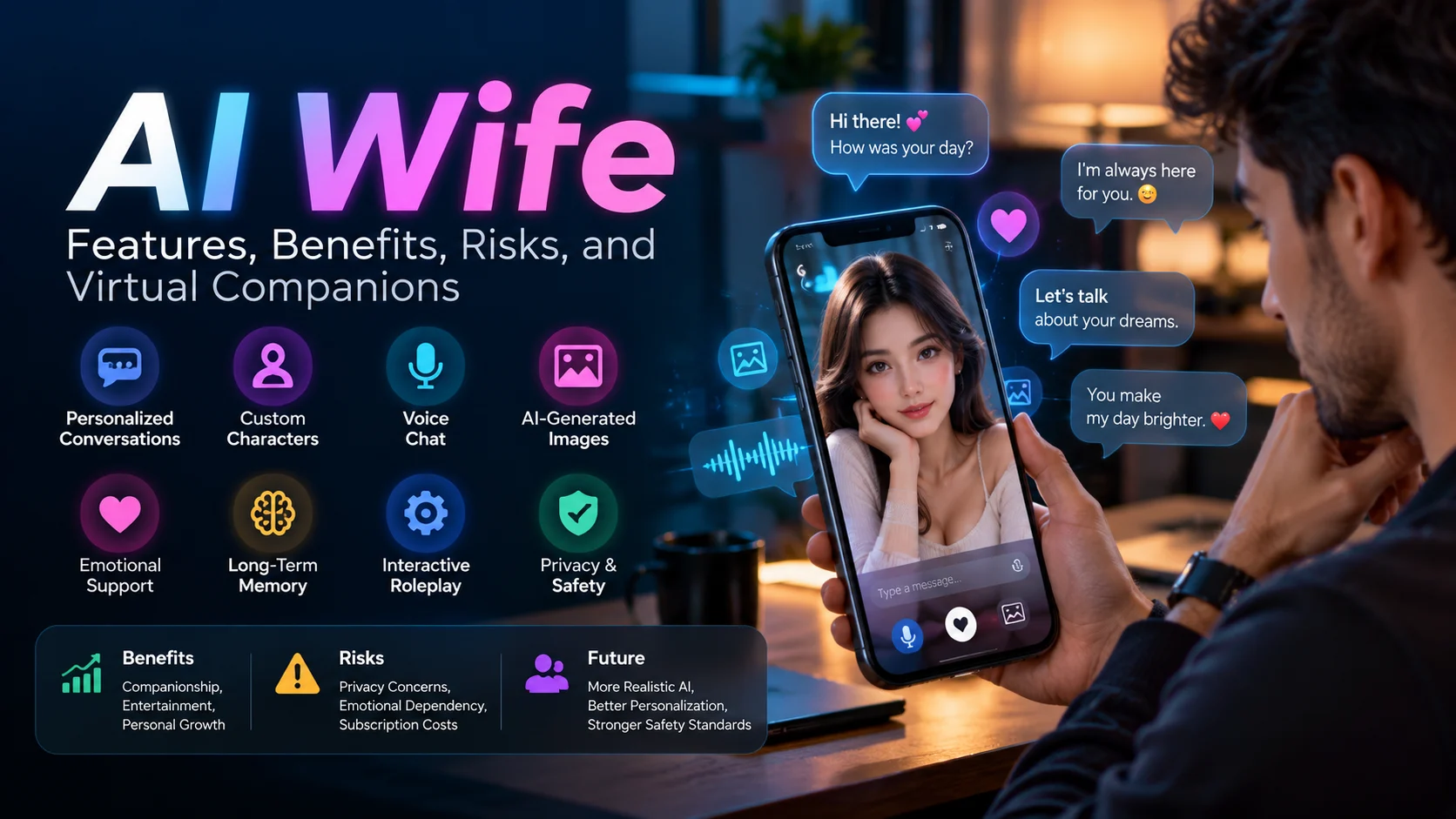
Artificial intelligence is changing how people communicate, build digital relationships, and interact with technology. One emerging development attracting attention is the AI wife: a virtual companion powered by artificial intelligence that can simulate conversations, emotional interaction, romantic communication, and personalized companionship.
Unlike traditional chatbots designed primarily to answer questions, an AI wife platform focuses on creating a more personalized conversational experience. Users can often choose a virtual character, customize her personality, discuss everyday experiences, and develop ongoing conversations that feel more consistent over time.
The growing interest in AI wives also reflects broader developments in conversational AI, generative technology, and digital companionship. Modern large language models can understand conversational context, generate natural responses, and adapt their communication style based on user preferences.
However, this technology raises important questions about privacy, emotional dependency, transparency, and the differences between simulated relationships and genuine human connections.
This guide explains what an AI wife is, how the technology works, its main features, potential benefits, limitations, privacy considerations, and what users should evaluate before choosing an AI companion platform.
What Is an AI Wife?
An AI wife is a virtual romantic or companionship-oriented character powered by artificial intelligence. It is designed to simulate some aspects of an ongoing relationship through text conversations, voice interactions, personalized responses, and other digital features.
Most AI wife applications use conversational AI technology to create characters with individual personalities, communication styles, interests, and conversational behaviors.
Depending on the platform, users may be able to:
- Choose or create a virtual wife character.
- Customize personality traits and conversational preferences.
- Exchange messages through an AI chatbot.
- Participate in fictional romantic roleplay.
- Use voice conversations or generated voice messages.
- Generate or receive AI-created character images.
- Continue conversations using stored memories or contextual information.
The experience varies considerably between services. Some platforms concentrate on simple romantic chat, while others emphasize persistent character memory, voice communication, visual customization, and interactive storytelling.
An AI wife is not a real spouse or an independent person. It is software generating responses through computational models. Its apparent personality and emotional expressions are simulated rather than evidence of human feelings or consciousness.
How Does an AI Wife Work?
AI wife platforms generally combine several artificial intelligence technologies to produce personalized conversations.
The underlying technology often includes large language models, natural language processing, contextual memory, recommendation systems, and sometimes generative image or voice models.
Understanding these technologies helps explain why modern AI companions can feel more interactive than conventional chatbots.
1. Natural Language Processing
Natural language processing (NLP) enables AI systems to interpret and generate human language.
When someone sends a message to an AI wife chatbot, the system processes the words, identifies relevant context, and generates a response based on its underlying model and instructions.
For example, a user might write:
“I had a stressful day at work.”
The AI companion may generate a supportive response, ask what happened, or continue the conversation in a more relaxed conversational style.
The quality of this interaction depends on the language model, system instructions, available context, and platform design.
2. Large Language Models
Large language models (LLMs) are trained on extensive collections of text and other data to recognize language patterns and generate relevant responses.
They help AI companions:
- Understand conversational questions.
- Maintain a consistent communication style.
- Generate natural-sounding dialogue.
- Respond to different topics.
- Participate in fictional scenarios.
- Adapt responses to available conversational context.
However, language models can generate inaccurate information or responses that sound confident without being correct. Users should not treat an AI companion as a reliable source of professional, medical, financial, or relationship advice.
3. AI Memory and Personalization
Memory is an important feature in an AI wife application because it can help maintain continuity between conversations.
Some platforms can store selected user preferences, character details, previous conversation summaries, or other contextual information.
For example, an AI companion might remember that a user enjoys science fiction, prefers humorous conversations, or previously discussed an important personal event.
Memory capabilities differ significantly between platforms. Some retain only limited conversational context, while others advertise longer-term memory.
Users should check whether memory can be reviewed, edited, disabled, or deleted.
4. AI Voice Generation
Some AI wife platforms incorporate text-to-speech technology and voice interaction.
These features can make conversations feel more natural by allowing users to listen to generated responses instead of reading every message.
Depending on the service, voice functionality may include:
- AI-generated speech.
- Different voice options.
- Voice messages.
- Real-time conversational calls.
- Speech recognition for incoming messages.
Not every AI wife app supports live voice conversations. Some offer voice generation only through premium subscriptions.
5. Generative Image Technology
Certain platforms integrate image-generation systems that create fictional character images.
Users may be able to select visual characteristics, clothing styles, backgrounds, or other appearance preferences.
These systems generate synthetic content rather than photographs of a real person.
A responsible platform should explain how generated images are produced, what content is permitted, and how it prevents unauthorized use of real people’s likenesses.
Main Features of AI Wife Applications
AI wife platforms are becoming more varied as conversational and generative technologies develop. Nevertheless, several features commonly define this category.
Elfieverse — Eva’s Official AI App | Chat & Daily Drops
OurDream AI – Stwórz Własną Dziewczynę AI Za Darmo
AI Voice Assistant – Smart Conversation by Masud Rana Palash 🔥 on Dribbble
10
Personalized Virtual Characters
Character customization allows users to select or create a virtual companion with particular personality traits.
Available customization options may include:
- Character names.
- Personality descriptions.
- Communication styles.
- Interests and hobbies.
- Fictional backgrounds.
- Visual appearance.
The depth of customization depends on the application. Some services offer predefined characters, while others allow more extensive personalization.
Continuous Conversations
An AI wife chatbot may support conversations about everyday activities, hobbies, entertainment, work, and personal interests.
The objective is to create an experience that extends beyond isolated question-and-answer interactions.
However, conversational continuity is not guaranteed. The AI may misunderstand previous discussions, forget information, or generate inconsistent responses.
Long-Term Memory
Persistent memory can make an AI companion feel more personalized.
For example, remembering a user’s preferred conversation style or a previously mentioned hobby can make later interactions more relevant.
Users should distinguish between genuine persistent memory and a platform’s marketing claims. Ask whether information is stored between sessions, how long it is retained, and whether users can control it.
Voice Chat and Audio Interaction
Voice features provide another way to interact with a virtual companion.
Rather than typing messages, users may communicate through speech or listen to generated responses.
Voice quality, response speed, language support, and subscription requirements can differ between applications.
AI-Generated Images
Some AI wife apps provide image-generation features to complement text conversations.
These features may support fictional character illustrations, personalized scenes, and other synthetic visual content.
Image generation should follow consent and safety standards, particularly when users attempt to recreate identifiable real people.
Romantic Roleplay and Interactive Storytelling
Many virtual companion platforms support fictional romantic scenarios and character-based storytelling.
These experiences can be customized according to the application’s content policies and available interaction settings.
Users should review age restrictions and content controls before accessing platforms that offer mature features.
Benefits of Using an AI Wife
AI wife applications offer several potential advantages, particularly for users interested in interactive entertainment, conversational technology, and personalized digital experiences.
Nevertheless, their benefits should be understood in context rather than treated as guaranteed psychological or emotional outcomes.
1. Accessible Digital Companionship
An AI companion can be available whenever the platform is operational.
Users can initiate conversations without coordinating schedules or waiting for another person to become available.
This accessibility may appeal to people who enjoy conversational interaction or want an additional source of digital entertainment.
2. Personalized Conversations
Unlike basic automated chat systems, AI wife platforms may adapt their responses to selected personalities and available conversation history.
This can create a more customized experience.
For example, someone interested in technology might prefer conversations about artificial intelligence, programming, science, and emerging innovations.
3. Interactive Entertainment
AI companions can provide entertainment through fictional conversations, character development, creative storytelling, and roleplay.
These experiences can make conversational AI more engaging than conventional text-based applications.
4. Communication Practice
Some people may use AI companions to practice expressing thoughts, exploring conversational topics, or becoming more comfortable initiating discussions.
However, AI-generated responses do not necessarily represent realistic human reactions. Digital interaction should not be considered a substitute for developing communication skills with real people.
5. Creative Exploration
AI wife platforms can also support imaginative activities.
Users may explore fictional scenarios, develop character personalities, experiment with storytelling, and participate in collaborative conversations.
These applications demonstrate how generative AI is expanding beyond productivity and information retrieval into entertainment and interactive experiences.
AI Wife vs. AI Girlfriend: What Is the Difference?
AI wife and AI girlfriend are closely related search terms, but they can represent slightly different expectations.
An AI girlfriend typically emphasizes dating-style conversations, romantic interaction, and virtual relationship experiences.
An AI wife generally emphasizes continuity, established character identity, long-term companionship, and a fictional relationship resembling marriage.
| Feature | AI Girlfriend | AI Wife |
|---|---|---|
| Main concept | Virtual dating | Virtual married-style companionship |
| Character relationship | Dating-oriented | Established partner persona |
| Conversations | Romantic and casual | Romantic and everyday |
| Personalization | Character preferences | Personality and relationship continuity |
| Memory | Depends on platform | Often emphasized by providers |
| Roleplay | Dating scenarios | Married-life scenarios |
| Technology | Conversational AI | Conversational AI and personalization |
These distinctions are not technical standards. Both categories can use the same underlying AI technologies, and individual applications may offer overlapping features.
Popular AI Wife and Companion Platforms to Explore
There is no universally best AI wife application. The right choice depends on conversational quality, character customization, supported devices, pricing, privacy practices, and available features.
The following examples represent different approaches to AI companionship rather than an independently verified ranking.
5 Aplikasi AI Viral, bisa Jadi Teman Curhat Sehari-hari | kumparan.com
kumparan.com
1. Replika
Replika is an established AI companion application focused on personalized conversations and digital companionship.
Its experience centers on interacting with a virtual character, developing conversational continuity, and exploring different forms of companionship.
It may appeal to users interested in a general-purpose AI companion rather than a platform exclusively marketed as an AI wife.
Website: Official Replika website.
Nomi AI Explained: How to Create Your Virtual Companion
geniusfirms.com
2. Nomi AI
Nomi focuses on AI companions and personalized conversational relationships.
Its positioning emphasizes character interaction and continuity, making it relevant to users researching virtual partners and long-term AI companionship.
Before subscribing, users should review its current memory capabilities, feature limitations, and privacy policy.
Website: Official Nomi AI website.
Learn How To Use Character AI: Ultimate Guide (2024) – Automators Lab
automatorslab.ai
3. Character.AI
Character.AI allows users to interact with AI-generated characters and participate in fictional conversations.
It supports a broader character-chat experience rather than exclusively focusing on virtual marriage or AI wife functionality.
Users interested in different personalities, fictional scenarios, and conversational experimentation may find the platform relevant.
Website: Official Character.AI website.
AI恋愛ゲームのおすすめ29選。AI恋人ができる無料恋愛ゲームを紹介!
smartlog.jp
4. Tokimeki AI
Tokimeki AI is an AI character-based romantic chat and dating simulation application.
Its App Store listing describes customizable romantic characters, dynamic conversations, and memory-related features. The listing identifies an 18+ age rating and in-app purchases.
It is particularly relevant to people looking for an AI girlfriend or romantic character experience.
Website: Tokimeki AI App Store listing. App Store
5. Virtual Wife AI
Virtual Wife AI is an example of a service marketed specifically around the AI wife concept.
Its website advertises persistent character interactions, voice calls, generated images, and personality-based virtual companions.
These are provider-advertised features, not independently verified performance claims. Users should evaluate the actual experience and privacy terms before creating an account.
Website: Virtual Wife AI official website. Virtual Wife
Important: Features, pricing, platform availability, and age requirements can change. Check each provider’s official documentation before choosing a subscription.
Potential Risks and Limitations of AI Wife Technology
Although AI wife platforms offer interesting capabilities, they also introduce challenges involving privacy, emotional well-being, data security, and responsible technology development.
Understanding these limitations is essential before using a virtual companion regularly.
1. Privacy and Personal Data Collection
AI wife conversations can involve sensitive personal information, including relationship preferences, private experiences, emotional concerns, and personal opinions.
Some applications may store conversations or process information through third-party AI providers.
A 2026 research study examining the AI companion application ecosystem identified concerns involving sensitive data collection, data sharing, anthropomorphic design, engagement mechanisms, and the misuse of generated intimate imagery. The researchers identified 489 companion apps and conducted detailed walkthroughs of 30 selected applications. gracebrigham.github.io
Before using an AI wife application, check:
- What personal information does it collect?
- Are conversations stored on company servers?
- Can chat information be used for AI training?
- Does the application share information with third parties?
- Can users delete conversations and accounts?
- Does the service offer meaningful privacy controls?
Avoid sharing passwords, financial information, identification documents, or other highly sensitive information with virtual companions.
2. Emotional Dependency
Personalized conversations and consistent interaction can make AI companions feel emotionally significant.
Some users may gradually spend excessive time communicating with virtual characters, potentially reducing their engagement with real-world relationships and activities.
The Australian eSafety Commissioner warns that AI companions can encourage overuse and create confusion about the difference between simulated emotional responses and genuine human relationships. eSafety Commissioner
Maintaining reasonable usage boundaries is therefore important.
3. Unrealistic Relationship Expectations
An AI wife is designed to generate responses based on algorithms, training data, and system instructions.
Unlike human relationships, it does not independently experience emotions, negotiate personal boundaries, or participate in a shared life.
Some applications are designed to provide highly agreeable responses, which may create unrealistic expectations about communication and relationships.
Users should remember that simulated romantic interaction is fundamentally different from mutual human connection.
4. Subscription Costs and Premium Features
Many AI companion services use freemium business models.
Basic messaging may be available without payment, while advanced features can require subscriptions or additional purchases.
Premium features may include:
- Unlimited conversations.
- Advanced character customization.
- Extended memory.
- Voice calls.
- AI-generated images.
- Additional characters.
- Exclusive interaction options.
Review subscription terms, renewal dates, cancellation procedures, and additional charges before purchasing.
5. Inaccurate or Misleading Responses
AI companions can generate incorrect information, misunderstand context, or produce inconsistent statements.
Their conversational style may sound convincing even when the underlying response is inaccurate.
An AI wife should not replace qualified medical professionals, therapists, financial advisers, or other trusted sources of professional assistance.
6. Age Restrictions and Content Safety
Some AI companion platforms offer romantic or mature interactions and therefore impose age restrictions.
Users should follow the minimum age requirements and review content moderation policies.
Parents and educators should also understand that conversational companion systems can expose younger users to inappropriate content or unhealthy relationship expectations.
The eSafety Commissioner highlights these concerns, particularly for children and teenagers. eSafety Commissioner
How to Choose the Best AI Wife App
Selecting an AI wife application requires more than looking at attractive character designs or promotional features.
A reliable platform should provide a reasonable balance between conversational quality, personalization, transparency, security, and usability.
Here are seven important factors to consider.
1. Conversational Quality
Evaluate whether the AI produces relevant, natural, and contextually appropriate responses.
A good conversational experience should not depend entirely on repetitive scripted messages.
2. Memory Capabilities
Check whether the platform remembers useful information across separate conversations.
Look for clear explanations of how memory works and whether you can manage stored information.
3. Customization Options
Consider whether you can modify personality traits, communication styles, character details, and interaction preferences.
More customization can provide flexibility, although it does not automatically guarantee better conversations.
4. Voice and Multimedia Support
If voice interaction matters to you, verify whether the platform supports real-time calls, voice messages, or generated speech.
Also check whether these capabilities require a premium subscription.
5. Privacy and Security
Read the privacy policy before providing personal information.
Prioritize platforms that explain their data practices, account security, retention periods, and deletion procedures.
6. Transparent Pricing
Compare free and paid features carefully.
A platform should clearly communicate subscription prices, billing frequency, usage limits, and cancellation conditions.
7. Device Compatibility
Check whether the AI wife service works through a web browser, Android application, or iOS application.
Also consider language availability, accessibility, and the quality of its mobile interface.
Is an AI Wife Free to Use?
Some AI wife applications offer free access, but the available features are usually limited.
A free version may provide basic text conversations, a small selection of characters, or restricted daily messages.
Premium subscriptions may unlock additional features such as:
- Extended conversational limits.
- Advanced character customization.
- Persistent memory.
- Voice interaction.
- AI-generated images.
- Additional virtual characters.
There is no universal pricing structure across the industry. Some platforms use monthly subscriptions, while others charge through credits, tokens, or individual feature purchases.
The best approach is to test the available free experience, review the subscription conditions, and pay only when the additional functionality provides genuine value.
The Future of AI Wife Technology
The future of AI wife applications will likely be influenced by improvements in large language models, voice generation, personalization, and multimodal artificial intelligence.
Several developments could shape the next generation of virtual companions.
More Advanced Conversational Memory
Future systems may become better at retaining relevant preferences and conversational details across longer periods.
This could make interactions more consistent and reduce the need for users to repeatedly explain the same information.
However, better memory will also require stronger privacy controls and transparent data management.
More Natural Voice Interaction
Improvements in speech synthesis and real-time audio processing could make conversations more fluid.
AI companions may become better at recognizing speech, understanding conversational context, and responding with more natural timing and expression.
Multimodal AI Experiences
Multimodal models can process different types of information, including text, audio, and images.
As these capabilities improve, virtual companions may combine conversations, generated visuals, and voice interaction within a single experience.
Greater Personalization
Future AI companions may provide more flexible personality customization and better adaptation to individual communication preferences.
This development could make digital companionship more diverse while increasing the importance of transparency about how personalization works.
Stronger Privacy and Safety Standards
As AI companionship becomes more widespread, privacy, consent, age assurance, and content moderation will become increasingly important.
The 2026 research on AI companion applications demonstrates why technical development needs to be accompanied by responsible security and safety practices. gracebrigham.github.io
Ultimately, the success of AI wife technology will depend not only on how realistic conversations become but also on whether companies can build trustworthy, transparent, and responsible services.
FAQs
1. What is an AI wife?
An AI wife is a virtual companion powered by artificial intelligence that simulates romantic or marriage-style conversations. Depending on the platform, it may offer personalized characters, conversational memory, voice interaction, and fictional relationship experiences.
2. Is an AI wife a real person?
No. An AI wife is a software-based virtual character. Its personality and emotional expressions are generated by artificial intelligence rather than human consciousness or genuine emotions.
3. Can I create my own AI wife?
Yes. Some AI companion applications allow users to customize virtual characters by selecting names, personalities, communication styles, interests, and visual characteristics. The available customization options depend on the platform.
4. Are AI wife apps free?
Some AI wife applications provide free messaging or limited character interactions. More advanced features, such as extended memory, voice calls, and additional customization, may require a paid subscription.
5. Can an AI wife remember previous conversations?
Some AI wife applications support persistent memory, allowing them to retain selected preferences and conversational details. However, memory quality and retention policies vary between providers.
6. Can I talk to an AI wife using voice?
Yes, some platforms offer voice messages, generated speech, or real-time voice conversations. However, voice functionality is not available in every AI companion application.
7. Is using an AI wife safe?
It depends on the platform and how it handles personal information. Users should review privacy policies, data retention practices, account security, content moderation, and subscription conditions before using an application.
8. What is the difference between an AI wife and an AI girlfriend?
An AI girlfriend generally focuses on dating-style virtual interaction, while an AI wife often emphasizes an ongoing, established companion relationship. Both categories use similar AI technologies, and their features frequently overlap.
9. Can an AI wife replace a real marriage?
No. An AI wife can simulate aspects of romantic communication, but it cannot participate in a genuine mutual marriage or replace the emotional, social, and practical dimensions of a human relationship.
10. What should I look for in the best AI wife app?
Prioritize conversational quality, memory capabilities, character customization, privacy protections, transparent pricing, voice functionality, and clear content policies.
Conclusion
AI wife technology represents a growing development in artificial intelligence, combining conversational AI, personalized virtual characters, voice interaction, and digital companionship. These platforms offer new ways to experience interactive entertainment and virtual relationships while demonstrating how rapidly AI communication technologies are evolving.However, users should consider privacy, emotional dependency, subscription costs, and the limitations of simulated relationships before choosing an AI wife application. Virtual companions can provide engaging digital interactions, but they cannot replace genuine human emotions, mutual understanding, or real-world relationships.
As AI technology advances, the future of AI wives will depend on more natural conversations, improved personalization, stronger privacy protections, and responsible platform development. Ultimately, the best AI companion experience should balance technological innovation with user safety, transparency, and realistic expectations.